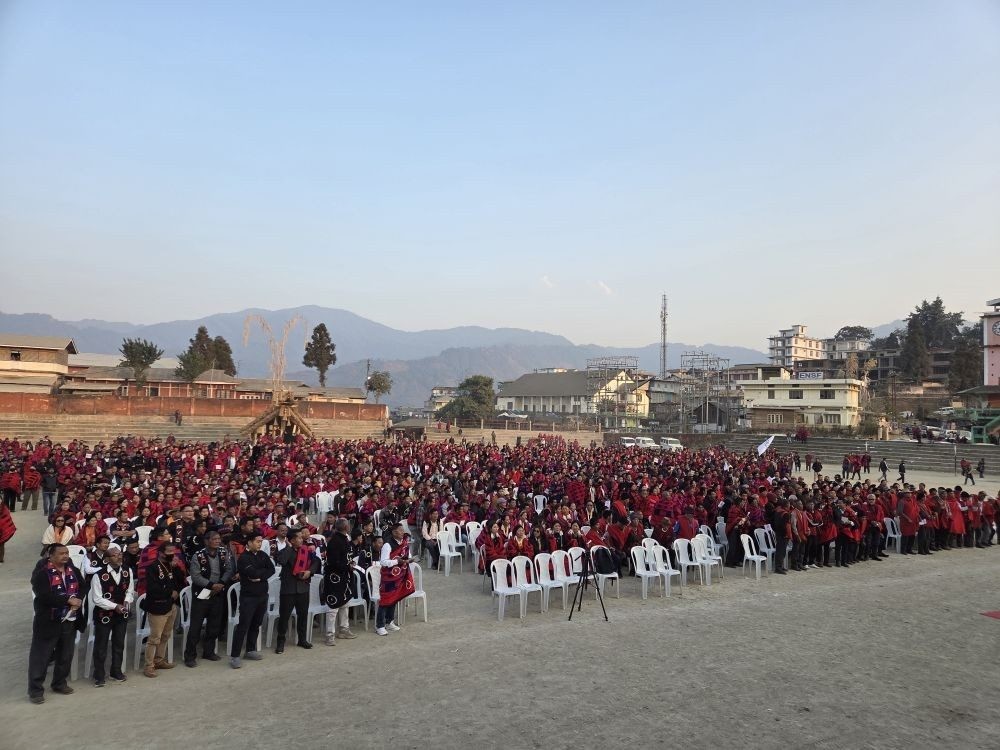
Attendees during civic reception and prayer programme held at the Parade Ground, Tuensang on February 8, 2026 to mark the culmination of the signing of Memorandum of Agreement for FNTA on February 5, 2026. (Morung File Photo)
Morung Express News
Kohima | October 25
The Frontier Nagaland Territorial Authority (FNTA) Bill, 2026, has received the assent of President Droupadi Murmu, marking a major step towards establishing the proposed authority for six eastern districts of Nagaland.
Chief Minister Dr Neiphiu Rio announced the development on October 25 in a post on X stating: “I thank Hon’ble President of India, Smt. Droupadi Murmu, for granting assent to the FNTA Bill 2026; unanimously passed by the NLA on Sept' 3, 2026. I thank @HMOIndia for coordinating the process. It's a key step towards realising the aspirations of the people of Eastern Nagaland.”
The Nagaland Legislative Assembly (NLA) unanimously passed the Bill on September 3.
With Presidential assent secured, the Act will come into force on a date appointed by the State Government through a notification in the Official Gazette, as stipulated under Section 1(3).
The FNTA, covering six districts comprising the Frontier Nagaland Territory (FNT)- Tuensang, Mon, Longleng, Kiphire, Noklak and Shamator, envisaged a decentralised self-governing authority with legislative, executive, administrative and financial powers over 46 transferred subjects.
After years of negotiations, momentum gathered with the signing of the Memorandum of Agreement (MoA) on February 5, 2026, by the Governments of India and Nagaland and the Eastern Nagaland Peoples’ Organisation (ENPO).
From March withdrawal to September passage
Thereafter, the first FNTA Bill was introduced in the Assembly on March 26. It was subsequently withdrawn, and Deputy Chief Minister Y Patton introduced a revised Bill on September 1.
Giving the background in the Assembly on September 3, Rio said the MHA had asked the State Government to await its views on the proposed conferment of legislative powers to the FNTA before taking further action. On the same day, the ENPO appealed to the State Government to uphold the February 5 MoA, while the Eastern Nagaland Legislators’ Union (ENLU) sought deferment of the Bill’s passage until concerns were addressed and clarity attained on the agreement.
The revised Bill was unanimously passed by NLA on September 3.
Among others, the Bill stated that the FNTA arrangement is based on the spirit of Article 371(A) of the Constitution. It also provides for the continuation, “without amendment or dilution,” of the special constitutional provisions under Article 371(A), the Bengal Eastern Frontier Regulation, 1873, and exemption from Panchayati Raj.
With Presidential assent secured, the next steps include commencement of the Act through an official notification, framing of rules and establishment of interim arrangements ahead of the eventual elected Authority.
The agreement envisages a review of the FNTA arrangement after 10 years.
Key provisions
The FNTA will comprise 62 members: 40 directly elected representatives, with one-third of the seats reserved for women; 20 MLAs representing constituencies within the Frontier Nagaland Territory (FNT), who will be ex-officio members without voting rights; and two members nominated by the Governor from recognised tribes that are unrepresented or under-represented. The nominated members will have voting rights.
Elected and nominated members will ordinarily serve five-year terms, with elections overseen by the State Election Commission.
An Executive Council of up to nine members, headed by the Chief Executive Member (CEM), will exercise the FNTA’s executive powers.
Pending constitution of the elected Authority, the State Government may establish an Interim Council comprising up to 13 members recommended by the ENPO in consultation with tribal councils. The Governor may also nominate one MP and three MLAs from the territory as advisers.
The interim arrangement cannot exceed one year or continue beyond constitution of the first elected FNTA, whichever is earlier.
Among others, the FNTA will have legislative, executive, administrative and financial powers over 46 transferred subjects, including agriculture, health, school education up to higher secondary level, rural development, tourism, social welfare and specified public works. Its functions will also cover village councils, urban local bodies, local taxes, village guards and customary courts.
The FNTA may initiate laws on transferred subjects, subject to approval by a majority of voting members, followed by the Governor’s approval and publication in the Official Gazette. The State Government will retain a role in staffing and administration, while an IGP-level officer will supervise police administration in the territory.
The Authority will receive annual allocations under a separate major subhead in the State Budget, with development funds subject to CAG audit.