Department of Environment, Forest and Climate Change (EFCC) and the Jorhat-based Indian Council of Forestry Research and Education–Rain Forest Research Institute (ICFRE-RFRI) inked a Memorandum of Understanding (MoU) touted as a bid to boost agarwood farming in Nagaland.
Bid to boost Agar farming
Morung Express News
Dimapur | August 1
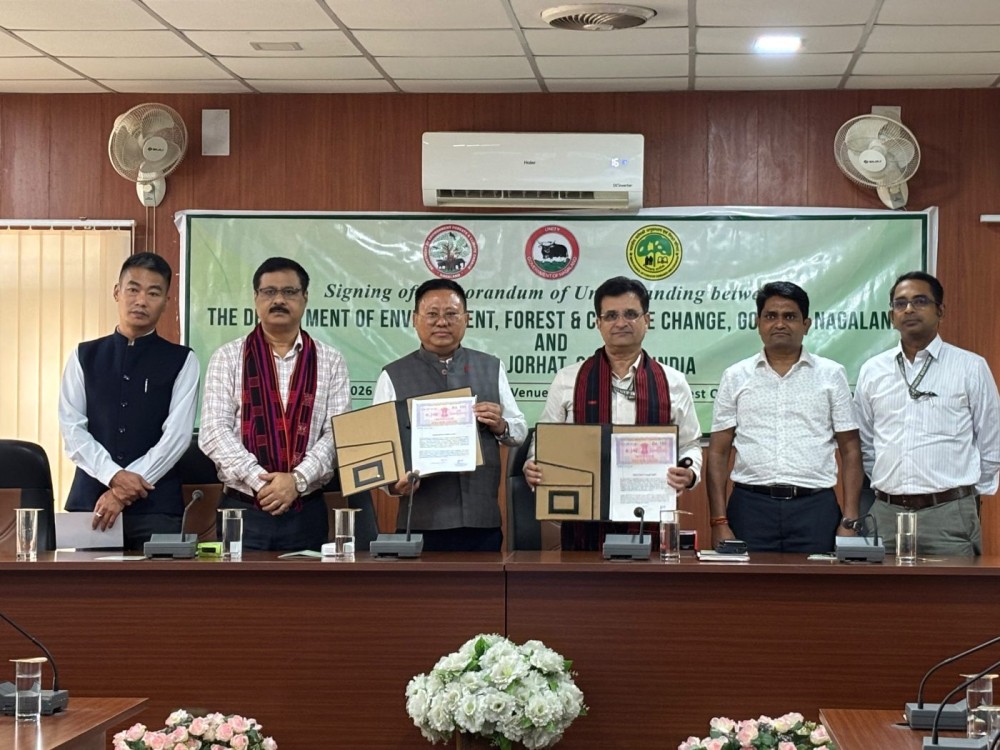
The Department of Environment, Forest and Climate Change (EFCC) and the Jorhat-based Indian Council of Forestry Research and Education–Rain Forest Research Institute (ICFRE-RFRI) inked a Memorandum of Understanding (MoU) touted as a bid to boost agarwood farming in Nagaland.
The MoU was signed on August 1 at a programme held at the Forest Office Complex in Dimapur. EFCC Principal Secretary Y Kikheto Sema signed on behalf of the state government. The ICFRE-RFRI was represented by its Director Dr Nitin Kulkarni.
The EFCC Principal Secretary described the MoU as a step toward establishing systematic resource management, explaining that despite having natural resources, the state previously lacked a formal Agarwood policy. “Because we lacked a policy, people from Assam would come and take our Agarwood away,” Sema said. According to him, Assam and Tripura currently are the major players with the former claiming 80 percent of the quota/demand, and the latter 15 percent. Nagaland’s share was a mere 2 percent.
Following the Cabinet's approval of the Nagaland Agarwood Policy on May 6, the department moved forward to collaborate with the Jorhat-based research institute. Under the terms of the agreement, both entities will collaborate on soil testing, selecting suitable varieties, and distributing saplings. The initiative also aims to train farmers in systematic cultivation, harvesting, and trading methods.
Sema said that Agarwood farming can generate 40 to 50 times more revenue compared to traditional jhum (shifting) cultivation. He noted that the partnership will utilise the RFRI's artificial agarwood inoculation technology that has a proven success rate of over 90 percent. The initiative aims to protect Agarwood farmers from being exploited by private entities charging high fees for artificial inoculation.
The state also plans to utilise RFRI's inputs for future processing facilities, following the Government of India's recent sanctioning of processing units in the region.
He revealed that the state is additionally planning to sign an agreement with RFRI in the near future for “clonal teak,” which matures in 20 years instead of 40 to 50 years.
ICFRE-RFRI Director Dr Nitin Kulkarni said that the institute aims to support Nagaland in sustainably exploiting its under-utilised natural resources, particularly for communities residing near forest areas.
According to Kulkarni, the scope of the agreement covers the assessment of Agarwood presence, quality and distribution. He added that the institute will promote agroforestry by planting Agarwood alongside other agricultural crops, allowing farmers to benefit from multiple income sources.
“The MoU is not restricted only to Agarwood particularly, but it will go a long way in other natural resources also,” Kulkarni said.