Chizokho Vero
Kohima | June 29
Nagaland has become the first state in India to assess schools and grade them under the initiative of Mayangnokcha Award Trust (MAT) with the support of the Nagaland government.
Chief Minister Neiphiu Rio, School Education Minister Nyeiwang Konyak and government officials and agencies complimented MAT for initiating the novel venture to promote quality education in Nagaland.
Initially, 79 schools from 3 districts (Kohima, Dimapur and Mokokchung) submitted their Letter of Request for assessment. Out of 79 schools, 58 schools completed the first part i.e., submission of institution data. However, only 21 schools could complete the Self-Evaluation Report (SER). 14 schools qualified to be visited for data-validation and grading. The grading of the schools is valid for 4 years.
The assessment, according to MAT, is not a fault-finding mission. With a panel of moderators, the Trust only visited the institutions to validate their reports, based on which the grading was given.
The assessment of schools has been done voluntarily and was participatory. The methodology was largely based on the concept and criteria used by the National Assessment and Accreditation Council (NAAC).
“The process shall attempt to guide the concerned authorities and the schools towards achieving skill-based method of educational delivery and imparting core values such as ethics, work culture, social responsibility, developing core competency, contribution to national development, use of IT, quest for excellence etc. by students, “ MAT said adding that it shall also provide platform of feedback for further improvements.
The assessment was carried out under fewer than six main criteria – aspects of curriculum, teaching-learning and evaluation, infrastructure and learning resources, student support and progression, governance and leadership and innovative practices.
The vision of MAT in carrying out the assessment is several: shaping ‘a shared future for Nagaland through sustainable and holistic development of human resources by imparting core-values and skill based education; making Nagaland a preferred destination for regional, national and international students; upgrade from assessment level to assessment and accreditation and to accredit and build linkages with national and international accreditation and certification bodies in education and training. “Together we can do this” said Moa Aier, trustee programme coordinator.
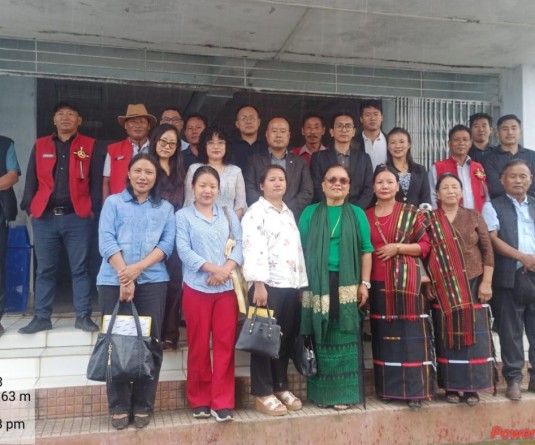
Earlier, releasing the report of the school assessment project and handing over certificates to the 14 graded schools here at Hotel Japfu, Minister for School Education & SCERT, Nyeiwang Konyak congratulated MAT for initiating the programme. “The Trust has done a positive thing for the department and for the people of Nagaland,” the minister said. Such a programme would certainly bring a tremendous impact in the overall process of education in Nagaland.
Remarking on the need to embrace positive changes, the minister said that there should be a paradigm shift from examination oriented education to quality and value based education.
He asserted that the assessment and grading would help improve the infrastructure as well as the quality of teaching and at the same the school authorities as well as teachers will have become more sensitive and alert and “thereby make the school not only a place where teaching happens as of now, but a place where learning will take place.” “This is how Nagaland schools will not only produce brilliant students as many institutions have been successfully achieving but also produce worthy citizens,” the minister said.
Encouraging MAT to continue working on the programme and venture to cover the entire state by this mission, the minister said he had taken note of the proposal submitted by the Trust for continuance of the assessment programme and assured that the department shall make all efforts to extend all necessary support and assistance, to enable the programme to continue and also to expand to other districts and schools as well.
The minister also further stated that the school education department and the Trust can work out modalities to give accreditation status to assessed schools from next year. The minister maintained that the school assessment & grading programme is one of the major achievements of the government under the ‘Year of Capacity Building’, adding “ I am sure, it is not only an achievement of the government, but a real benefit for the state, which impact shall be felt in the years to come.”
He reiterated that the assessed programme must continue, for which the government and the school education department shall be extending all necessary support and assistance.
Commissioner & Secretary, school education & SCERT Mhathung Kithan said that MAT was really doing a great job in improving education in the state. Terming the assessment as a necessity, Kithan said that educational institutions should be more responsive and responsible to the future of the students.
Stating that the school assessment is not a fault finding exercise, he strongly felt that all institutions both private and government schools should welcome the grading system and be assessed for good wholesome education system. Nagaland Board of School Education (NBSE) chairman Nini Meru said that MAT has been a great encouragement to the student who is doing well in HSLC. She hoped that in the coming days, the assessment is carried out not only for those schools willing to assess but all registered schools must be assessed.
Panel (of moderators) convenor L. Edward Lotha complimented MAT for coming forward to help Naga society though this venture, adding that whatever MAT graded the school was of “very high standard” as it adopted the same criteria of NAAC. He said felt that if similar programme is carried forward, it would become an important movement in education activities in Nagaland. CHSS Dimapur principal Aheto Sumi said that the exercise has been an eye opener for the schools with the target to improve and excel in their achievements.
Dr. Imomanen Tzüdir, president MAT hoped that the school assessment be not only a one- time event, but a continuous process, “for which we hope that the government shall continue to extend its support.”