Officials along with the participants during a lecture on solid waste management held at Nagaland University, Lumami on October 21.
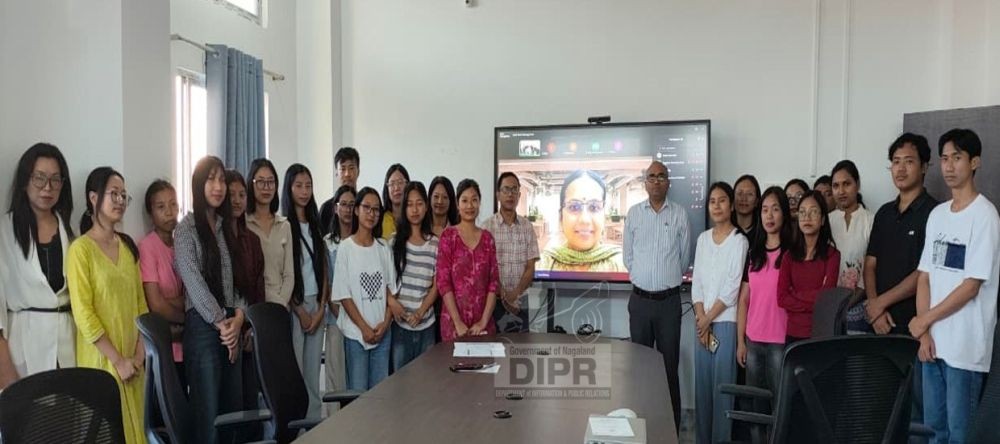
Lumami, October 22 (MExN): The Committee for Mission LiFE of Nagaland University organised a lecture on solid waste management at the Conference Hall of the Department of Environmental Science (EVS), Nagaland University, Lumami, in hybrid mode on October 21.
Prof Ligy Philip, Institute Chair Professor in the Department of Civil Engineering, Indian Institute of Technology (IIT) Madras, was the resource person. She was introduced by Peter Ki, Public Relations Officer (PRO), Nagaland University.
Prof Philip highlighted that effective solid waste management was essential for protecting public health, preserving soil and water resources, and promoting sustainable development.
She explained that waste generation varied considerably between rural and urban areas, with rural communities generating approximately 0.1 to 0.4 kg of waste per capita per day, compared with 0.5 to 1.2 kg in urban areas. The higher waste generation in towns and cities was largely attributed to packaged and ready-to-eat food, commercial activities, rising incomes and changing lifestyles.
In rural areas, a significant proportion of household waste was biodegradable, but much of it was reused for purposes such as feeding livestock and therefore did not always reach centralised waste-management facilities, she said.
Highlighting the environmental and public-health risks of improper waste disposal, particularly open dumping, Prof. Philip explained that rainwater percolating through unsegregated waste produced leachate, which could carry heavy metals, organic pollutants and hazardous household fluids into groundwater and surface-water sources.
She added that plastic waste degraded soil structure, reduced water absorption capacity and affected agricultural productivity. Open dumping also encouraged the breeding of disease vectors such as rats and mosquitoes, released methane from decomposing organic matter and contributed to air pollution.
The growing presence of microplastics, defined as plastic particles smaller than five millimetres, had further complicated the problem, as these particles could adsorb toxic pollutants and potentially contaminate soil and groundwater.
Emphasising the importance of waste segregation at source, Prof. Philip said waste should be separated into at least three categories: organic or biodegradable waste, non-biodegradable waste and sanitary waste.
Organic waste, including kitchen and garden waste, could be converted into compost or processed through biomethanation. Non-biodegradable waste included plastics, paper, textiles, metals, glass and electronic waste, many of which could be recycled if kept clean and properly segregated.
Sanitary waste, including diapers, sanitary napkins, bandages, syringes and needles, required separate handling to prevent contamination of recyclable materials and protect sanitation workers.
She outlined the preferred hierarchy of solid waste management, placing source reduction and reuse at the top, followed by recycling, composting, waste-to-energy recovery and sanitary landfilling.
Source reduction and reuse, such as carrying cloth bags instead of accepting single-use bags, remained the most sustainable approaches because they prevented waste generation in the first place. Recycling helped recover valuable materials such as paper, plastic, metal and glass, while composting converted biodegradable waste into a nutrient-rich soil conditioner.
Landfilling, she said, should be the last resort for residual waste after maximum resource recovery and must be clearly distinguished from open dumping. A sanitary landfill was an engineered facility equipped with protective liners, leachate-collection systems and daily covering, along with measures to prevent groundwater contamination.
Prof. Philip also highlighted composting as a practical, decentralised solution for managing biodegradable waste. She explained that, in proper aerobic composting, organic waste should reach temperatures of approximately 55 to 60 degrees Celsius for three to five days to help destroy pathogens.
Mature compost could generally be produced within 20 to 60 days, depending on the method adopted. Maintaining an appropriate carbon-to-nitrogen ratio of about 30:1 and a moisture content of around 40 to 45 per cent was essential for effective decomposition and odour control.
Methods such as pit composting, windrow composting, vermicomposting and mechanical or in-vessel composting could be adopted according to the scale of operation, ranging from individual households to municipalities.
Stressing the importance of community participation and local-level implementation, Prof. Philip referred to a corporate social responsibility-supported sustainable villages programme implemented in more than 12 villages. The initiative integrated waste segregation, collection, composting, recycling, wastewater management and community training.
In one village, improved composting practices reportedly enabled the production of mature compost within 20 to 25 days, which was sold at Rs 25 per kg. Income generated from compost and recyclable materials was said to cover approximately one-third of the operating costs.