Moa Jamir
Dimapur | December 28
Governance-related matters dominated court proceedings involving Nagaland in 2025, with repeated hearings on recruitment disputes, delays in National Highway projects, and compliance with judicial directions on service and administrative issues.
Alongside these developments, the Nagaland Government recorded a mix of legal successes and setbacks, even as several cases remained unresolved and are set to carry over into the next year.
Recruitment blues
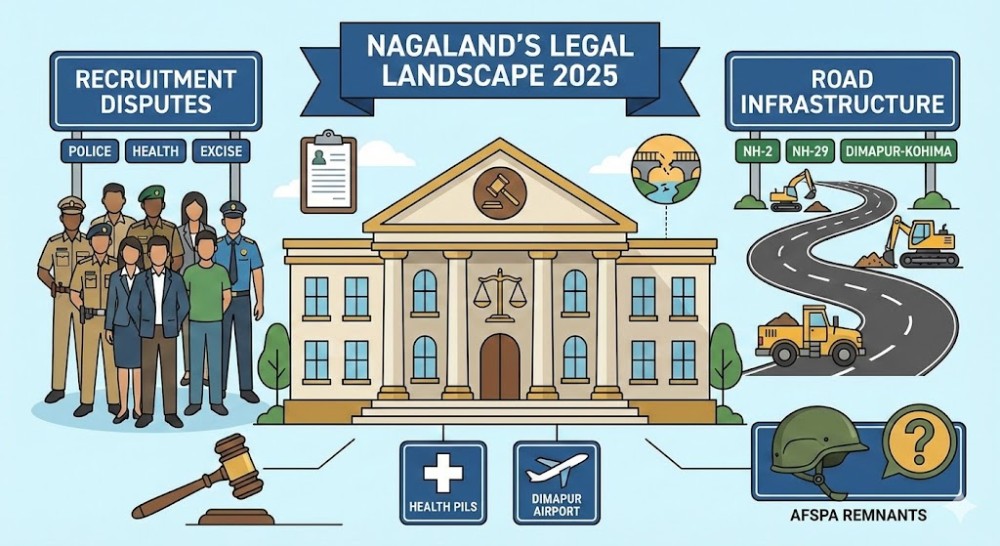
Recruitment-related disputes emerged as one of the most dominant legal themes of the year, cutting across the police, health and excise departments.
Early in the year, on January 21, the Supreme Court (SC) dismissed a Special Leave Petition (SLP), declining to interfere with a judgment of the Gauhati High Court, Kohima Bench (GHCKB), which had quashed the appointment of 935 police constables and 40 SI/UBSIs, effectively bringing closure to one of Nagaland’s most contentious recruitment controversies.
In the aftermath, the Nagaland Police issued an advertisement dated September 30 for the recruitment of 1,176 Constable (GD) posts, with initial physical tests scheduled for January 2026.
On October 31, a Division Bench of the GHCKB dismissed appeals filed by individuals appointed as Sub-Inspectors (SIs), Unarmed Branch Sub-Inspectors (UBSIs), Assistant Sub-Inspectors (ASIs) and Instructor Havildars between 2019 and 2020 without public advertisement.
Meanwhile, 0n August 19, the GHCKB struck down the recruitment process for 61 Auxiliary Nurse Midwife (ANM) and Female Health Worker (FHW) posts conducted by the Nagaland Staff Selection Board (NSSB), citing “serious and glaring irregularities.” Consequently, on August 22, the NSSB cancelled the entire process and stated that fresh recruitment would be initiated only after amendment of the Nagaland Nursing Services Rules, 1988, in compliance with court directions.
Recruitment for Excise Constables also came under judicial review with the GHCKB quashing the inclusion of a written test introduced mid-way into the selection process, holding that it violated the advertisement and service rules on October 16.
However, on December 3, the High Court permitted the State to continue with the recruitment, while restraining declaration of final results pending adjudication of appeals.
Another significant recruitment-related matter concerned the regularisation of 98 medical officers (MOs) engaged during the COVID-19 pandemic under a Special Recruitment Drive (SRD). On August 1, a Single Judge of the GHCKB dismissed writ petitions challenging the policy, which was upheld by a Division Bench on December 11, finding “no infirmity” in the judgment.
The Division Bench held that the appellants lacked locus standi, as they were either ineligible at the relevant time or had voluntarily resigned. It ruled that the one-time, merit-based regularisation did not violate Articles 14 or 16 of the Constitution and did not amount to a “backdoor entry,” permitting the State to proceed with the process.
Subsequently, on December 16, the Directorate of Health & Family Welfare notified the regularisation of 97 medical officers, a move opposed by the Naga Students’ Federation, which termed it legally “untenable.” The issue is expected to resurface in the coming year, either in court or outside it.
AFSPA remnants
Proceedings in 2025 also brought renewed focus on unresolved accountability under the Armed Forces (Special Powers) Act (AFSPA).
During the year, the Oting killings case returned to the Supreme Court’s docket, where the Nagaland Government’s writ petition challenging the Union Government’s refusal to grant prosecution sanction against Army personnel remained pending and unheard, despite tentative listings.
Parallelly, on February 24, the issue of prosecution sanction again came to the fore during the hearing of a criminal writ petition before the GHCKB relating to the 2015 Wuzu firing incident. Filed in 2024, the petition contended that prosecution sanction had not been granted for over eight years and that adequate compensation had not been provided to the victims’ families.
While the Central Government Standing Counsel produced a letter dated October 15, 2024, proposing prosecution sanction from State Government Authorities, the Court held that since the accused were Army personnel, sanction must be accorded by the Union Home Ministry, not the State Government.
Road infrastructure
Road infrastructure emerged as another major governance issue under sustained judicial scrutiny in 2025, particularly in relation to National Highways 2 and 29.
One of the most closely monitored projects was the NH-2 Kohima–Mao Gate road. On June 4, the GHCKB recorded that only 56.25% of the work had been completed, despite assurances that the project would be finished by May 31, “unless prevented by Act of God.”
While delays were attributed to early and unseasonal monsoon rains, the Court observed that repeated extensions had become a recurring pattern.
In a subsequent hearing on November 19, the GHCKB was informed that an alternative alignment for the Kohima–Mao Gate road was under consideration and a Detailed Project Report (DPR) was being prepared, indicating the possibility of two road links connecting Kohima and Manipur.
Judicial concern was also evident in proceedings relating to NH-29, particularly the Dimapur–Kohima four-lane stretch and recurring erosion at Chainage 126 (Tsiedukhru Range). On July 16, the Court expressed dissatisfaction over the State’s failure to file affidavits on erosion caused by the Chathe River, despite repeated directions.
The Court’s scrutiny intensified on October 29, when it questioned delays in repairing a 27-kilometre stretch of NH-29, noting that the issue had persisted since 2019. Both matters are set to continue into the next year.
Health and other PILs
Public interest litigations (PILs) relating to health services and essential public systems also featured prominently. On January 30, the GHCKB closed a batch of 34 PILs on health services and infrastructure, first instituted in December 2017, while directing the State to continue filling medical vacancies in accordance with law.
In December, the High Court revisited healthcare infrastructure through a PIL on blood storage and transfusion services. On December 4, the Bench was informed that Nagaland had only one blood transfusion specialist. The Court directed the Health Department to submit a comprehensive roadmap to address shortages and emergency preparedness.
Beyond health, the judiciary also addressed PILs linked to social justice. On June 30, the Gauhati High Court directed that all child trafficking cases pending across Assam, Nagaland, Mizoram and Arunachal Pradesh be concluded within six months, in line with Supreme Court directions.
Dimapur Airport issue
The alleged encroachment of land at Dimapur Airport emerged as a significant legal issue involving criminal investigation and civil eviction proceedings.
On May 27, the Gauhati High Court Principal Bench passed a judgment in favour of the State, quashing interim injunctions that had stayed eviction proceedings on land earmarked for airport expansion. An eviction drive was subsequently carried out on June 13.
Parallel civil proceedings culminated on June 29, when the SC dismissed an SLP challenging the High Court’s order.
On June 13, Nagaland Police confirmed that 31 individuals, including six government officials, had been named as accused. Chargesheets were filed against 25 private individuals, while prosecution sanction was sought against the public servants. However, in October, the State declined to grant sanction against three senior officers, leaving accountability ‘constrained.’
Other significant legal developments
On May 20, SC declined to interfere with a March 16, 2022 judgment of the GHCKB and directed the GoN to pay salaries to RMSA teachers at par with similarly placed counterparts.
On December 3, the SC pulled up the State over non-compliance in the Kakiho Village recognition matter, terming its affidavit“eyewash,” and issuing new directive to complete the process.
On December 18, when the Apex Court ruled that the SARFAESI Act, 2002, could not be applied retrospectively in Nagaland, as it was extended to the State only in December 2021, while dismissing an appeal filed by NEDFI.
On December 12, the GHCKB dismissed a plea by a senior IAS officer seeking to quash criminal proceedings arising from a workplace harassment complaint, holding that the matter warranted trial.
Nagaland Legal Landscape 2025: A Timeline
January 21: Supreme Court (SC) dismissed a Special Leave Petition (SLP) challenging the judgment and order passed by the Gauhati High Court, Kohima Bench (GHCKB), quashing police appointments.
January 21 (computer-generated listing): A writ petition (Criminal) filed by the Government of Nagaland (GoN) in connection with the Oting killings, challenging the Union Government’s refusal to grant prosecution sanction, was listed in SC but not heard.
January 30: GHCKB closed a batch of PILs relating to health services and infrastructure, directing the GoN to take necessary steps to fill vacancies.
February 9: GHCKB directs GoN to submit an updated status and decisions taken by the six-member committee examining pay and service conditions of work-charged and contingency employees. In May, GoN announces policy for engagement of Short Term Workers (STWs) across all government departments and related issues.
February 24: Issue of prosecution sanction resurfaced during a GHCKB hearing concerning the 2015 Wuzu firing incident.
March 10: SC directs all States and Union Territories to notify sanctioned posts for teachers for children with special needs (CWSN).
April 2: GHCKB raps the GoN for its failure to acquire land for riverbank expansion on NH-29.
April 2: GoN informs GHCKB that it is considering a new insurer insurance company for the CMHIS.
May 20: SC declines to interfere with a March 16, 2022 judgment of the GHCKB and directed the GoN to pay salaries to RMSA teachers at par with similarly placed counterparts.
May 21: GoN seeks six weeks’ time to carry out the process for constituting Customary Courts and Subordinate District Customary Courts.
May 27: Guahati HC Principal Bench quashes interim injunctions staying eviction proceedings on land earmarked for Dimapur Airport expansion.
– On the same day, the Supreme Court directed Nagaland authorities to re-issue a public notice and complete the process for recognition of Kakiho Village within six months.
June 5: Nino Iralu, retired District and Sessions Judge, was appointed Nagaland Lokayukta, subject to the outcome of a pending PIL challenging amendments to the Lokayukta Act.
June 13: Nagaland Police informed that 31 individuals, including six government officials, had been named in a criminal case related to alleged illegal encroachment of land at Dimapur Airport. Eviction carried out on Airport
June 25: Proceedings before the GHCKB indicated continued State inaction on erosion caused by the Chathe River along NH-29, despite repeated court directions.
June 29: SC dismisses an SLP challenging the May 27 order of the Gauhati HC concerning eviction at Dimapur Airport.
July 21: Justice Ashutosh Kumar took oath as Chief Justice of the Gauhati High Court.
August 1: GHCKB dismisses two writ petitions challenging the GoN’s decision to regularise 98 in-service MOs engaged during the COVID-19 pandemic.
August 19: GHCKB strikes down the recruitment process for 61 ANM and FHW posts; the NSSB formally cancelled the process on August 22.
September 3: GHCKB expressed dissatisfaction over the slow progress of the 26.7-km Kohima–Mao Gate road project (NH-2).
September 27: SC directs GoN to carry forward the appointment process for teachers CWSN.
October 29: GHCKB Division Bench pulls up the GoN over delays in works on NH-29, remarking, “So you need six years to get 27 kilometres repaired?”
October 31: GHCKB Division Bench upholds Single Judge’s decision quashing the appointments of 38 police personnel.
November 12: GHCKB dismisses writ petitions challenging contractual appointments of Assistant Professors in government colleges on technicality, while urging systemic reform.
November 20: GHCKB was informed that an alternative alignment was under consideration, raising the possibility of two road links between Kohima and Manipur.
December 3: GHCKB permitts continuation of the Excise Constable Recruitment process, subject to the outcome of pending appeals.
- SC pulls up GoN for failing to take meaningful action on Kakiho Village recognition, directing re-issuance of a public notice and consideration of objections within six months.
December 4: GHCKB launches its official mobile application, the GHCKB App.
– Court directs the Health Department to submit a roadmap for strengthening blood storage and transfusion services.
December 5: GHCKB Division Bench flags prolonged “ad-hocism” in faculty appointments in Nagaland.
December 12: GHCKB dismisses a petition filed by a senior IAS officer seeking to quash criminal proceedings arising from a complaint lodged by the Nagaland State Commission for Women (NSCW).
December 13: GHCKB Division Bench dismisses appeals challenging the dismissal of writ petitions against regularisation of COVID-era MOs.
December 15: SC lists SLP concerning Nagaland’s Central Pool MBBS quota policy for final hearing in February 2026.
December 18: SC dismisses an appeal filed by NEDFI, holding that the SARFAESI Act, 2002, could not be invoked retrospectively in Nagaland for recovery proceedings initiated before the Act’s extension to the State.