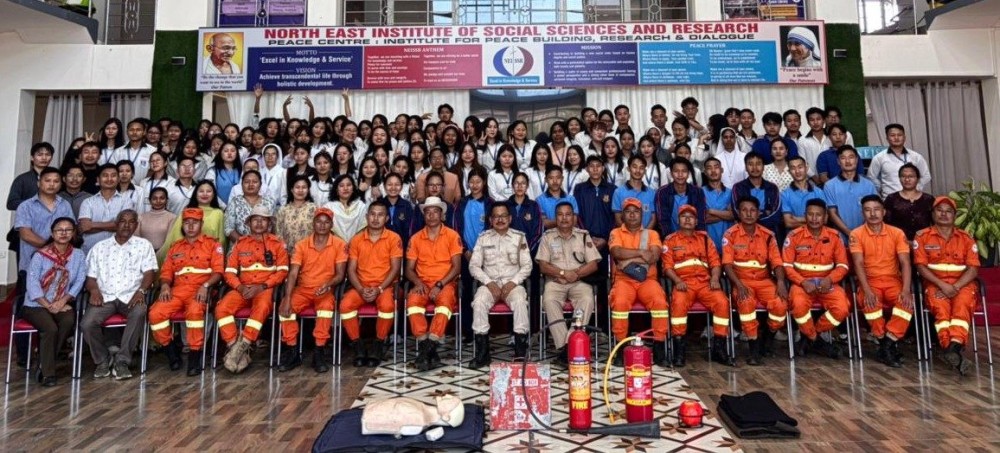
Dimapur, April 7 (MExN): The North East Institute of Social Sciences and Research (NEISSR) conducted a capacity building and training programme on disaster preparedness on April 7 at BAM Hall in collaboration with the Home Guards, Civil Defence and State Disaster Response Force (SDRF), along with the Community Development Forum, NEISSR.
The programme began with an evacuation exercise simulating an earthquake scenario, enabling participants to practice safe and timely evacuation procedures in a controlled environment.
During the technical sessions, Sub-Inspector Kangkang highlighted the gap in disaster awareness and stated that lack of preparedness often leads to panic during emergencies. He informed that around 360 volunteers have been trained so far and stressed that disaster preparedness is essential not only during crises but also in everyday life.
Assistant Sub-Inspector Angukato underscored the importance of mock drills and maintaining calmness during disasters, noting that many casualties occur due to panic rather than the disaster itself.
He also highlighted the importance of first aid and CPR in saving lives during emergencies.
Practical sessions on Cardiopulmonary Resuscitation (CPR) and Emergency Medical Response (EMR) were conducted, focusing on timely intervention, stabilization of victims, and prevention of further injury. A demonstration on bandaging techniques was led by Lanutemsu H/LNK, covering methods such as jaw, chest, arm slings, neck, capeline, finger, and spiral bandages.
A session on fire safety and management explained the fire triangle—fuel, heat, and oxygen—and different types of fire extinguishers, including water, foam, dry chemical powder (DCP), and CO₂.
Participants were also trained in the PASS technique (Pull, Aim, Squeeze, Sweep) and took part in a live demonstration on the use of fire extinguishers.
The programme was moderated by Kili Awomi. Earlier, Vice Principal and Administrator of NEISSR, Rev. Fr. G.L. Khing, delivered the welcome address, stressing the importance of disaster preparedness and the institute’s focus on integrating theoretical learning with practical-based experience.
The programme concluded with a vote of thanks by Dr. Toli H. Kiba, Head of Department, Social Work, NEISSR, who acknowledged the contributions of collaborating agencies, resource persons, and participants.