Improvement across most indicators, but national benchmarks remain distant
Moa Jamir
Dimapur | June 4
Nagaland has registered significant improvements in maternal and child health outcomes since the previous National Family Health Survey, with NFHS-6 (2023–24) recording gains across most key indicators, including antenatal care, institutional births, skilled birth attendance and childhood immunisation.
However, as per the provision ‘Fact Sheets’ data of the NFHS-6, most indicators continue to remain below national averages, highlighting the need for sustained efforts to improve maternal and child healthcare coverage and outcomes.
Maternal health indicators
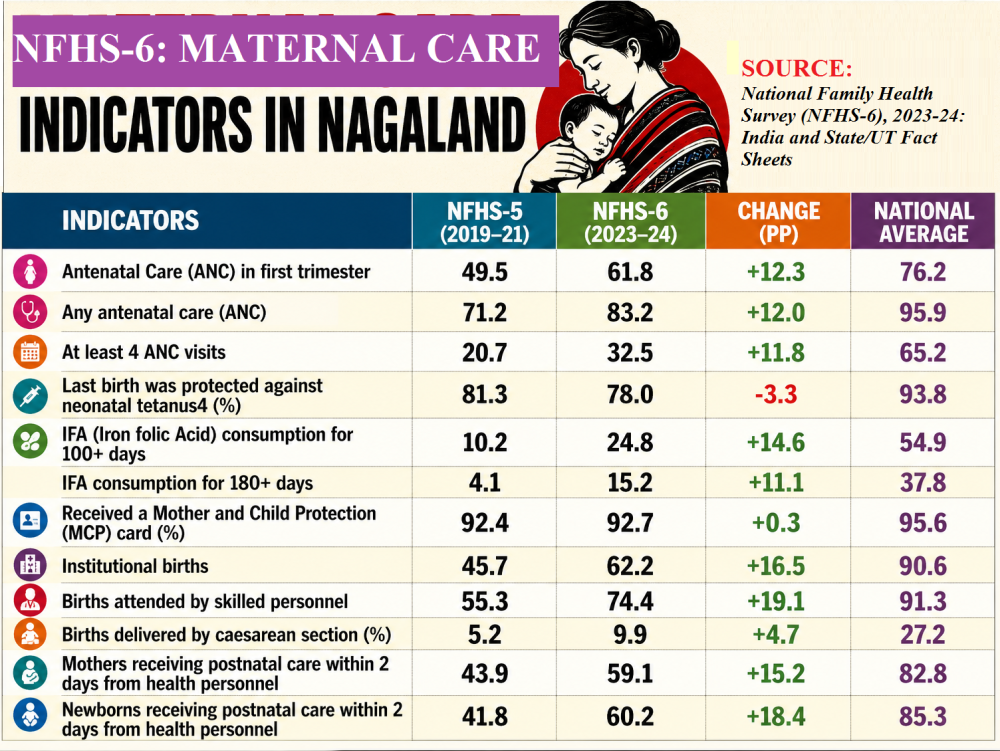
Among maternal health indicators, the proportion of women receiving antenatal care (ANC) during the first trimester increased from 49.5% in NFHS-5 to 61.8% in NFHS-6, while mothers receiving any antenatal care rose from 71.2% to 83.2%.
The survey also recorded improvements in continuity of care during pregnancy.
The percentage of mothers receiving at least four ANC visits increased from 20.7% to 32.5%, while women consuming iron and folic acid (IFA) supplements for at least 100 days increased from 10.2% to 24.8%. Those consuming IFA supplements for 180 days or more rose from 4.1% to 15.2%.
One of the most significant gains was recorded in delivery care. Institutional births increased by 16.5 percentage points, from 45.7% to 62.2%, while births attended by skilled health personnel rose from 55.3% to 74.4%, representing the largest improvement among the major maternal health indicators.
Caesarean section deliveries also increased from 5.2% to 9.9%, but were considerably lower than the national average of 27.2%.
Mothers receiving postnatal care from health personnel within two days of delivery also impoved from 43.9% to 59.1%, while newborns receiving postnatal care within two days increased from 41.8% to 60.2%.
The survey further found that coverage of Mother and Child Protection cards remained consistently high, increasing marginally from 92.4% to 92.7%.
Not all indicators registered improvement, however. Protection against neonatal tetanus declined from 81.3% to 78.0%.
Despite the gains, several maternal health indicators continue to lag national levels. For instance, while 61.8% of women in Nagaland received antenatal care in the first trimester, the national average stood at 76.2%.
Similarly, the national average for four or more ANC visits was 65.2% against 32.5% in Nagaland.
Institutional births accounted for 62.2% of deliveries in the State against the national average of 90.6%, while skilled birth attendance stood at 74.4% compared to 91.3% nationally.
IFA consumption, postnatal care and protected against neonatal tetanus were also much lower than national averages.
Child immunisation coverage rises
One of the main challenges in child care over the years, the NFHS-6 recorded significant improvement in most child immunisation indicators.
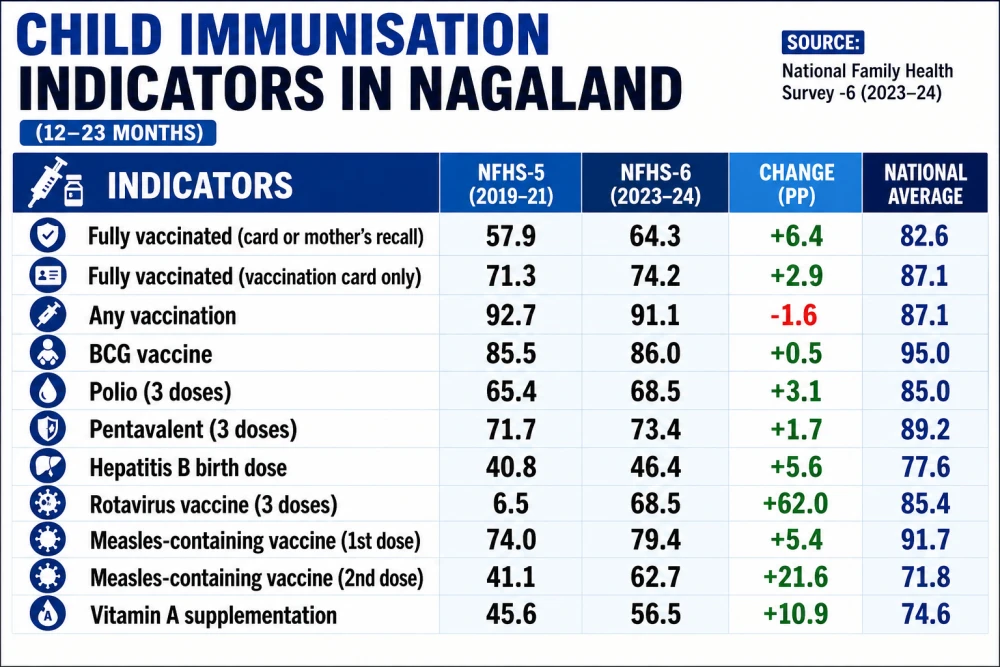
The proportion of children aged 12–23 months who were fully vaccinated increased from 57.9% to 64.3%.
Among those having a vaccination cards, full immunisation coverage increased from 71.3% to 74.2%.
Coverage of three doses of polio vaccine rose from 65.4% to 68.5%, while coverage of three doses of pentavalent vaccine increased from 71.7% to 73.4%.
Hepatitis B birth-dose coverage improved from 40.8% to 46.4%, and Vitamin A supplementation increased from 45.6% to 56.5%.
Among the standout improvements was rotavirus vaccination coverage, which surged from 6.5% to 68.5%, marking the largest increase among all maternal and child health indicators.
Coverage of the second dose of the measles-containing vaccine also registered a substantial increase, rising from 41.1% to 62.7%, while coverage of the first dose increased from 74.0% to 79.4%.
The survey also found that 91.1% of children aged 12–23 months had received at least one vaccination, indicating that initial access to immunisation services remains high.
However, full immunisation remains a big challenge only 64.3% were fully vaccinated, against the national benchmark of 82.6%.
The all-India coverage of key vaccines such as BCG, polio, pentavalent, Hepatitis B birth dose and Vitamin A supplementation were also much higher than Nagaland status.
Only in percentage of children receiving any vaccine, Nagaland’s 91.1% was higher than national average at 87.1%
About NFHS-6
The NFHS-6 was conducted during 2023–24 by the Union Ministry of Health and Family Welfare (MoHFW), with the International Institute for Population Sciences (IIPS), Mumbai, serving as the nodal agency.
The sixth round of India's flagship nationwide health survey covered nearly 6.79 lakh households across 715 districts and collected information from 679,238 households, 716,397 women and 100,977 men. It was conducted in all States and Union Territories, except Manipur.
In Nagaland, fieldwork was conducted between August 26, 2023 and March 5, 2024, covering 11,104 households, 9,693 women and 1,635 men.
The provisional results of NFHS-6 ‘India and State/UT Fact Sheets’ were released on May 29. The detailed report is still awaited.