New Delhi: Leader of Opposition in the Lok Sabha Rahul Gandhi speaks in the Lok Sabha during the winter session of Parliament in New Delhi on Tuesday, December 09, 2025. (Photo: IANS/Video Grab/Sansad TV)
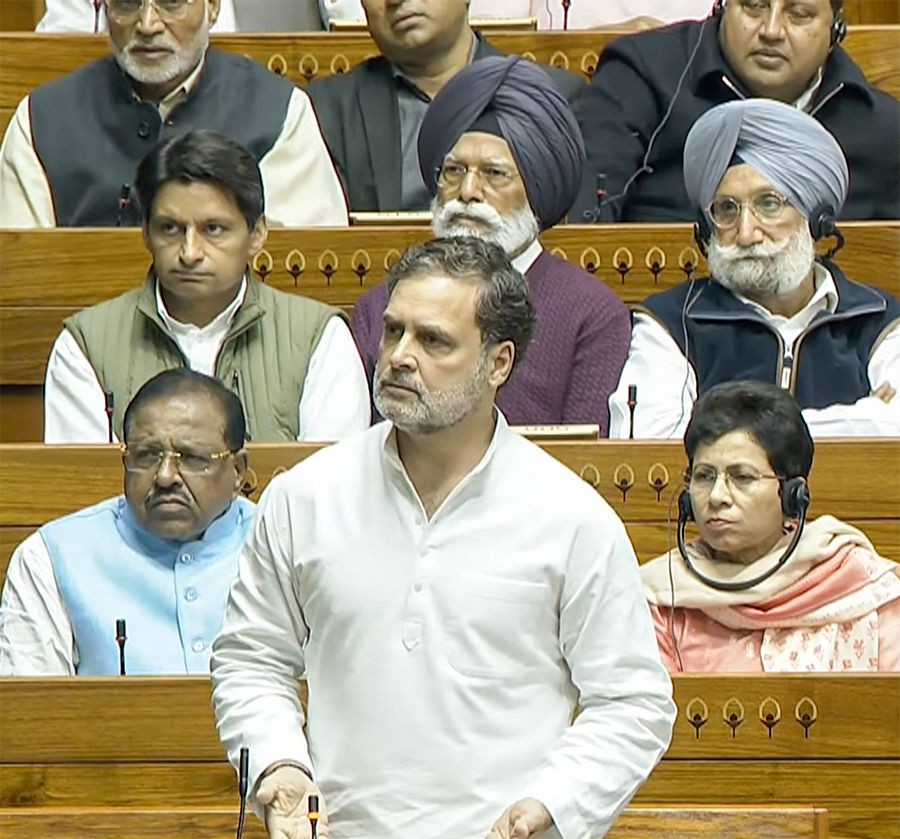
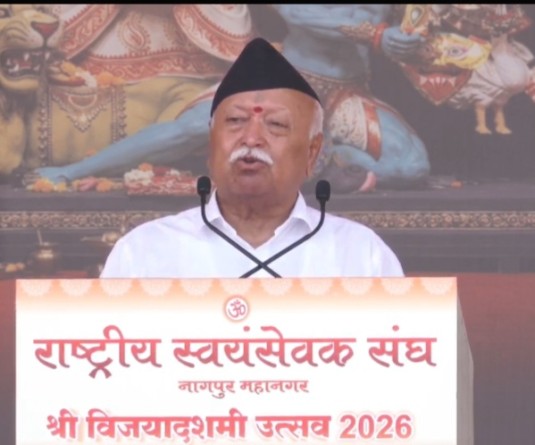
New Delhi, December 9 (IANS) The Lok Sabha witnessed a stormy debate as Congress MP Rahul Gandhi launched a fierce attack on the Rashtriya Swayamsevak Sangh (RSS), accusing it of “systematically seeking to dominate India’s institutions”, and said that there is "no bigger anti-national act than vote chori.”
Speaking during a discussion on electoral reforms, Leader of Opposition Rahul Gandhi asserted that “everything in India that exists today has emerged from the vote, and the RSS is trying to capture that.”
His remarks provoked loud protests from ruling party members, prompting Speaker Om Birla to intervene multiple times to restore order. Gandhi alleged that the RSS, in collaboration with the Bharatiya Janata Party (BJP), has undermined democratic institutions, beginning with the Election Commission of India (ECI).
Gandhi outlined three areas of institutional capture: education, investigative agencies, and the Election Commission.
To support his claims, he posed three questions: why the Chief Justice of India was removed from the selection panel for Election Commissioners; why, in December 2023, the government granted unprecedented immunity to Election Commissioners; and why CCTV footage of polling stations is destroyed after 45 days. He argued that these measures weaken transparency and enable manipulation.
“Today, the Election Commission of India is colluding with those in power to shape the election,” he declared, questioning why the Prime Minister and the Home Minister were so intent on deciding who should serve as Election Commissioner.
He further claimed that investigative agencies such as the Enforcement Directorate (ED), National Investigation Agency (NIA), and Central Bureau of Investigation (CBI) have been compromised, with bureaucrats appointed to target opposition voices.
In a dramatic moment, Gandhi invoked history, recalling Mahatma Gandhi’s assassination on January 30, 1948. He argued that the RSS project began after the Father of the Nation was killed, with the aim of dismantling his vision of an equal India where institutions belonged to the people. “These are uncomfortable truths, but they have to be spoken,” Gandhi said when treasury benches raised objections to his statements against RSS.
His remarks drew sharp objections from Parliamentary Affairs Minister Kiren Rijiju, who insisted Gandhi was straying from the subject of electoral reforms. “He is not speaking anything related to electoral reforms,” Rijiju said, urging the Speaker to direct Gandhi to remain relevant to the debate.
Speaker Om Birla also intervened, reminding Gandhi to confine his speech to electoral reforms rather than making sweeping allegations against institutions.
Rahul Gandhi further said that the wholesale capture of India’s institutional framework was part of a long-term plan. He cited universities as an example, alleging that “Vice Chancellors are appointed not on merit or scientific temperament but on ideological affiliation.”
According to Gandhi, the result of this capture is a distorted electoral process, with campaigns tailored to suit the Prime Minister’s schedule and irregularities such as a Brazilian woman appearing 22 times on the voter list in Haryana.
Despite interruptions, Gandhi insisted these were truths that needed to be spoken. His intervention underscored opposition concerns about democratic safeguards, while the government maintained the debate must remain focused on electoral reforms.