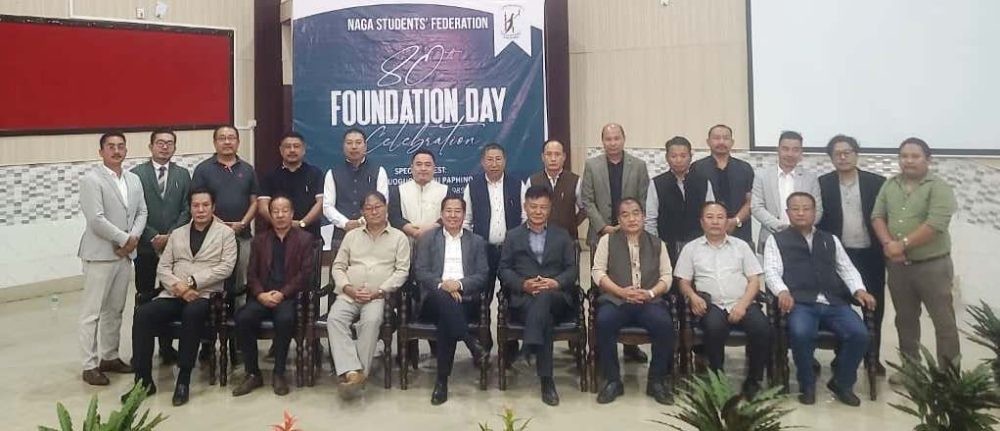
Dignitaries with the present NSF team and senior members during the NSF’s 80th Foundation Day celebration in Kohima on October 29. (Morung Photo)
Our Correspondent
Kohima | October 29
The Naga Students’ Federation (NSF) today commemorated its 80th Foundation Day by taking a pledge to strengthen Naga unity, uphold collective identity and safeguard the common destiny of the people.
“We pledge to rise above tribal differences, geographical divisions and artificial political boundaries, united by our shared history, ancestral heritage and common aspirations,” stated a pledge administered by NSF Federal Assembly Speaker Marikho O Lerüna at the event marking the day at SIRD Auditorium, Kohima.
The gathering also took a pledge to “cherish our diversity, uphold mutual respect, foster fraternity and stand resolute in protecting the collective rights, dignity and interests of the Naga people.”
It further reaffirmed its unwavering commitment to nurturing Naga unity and preserving collective identity for generations to come.
“Though we walk diverse paths in life and service, we remain connected in heart and purpose to safeguard the common interests of the Naga people,” it said.
“May this day remind us of the roots that bind us, and may the spirit of unity continue to inspire us to work for the progress, dignity and rights of the Naga people, wherever we may be and in all that we do,” the pledge added.
Hoisting the NSF flag for the day, Lok Sabha MP S Supongmeren Jamir, a former NSF general secretary in 1989, called upon the NSF to renew its commitment and continue to serve society.
He recalled that successive generations of NSF leadership had focused on Naga unity and the protection of Naga rights and identity.
“When it comes to NSF, we all always used to be together under the banner for the unity of the Nagas. That clearly shows that the NSF is above all of any political party in the state,” he said.
Jamir also stressed the need to maintain a vision for the Federation’s centenary celebration.
‘Naga struggle and rights’
Sharing a brief account of the Naga struggle and rights, Naga Peoples' Movement for Human Rights (NPMHR) Secretary General Neingulo Krome said that the Naga movement and struggle were collective efforts, with everyone playing their part in advancing the movement.
“Talking about rights, our unique history and our unique identity itself is more than a complete right to say that we are different people. We have the right to have our own definition of our identity, the right to self-determination,” he said.
NSF President Mteisuiding Heraang said that the NSF was formed to take forward the aspirations of the Naga people, adding that it was established not merely to address issues concerning students and the community but also to address the issues of the Naga people as a whole.
The NSF would never shy away from addressing the issues of students and the youth community, he added.
Amid the various challenges facing the Naga people today, he stressed the need to come together, unite and live together while embracing each other’s difficulties.
He informed that the NSF, during its 2nd Federal Assembly, had resolved to strengthen the unity of the Naga people and their collective identity.
“Let us all embrace unity among our people, despite we live in different areas. Let us all come together, be unified for people,” he added.
Earlier, the Foundation Day programme was chaired by NSF Vice President Vimeyiekho Vitso.
‘Powered 60’ launched
Meanwhile, the NSF General Secretary Kenilo Kent led the formal declaration of “Powered 60”, which was subsequently launched by the NSF president.
“Powered 60” is a project aimed at providing full sponsorship for coaching to 60 aspirants preparing for competitive examinations, particularly the UPSC examinations.
It will provide intensive coaching to 60 candidates, with one candidate selected from each Assembly constituency in Nagaland.
The initiative is being undertaken by the NSF under “Youth & Students Empowerment for Self Reliance” and is supported by the Government of Nagaland.
The selection process will be based purely on merit, fairness and transparency, Kent informed.
The first phase will begin in the next academic session.
.jpg)