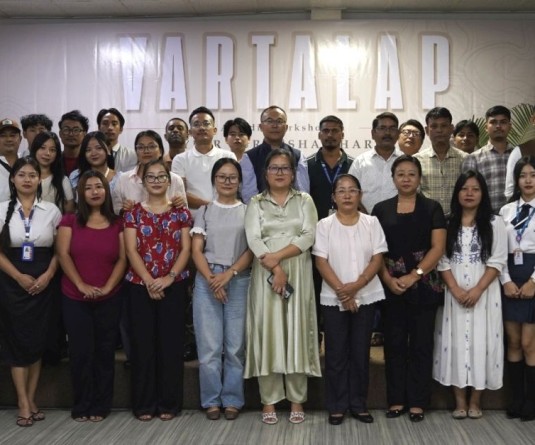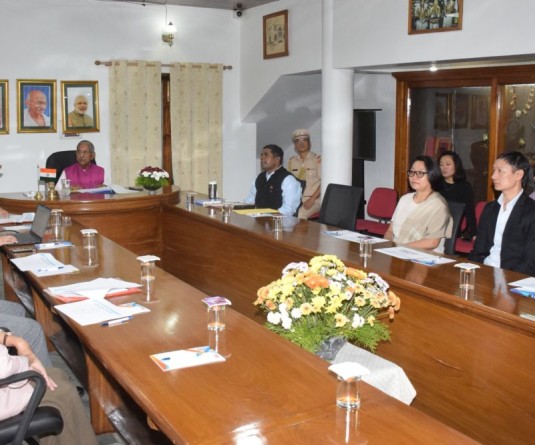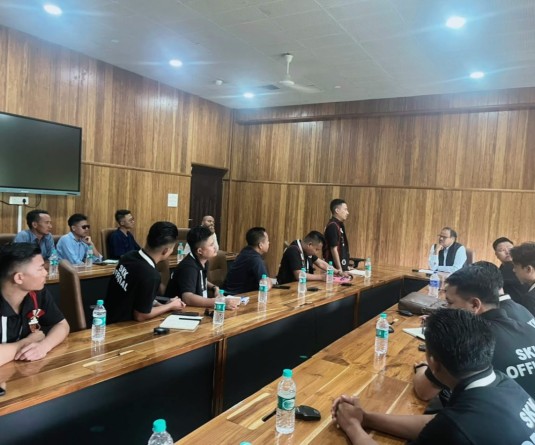
DIMAPUR NOV 29 (MExN): Ahead of the World AIDS Day, a programme was held today at the Nagaland Police Officer’s Central mess, Dimapur jointly organized by Police Training School, Constella Futures in collaboration with Nagaland State AIDS Control and ORCHID. The meeting was attended by members from the Nagaland Police including Inspectors, Assistant Sub – Inspectors, members from the training school and cadres from all the districts. It informed that speaking at the programme, Sankar Sen, former Member of Human Rights Commission and Former DGP stated “A more coordinated response is required between law enforcement and civil society to build a more inclusive society, especially with regard to communities living in difficult and marginal circumstance”
CP Giri IGP, Training and Border, Nagaland, also spoke about the response initiated by the Police Department: “We have already introduced HIV/AIDS in our police training curricula and a Red Ribbon Club is functioning to continuously create awareness amongst the forces.” He further requested the Nagaland State AIDS Control to provide guidance and assistance in the active functioning of these clubs. Singsit, Principal, Police Training School expressing concern on the status of HIV/AIDS in Nagaland, emphasized that the police had a vital role to play in the response, “As law enforcers we have to be sensitive to social concerns and work with communities such as sex workers and IDUS.”
Speaking on the occasion, Dr. Subhadra Menon, Director, Essential Advocacy Project, Constella Futures stated “The police are key stakeholders in the overall response to HIV/AIDS. HIV is not just a health problem but affects all sections of society. The police with its large workforce can play a prominent role in protecting their own health and the health of society.” According to press communiqué, numerous efforts are being taken within the law enforcement to respond to HIV/AIDS. The Government of India has set up a task force for HIV prevention in the Central Police force in December 2005 and Assam Rifles, BSP and CRPF have also chalked out extensive prevention activities for HIV/AIDS. It also informed that about 12000 police officers from New Delhi’s 60,000 member police force have been trained in AIDS awareness and Over 4000 police personnel in Kanpur district are being educated.
Responding to the initiative taken by the Police Department, Abemo, President of the Positive People’s Foundation stated, “As the Police force commands respect in the community, their involvement will go a long way in preventing the spread of HIV. There are thousands of people who are living in denial and shame. Due to fear of discrimination, they are unable to get access to information and services. It is important for affected people to be able to stand before all of you and speak openly.” Seeking more meaningful collaboration with all stakeholders including the police, a representative of Nagaland Network of Positive People shared her experience and urged the police to adopt HIV prevention programmes.
Police form an integral part of society and can be a role model for the community. They also have a dedicated audience because of their position as protectors of the law. Importantly, in their official role they also come across vulnerable groups such as women in sex work, IDUs and MSMs. Their whole hearted involvement in the HIV/AIDS prevention programmes can strongly benefit such initiatives.