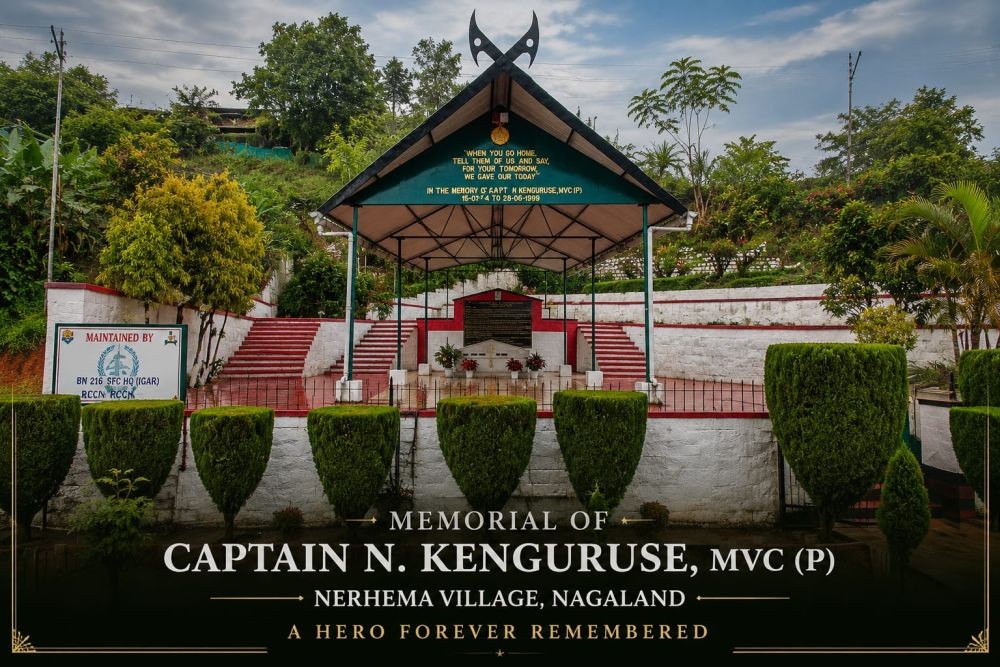
Every year on 28 June, the state of Nagaland pauses to remember a son of the soil whose life became larger than life itself. Captain Neikezhakuo Kengurüse, Mahaveer Chakra (Posthumous), was not born into history, he was shaped by a humble village upbringing, disciplined training and a deep sense of duty. From Nerhema village in Kohima district to the icy heights of Drass in Kargil, his journey is the story of a young Naga boy who answered the call of the nation with courage, dignity and sacrifice.
What makes his story so moving is its simplicity. He was not a man of grand words or public display. He was a soldier who believed in service. He came from a place where family values, community life and hard work matter deeply. Like other young people from Nagaland, he grew up with dreams, hopes and responsibilities. But unlike many, he turned those dreams into a life of national service. That decision would one day place him among India’s immortal heroes.
Drass, where Captain Kenguruse made the supreme sacrifice in the line of duty, is one of the coldest inhabited places on earth. During the Kargil War in 1999, it became a battlefield of extraordinary danger, where Indian soldiers fought enemy positions hidden high in the treacherous mountains. The terrain was steep, harsh and unforgiving. Every step demanded strength. Every move could mean life or death. In such conditions, the courage of soldiers was tested beyond imagination.
Captain Kenguruse’s name shines because he did not hesitate when duty demanded everything. He fought with determination in one of the most difficult battle zones of the war. His bravery was not of the loud kind. It was the bravery of action, of remaining steady when fear would have been natural, of choosing duty over self. That is why his story continues to move people. He showed that heroism is not about fame, it is about sacrifice.
For his family, the sacrifice was personal and painful. For his village, it was a moment of deep sorrow mixed with pride. For Nagaland, it became a reminder that the state has given the nation brave sons who stood tall in the most difficult hours. And for India, Captain Kenguruse became a symbol of the unity that binds the country together. A boy from a small village in Kohima district served in the farthest reaches of the north, proving that patriotism knows no geographical limit.
There is something powerful in the thought that a simple village boy could rise to such heights of honour. In many homes across Nagaland, children grow up hearing stories of elders, land, faith and community. Captain Kenguruse’s life fits naturally into that world. He did not forget his roots. He carried them with him. That is perhaps why his sacrifice feels so personal to the people of the state. He was one of their own, yet his life belonged to the whole nation.
One of the most striking things about soldiers like him is that they make us rethink the meaning of success. In today’s world, young people are often seen chasing comfort, popularity and quick rewards. Captain Kenguruse’s life offers a different lesson. It says that true greatness is found in responsibility. It says that a person’s worth is not measured only by personal gain, but by service to others. He reminds us that dignity comes from character, not convenience.
There is an old truth in military life: the uniform does not erase a person’s humanity, it reveals it. Behind every brave soldier is a son, a brother, a friend and a dreamer. Captain Kenguruse was all of these. That is why his story touches hearts so deeply. He was not an abstract hero in a history book. He was a living human being, one among us, who made a conscious choice to stand where danger was greatest. His sacrifice was not accidental. It was deliberate, noble and rooted in love for the country.
The people of Nagaland have every reason to be proud of him, but pride alone is not enough. Remembrance must lead to reflection. His martyrdom day should not only be a ritual of wreaths and speeches. It should become a time to ask what kind of values we are giving to our children. Are we teaching them discipline? Are we teaching them courage? Are we teaching them to care for the nation, the community and one another? Captain Kenguruse’s life gives a clear answer to these questions.
For the younger generation, his story is a call to live with purpose. Not every young person will wear a uniform and not everyone is meant for military service. But the values of Captain Kenguruse are needed everywhere. In schools, they mean honesty and hard work. In colleges, they mean focus and responsibility. In public life, they mean integrity. In homes, they mean respect and selflessness. His legacy is not limited to the battlefield. It belongs to every place where courage and character are needed.
An anecdote often shared about soldiers from the Northeast is how quietly they carry themselves, even when their deeds are extraordinary. That quiet strength is part of their greatness. Captain Kenguruse’s life had that same quality. He did not seek attention. He simply served. And in that simplicity lies a lesson that our age badly needs. In a time when many people want to be seen, he chose to be useful. In a time when many chase praise, he chose duty.
28 June in the state of Nagaland is therefore not just a memorial date. It is a moral reminder. It tells the people of the state that bravery can come from a village path, from a family home, from a young man who chooses discipline over comfort. It tells the nation that its strength lies in the sacrifices of people from every region and community. And it tells the youth that the highest form of love is sometimes silent, demanding and willing to give everything.
Captain Neikezhakuo Kenguruse gave his life in the service of India and in doing so he gave meaning to the word sacrifice. Nerhema village, Kohima district, Nagaland, the Indian Army and the country as a whole carry his memory with honour. His life remains a light for the young and a comfort for those who remember that freedom and peace are often protected by the courage of a few. On 28 June, Nagaland does more than mourn. It salutes a son who became a soldier, a soldier who became a hero and a hero whose sacrifice will never be forgotten.
Issued by Lt Col Amit Shukla, PRO & Spokesperson, Ministry of Defence, Manipur, Nagaland and Southern Arunachal Pradesh