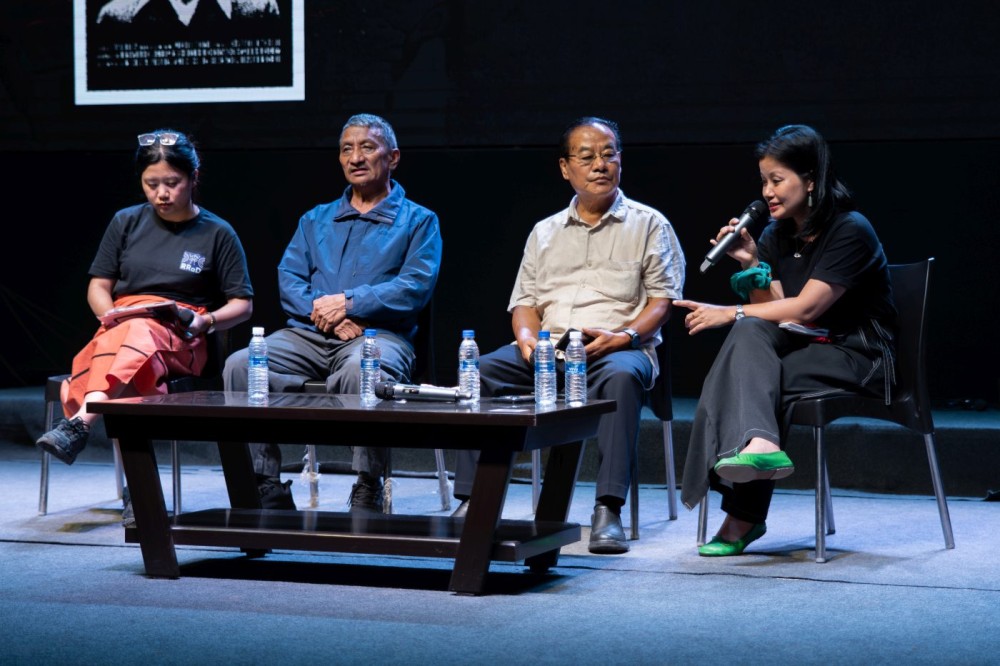
(From left) Küvethilü Thülüo, Murhenyi Rhakho, Dezoto Rhakho, son of late NNC leader Venyiyi Rhakho, and Dr Talilula during a panel discussion following the premiere of ‘Prophetic Homecoming’, a documentary on the repatriation of the mortal remains of Venyiyi Rhakho. The panel was part of the September Dialogue organised by FNR-RRaD at The Lighthouse Church, Dimapur, on September 5. (Morung Photo)
Morung Express News
Dimapur | September 6
The repatriation of ancestral human remains from Western museums can contribute meaningfully to healing and reconciliation, but their return alone cannot automatically resolve deep-seated historical wounds, academicians and community leaders said at a panel discussion here.
The discussion, titled "From Recovery to Reclaiming – What Repatriation of our Ancestral Human Remains Means for our People," was organized on September 5 at The Lighthouse Church by the Forum for Naga Reconciliation–Recover, Restore and Decolonise (RRaD) as part of its September Dialogue.
Dr Visier Sanyü, an academician and member of the Forum for Naga Reconciliation (FNR), observed that the core issue with colonial representation was not necessarily that every observation was false, but that colonial authorities possessed the power to dictate which aspects of indigenous lives were deemed significant enough to record. This dynamic, he noted, explains why the discourse surrounding the Naga collection at Oxford University extends far beyond the physical artifacts themselves.
Stressing that human remains should never be treated as mere museum objects, Sanyü pointed out that the question of who holds the authority to interpret Naga history remains paramount. Recalling the initial repatriation journey, he characterized it as a path marked by anger, hope, healing, and reconciliation, which ultimately transformed into a "sacred journey."
He noted that the museum had acknowledged that the circumstances under which the ancestral remains were acquired failed to meet present-day ethical standards. The subsequent removal of these human remains from public display in 2020 reflected a necessary, evolving shift toward colonial collections.
Repatriation and healing
However, Sanyü cautioned against viewing repatriation as an instant remedy for past traumas. "Historical wounds are not automatically healed simply because remains are returned. At the same time, repatriation can help restore a relationship that was interrupted," he said, adding that for many Nagas, the proper place for the deceased is within their ancestral soil and community.
On the subject of decolonisation, Sanyü argued that it should not mean rejecting Western scholarship, museums, or archives, but rather critically examining the unequal power relations that governed knowledge production and excluded indigenous voices. Questioning whether Nagas had an equal voice in how their culture and forebears were represented, he asserted that local scholars, elders, and community leaders must take an active role in interpreting and curating these collections. He also urged younger researchers to thoroughly study overseas archives, field notes, photographs, catalogues, and correspondence, noting: "That is how a difficult past can become a source of knowledge rather than merely a source of pain."
Tangkhul traditions
Placing repatriation within indigenous cultural frameworks, social anthropologist Dr. Achan Mungleng highlighted the traditions of the Tangkhul community, where bringing the dead home is intimately bound to mourning, soul-sending, and final rest. Tracing the community’s demographic growth from around 12,000 in late 19th-century colonial records to over two lakh across roughly 280 villages today, she noted that despite diverse dialects, shared cultural rites endure.
Mungleng cited historical practices such as retrieving the heads of fallen warriors and recounted the experience of the Tangkhul Naga Labour Corps during World War I. Of approximately 1,200 members deployed, more than 10 per cent did not return, prompting surviving comrades to bring back the hair of the deceased to maintain a vital, symbolic connection to their native soil. She specifically emphasized Thisham, the annual Tangkhul soul-sending ritual performed to ensure departed spirits find eternal peace in kazeiram (the land of the dead).
Referring to human remains from the Tangkhul area held at Oxford's Pitt Rivers Museum—connected to a 1918 massacre in which 30 to 40 individuals were killed—Mungleng advocated bringing them back collectively to be laid to rest together with honor and dignity. She expressed conviction that this process could serve as a "cornerstone" for genuine healing, reconciliation, unity, and lasting peace among the Naga people.
‘Restoring human dignity’
Speaking on behalf of the Konyak Union and the Konyak Baptist Church Association, Rev. Peihwang defined repatriation as fundamentally an act of "restoring human dignity." He said the remains were taken from Naga territories during the British colonial era by administrators and anthropologists, including J.P. Mills and J.H. Hutton, entirely without the knowledge or consent of community forefathers.
"No family would have given away the head or the body of their loved ones," Peihwang remarked, questioning whether any community would have willfully surrendered even trophy heads taken in conflict. He noted that the remains had been publicly exhibited for decades before being taken off display in September 2020 following an ethical review of colonial legacies, racist stereotyping, and indigenous rights.
Peihwang commended researchers Dolly Kikon, Dr. Arkotong Longkumer, the FNR, and RRaD for steering the repatriation initiative. He affirmed that extensive consultations with Konyak Union functionaries, church leaders, and civil society representatives in Mon confirmed unanimous community support for bringing the remains home.
Recalling the mixed emotions felt during the delegation's visit to the Pitt Rivers Museum, Peihwang said the return represents righting the wrongs of history, concluding with an earnest appeal for the exercise to "plant the seed of love and reconciliation in Naga society."