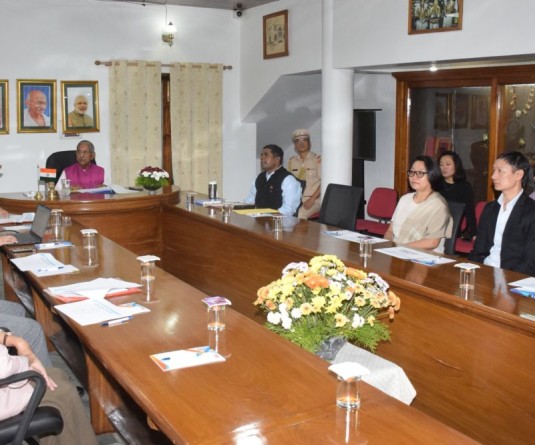
Dimapur, Nov 15 (MExN): Chief Minister of Nagaland Neiphiu Rio highlighted his governments “Vision 2020 document” containing envisage developmental thrusts for the coming decade, at the 53rd meeting of the NEC held November 15-16 at New Delhi.
Opening his remarks, Rio said that the vision for greater development of the Northeast region be discussed since the region is on the threshold of the 11th Five Year Plan, which will also be the first five year plan of NEC as a statutory planning body .
Nagaland has already prepared its own “Vision 2020” document, which has been incorporated in the Human Development Report of Nagaland 2004, he informed. “It would be appreciated if some of the aspirations of the State Government, as highlighted in the Vision 2020 chapter of the State Human Development Report 2004, are also incorporated while finalizing the Vision NER 2020 document” Rio asked. He then proceeded to highlight the state’s visions for economic development as well as for the region.
Rio highlighted agri and allied sectors. He said that the main thrust areas for the 11th plan, as far as Nagaland is concerned, should be agriculture and allied sectors.
“The favorable land-man ratio, the good rainfall and temperate climatic conditions, the naturally fertile soil which supports luxuriant growth of all kinds of plants, are some of the advantages and potentials that can be exploited to harvest rich dividends, and to produce exportable surplus sufficient to sustain the State’s economy at a sufficiently high levels of development. Horticulture, floriculture, sericulture, aromatic and medicinal plants, animal husbandry and bee keeping etc. can be taken up on commercial scales, with organic farming as an essential element to enhance its market value. As a corollary to this, we shall have to develop food processing industries for value addition, post-harvesting and marketing infra-structures, including agri-link roads to potential areas etc” he explained.
Rio also stated called for embarking for reality the oft-discussed NE Express Highway linking all State capitals, with private public partnership. Railway line from Dimapur to Kohima, and construction of a new green field airport at Chiethu (Kohima), both of which are presently under investigation, should be expedited, he said. Another Railway line from Dimapur to Tizit via the foothills of Nagaland, and roads of economic importance connecting the eastern belt of the State are other priority areas to open up the agricultural and mineral rich belts of Nagaland, he pointed out. Other priority areas Rio highlighted are Hydro-power development and tourism.
“While the vast hydro-power potential of the N.E. region should be exploited to produce exportable surplus, at the same time, the vast potentials for mini and micro-hydel power plants should be harnessed for power self–sufficiency in power at the grass root level, and also to avoid high transmission loss and costs” Rio advised while informing that the experiment with the Chinese-made hydroger has shown that simple technology can be conveniently and economically introduced on a large scale in all rural areas.
On tourism, Rio presented his vision: “The North East could be marketed as a common tourist destination, and attractive tourist circuits to fit various pocket sizes can be worked out and advertised world wide through internet. In this regard, the proposed creation of ‘North East Tourism Development Council’ is a welcome step. However, he cautioned that the NE region is projected as a tourist paradise, the ‘out-dated’ RAP/PAP regimes, “which were the product of the Cold War era, and which do not appear to serve any useful purpose now,” shall have to be further relaxed, or altogether removed from the statute book.
The Chief Minister also called for revival and modernization of traditional handlooms and handicrafts, along with their patenting dynamics as well as opening of trade with South East Asian countries, not only to boost trade and economy, but also to remove the sense of isolation and neglect felt so long by the people of the region. In this connection, the ‘Look East’ policy of the Government of India needs to be better defined and crystallized into specific action programmes, so that it does not remain a mere ‘policy statement’ or a ‘attractive slogan’, he remarked.
Rio then highlighted the need for empowering the youths. According to him, training and capacity building to enable them to find gainful employment, in the organized sector, or to be self-employed as entrepreneurs should be pursued. For this purpose, appropriate technical and training institutes, such as Engineering Colleges, institutes of communication and information technology etc. may be set up within the region itself, instead of solely depending on institutions outside the region, Rio advised the attending policy-makers. Further, the existing ITIs also need to be expanded and modernized, their syllabi upgraded to suit the market demands for technicians, promote youth activities in the areas of sports, music, art and culture, and necessary sports infrastructures and other facilities, Rio said.
“These measures may also be seen as means of weaning away the youth from insurgency and other destructive tendencies” he said informing that the country spends huge sums of money on army and paramilitary forces being deployed in the region on counter-insurgency duties. “This money could perhaps, be better used for youth empowerment and other development activities, which may, in the long run, prove to be more effective in countering insurgencies in the region’ he suggested.
Micro credit facilities & strengthening and widening the scope of existing good practices.
To realize all these ‘visions’ a credit infrastructure is need he reminded. Rio said that the CD ratio in Nagaland is one of the lowest in the country, and currently hovers around 23%, against the national average of 60%. The private money lenders are charging exorbitant and back breaking rates of interest. Out of 52 R.D. Blocks in the State, as many as 21 RD Blocks, covering 421 villages, are still without any banking facilities. “Our success in communitisation of public services and institutions in rural areas have demonstrated the strength of our village communities and traditional institutions. Hence, we propose to provide micro credit in our rural areas through the VDB (Village Development Board) by using them as credit channelzing agencies. This is considered to be the surest way of reaching cheap credit in rural areas, combined with assured recovery” he said and solicited “liberal financial assistance” from various agencies of the Central Government in making available the initial corpus fund to the VDBs.
Other vision areas the Chief Minister presented included promotion of border trade and construction of roads in border areas, Bamboo missions, ecology and environment, maintenance of roads constructed with NEC funds, making NEC as effective planning and implementing body etc.