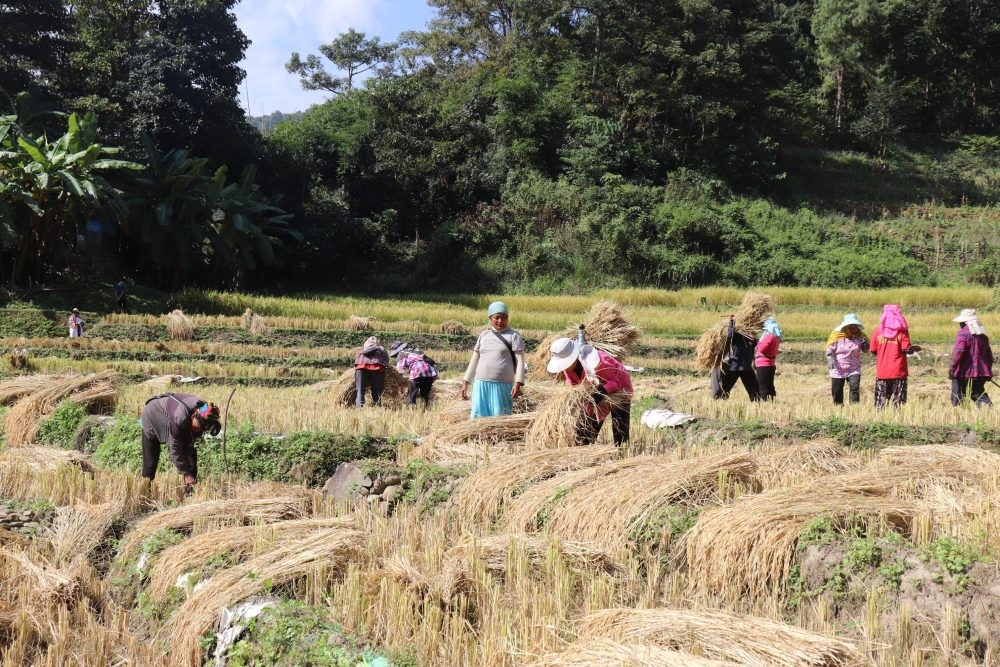
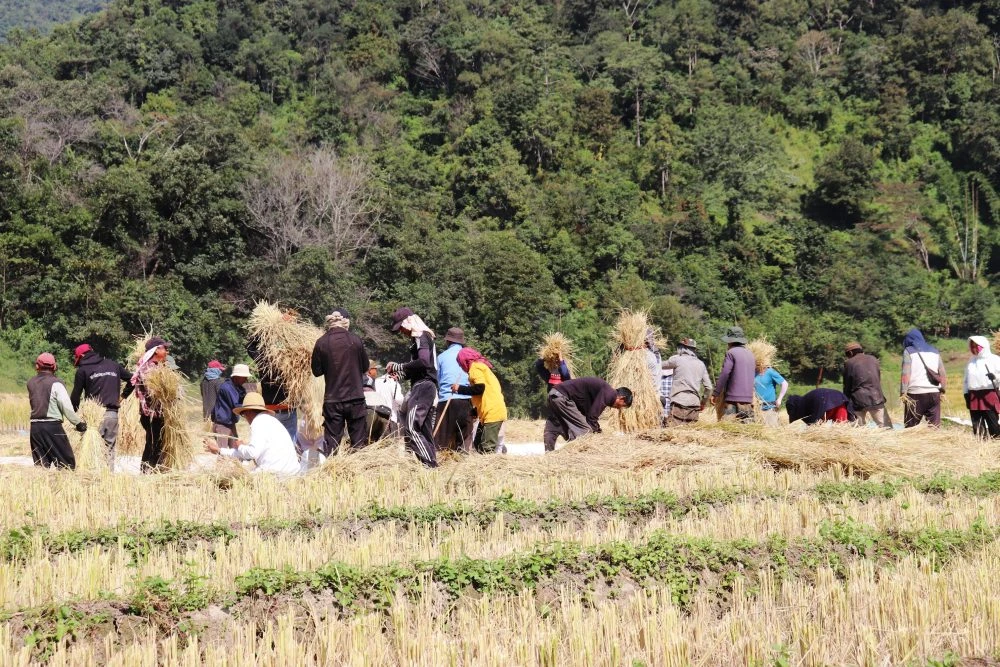
People of Satami village in Zunheboto district engaged in the rice harvesting activities. (Morung Photo)
Tokavi K Zhimo
Zunheboto | November 2
For the people of Satami village in Zunheboto district, rice harvesting is more than an annual agricultural activity. It represents a way of life built on hard work, unity and the belief that a community should sustain itself through the fruits of its own labour.
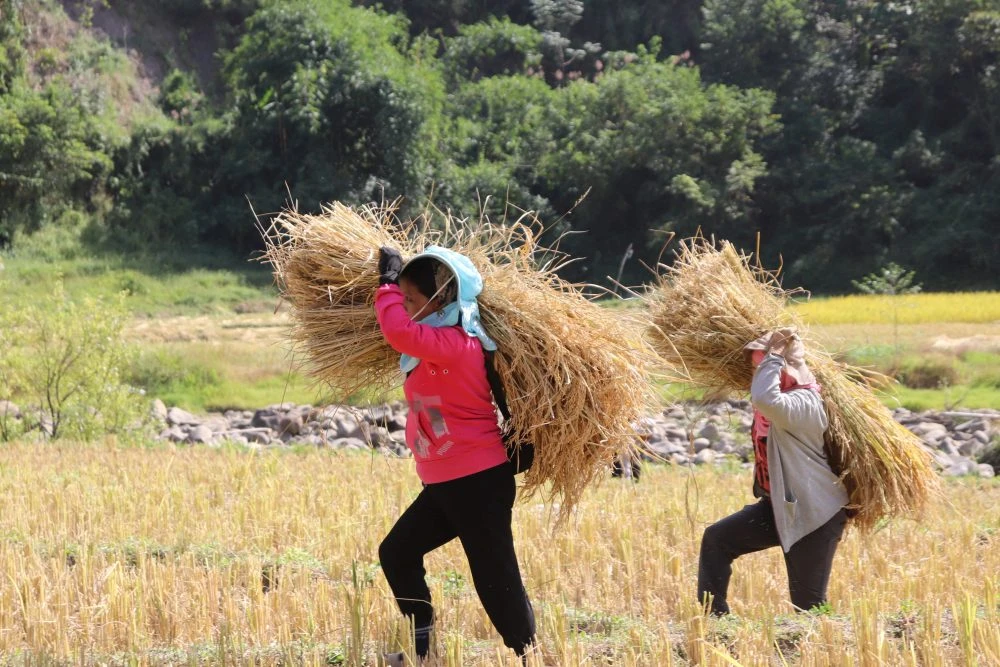
As villagers gather in their paddy fields during the harvesting season, they continue practices passed down by their forefathers, preserving not only their agricultural heritage but also the values of self-reliance, collective responsibility and respect for labour.
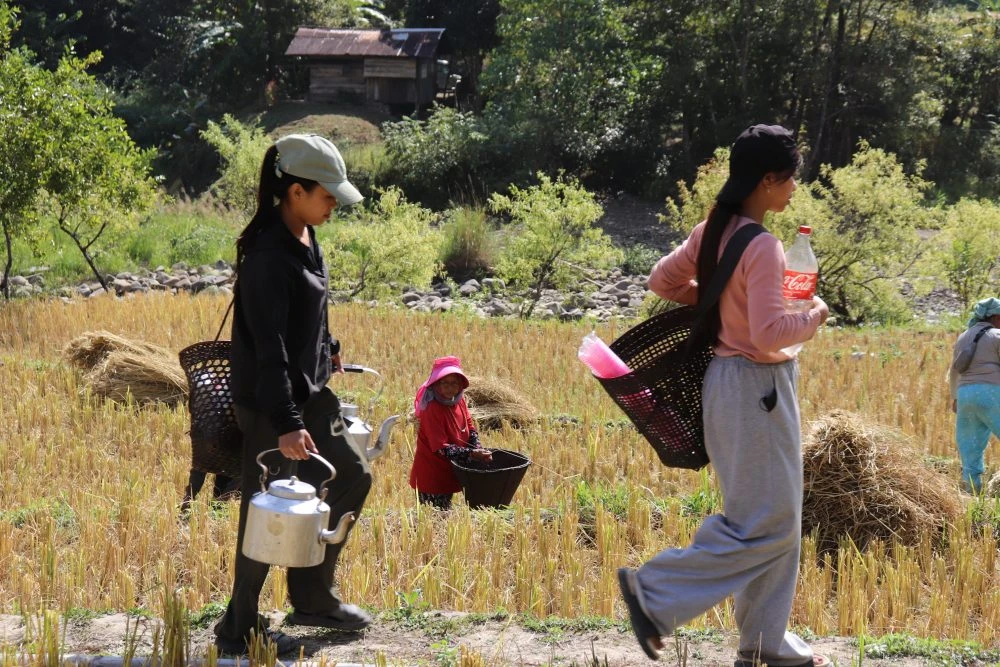
Vihokhu Awomi, village chief of Satami, highlighted the importance of promoting self-sufficiency through agriculture, noting that villagers come together for collective participation in rice harvesting. The practice, he said, reflects the community’s commitment to farming and “its determination to preserve agricultural traditions for future generations.”
Kiyeto Phuleshe, a field owner from Satami village, said ‘every individual in the village practises agriculture, emphasising that the community believes in producing its own food rather than depending on the government for its daily needs.’
Expressing gratitude for the village’s agricultural productivity, Phuleshe thanked God for blessing Satami with high-yielding paddy fields and acknowledged the forefathers who preserved the land and agricultural practices that continue to sustain the community.
According to Phuleshe, the Agriculture Department in Zunheboto has recognised Satami for harvesting a substantial quantity of rice grain among villages in the district. He also referred to assistance amounting to Rs 2.20 lakh, rice mill and the provision of an agricultural link road towards the paddy fields, which have supported the village’s farming activities.
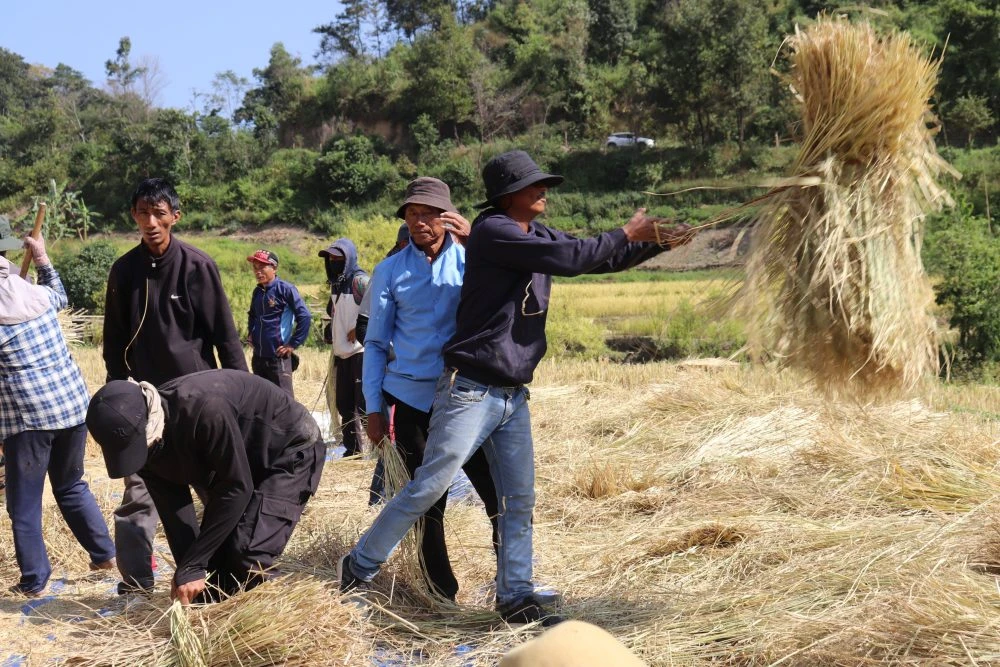
Satami’s agricultural approach goes beyond producing enough grain, it upholds the dignity of labour, ensures food security, and encourages every household to contribute to community well-being. Notably, the village has resolved to discourage procuring rice from outside, including through the BPL distribution system.
According to Phuleshe, the village chief and leaders have adopted a resolution under which individuals found procuring rice grains from outside the village may be fined Rs 1,500. An exception had been made for people with diabetes, taking into account their specific dietary requirements, he added.
Phuleshe further stated that BPL rice meant for villagers are distributed to the Village community residing in Zunheboto town and is not brought back into the village. The arrangement, he explained, allows Satami to maintain its emphasis on locally produced food while keeping the rice distributed to its town residents separate from the village’s own agricultural practices.
For the village leadership, self-reliance is closely tied to the belief that agriculture should remain a source of livelihood, pride and collective responsibility. According to Phuleshe, the rice is distributed to those residents in town rather than being brought into the village.
The community’s approach emphasizes farming as a means of sustaining households. Rather than let dependence on outside supplies replace local cultivation, the village keeps agricultural work central to everyday life. For Satami, the dignity of labour lies in the willingness to cultivate the land, produce food and contribute to community well-being, a belief that self-reliance begins with the effort people put into sustaining themselves. Although modern tools have gradually changed rice harvesting, Satami continues to preserve customs associated with the agricultural season.
Awomi recalled that in earlier times, men harvested rice using their bare hands and carried cane-woven baskets to collect the grains. “Today, sickles and tarpaulins have made the process easier, reflecting changes in farming methods while retaining the importance of manual labour.”
Harvesting was traditionally accompanied by customs that brought families and community members together. The person responsible for filling the measuring tin with harvested rice was invited to stay with the field owner for three days before harvesting began. Meat was served only during this period, and on harvesting day, the field owner and including Father and mother accompanied the person to the field, yodeling and offering prayers for a bountiful yield.
The quantity of rice harvested and the amount of meat served were traditionally regarded as measures of competition among participants. Pigs were slaughtered to celebrate the occasion, while cows were avoided because of the belief that slaughtering them could result in a poor harvest. Hunting wild animals and birds before harvesting was also traditionally considered an omen of bad fortune.
Satami’s agricultural traditions are closely connected to Ahuna, the traditional post-harvest festival celebrated annually on November 14.
Following the harvest, newly collected rice is stored in the granary, which is traditionally opened only after the festival. The grains are then distributed among family members and loved ones.
According to local tradition, Satami was established by Puloshe, who is believed to have crossed the Tizu River in the 1700s alongside others.
Phuleshe stated that Satami produces more than 20,000 tins during the harvesting season from its own resources. For villagers, the harvest season is therefore about more than collecting paddy. It brings together traditional knowledge, food production, cultural practices and the shared responsibility of sustaining community life.
Phuleshe said that Satami believes in self-sustainability through paddy cultivation and collective effort. “The community does not discriminate against any section of society but works together in unity towards a common goal,” he added.