

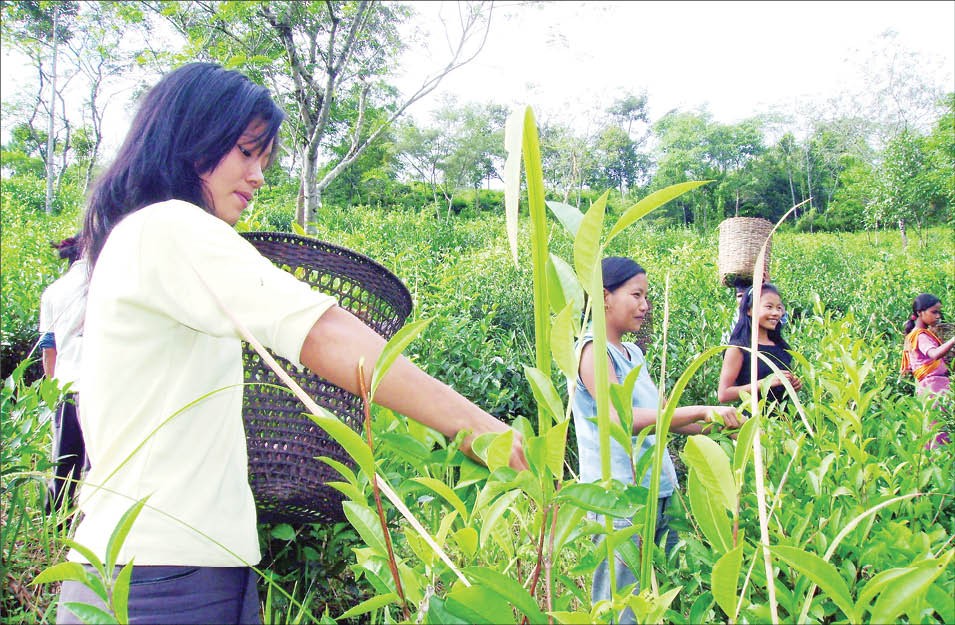
A Naga girl seen plucking leaves at the N.I. Jamir Tea Estate at Moalenden, Longsa Village in Mokokchung district on Monday afternoon.
Noel Manuel
Longsa Village | November 19
“The best quality tea must have creases like the leathern boot of Tartar horsemen, curl like the dewlap of a mighty bullock, unfold like a mist rising out of a ravine, gleam like a lake touched by a zephyr, and be wet and soft like a fine earth newly swept by rain,” said Lu Yu the most prominent and influential person in tea history who lived through the peak of the Tang Dynasty (618-901).
Almost two thousand years on and Lu Yu’s influence appears to be rubbing off on the quality performance of the state’s only orthodox tea producer nestled in the picturesque tourist spot of Moalenden under Longsa village of Mokokchung district.
The N.I. Jamir Tea Estate, with an average production of 2500 kgs per month, was adjudged second for quality orthodox tea production at the Guwahati Tea auction recently and this has added a new impetus to tea cultivation in the state.
“Unlike the tea in Assam, which is rich in strength and Darjeeling, where the aroma is high, the tea grown in Nagaland has a combination of both,” said Akum Pongen the Manager of N.I. Jamir tea estate and alumni of the tea research association, Toklai.
With a well equipped factory, financed by the State Bank of India, at Moalenden on the Mokokchung Tuensang road, the onus of tea cultivation is fast picking up and farmers at Chare, Longkhim including parts of Mokokchung are turning their attention to the world’s most popular baverage. “Tea cultivation needs a lot of labour and patience, and considering that most farmers depend more on seasonal cash crops, we are coming forward to sustain them both financially and logistically for the time being. Expert guidance from the Tea Research Association at Tocklai is also provided to the farmers on tea production,” said Tia Jamir, a prominent link between the farmers and Tea Board of India, besides also being a research assistant of the state agriculture research station at Mokokchung.
The N.I. Jamir, tea estate, established a few decades ago, began production in 2001 with the initiative of the State Bank of India to encourage farmers in tea cultivation. “The first success story of financed tea production in the state dates back to January 2006 where 1105 farmers were financed an amount of Rs 39.97 lakh by the SBI under the KCC funding plan. The recovery was 100 percent. Similarly, farmers at Chare and Longkhim also responded well and subsequently term loans were granted,” said G. Sekar, branch manager State Bank of India Mokokchung branch.
Tea growers in the state have good reason to smile and this is partly because the State Bank of India, Mokokchung branch has taken the initiative to fund and educate more tea growers, so that the only existing factory, N.I. Jamir tea estate could meet its production capacity of 500 kilos a day. But, it is the quick and high returns this brew is yielding, that is actually keeping the smiles of the Naga farmers warmer than ever.
.jpg)
