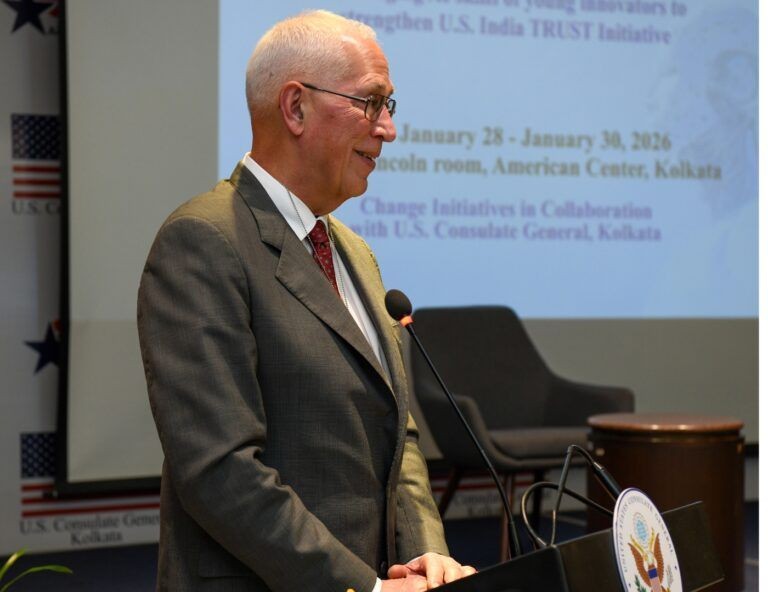
U.S. speaker James E. Lerums outlines how digital literacy and strong cybersecurity safeguard innovation, businesses, and critical infrastructure.
By Krittika Sharma, SPAN Magazine, U.S. Embassy New Delhi
As the United States and India deepen ties across digital infrastructure, supply chains, financial systems, and artificial intelligence (AI) platforms, cybersecurity no longer stops at national borders. A vulnerability in one ecosystem can ripple across the other, and protecting these systems is as much a matter of economic resilience as technical defense.
For cybersecurity expert James E. Lerums, who visited Kolkata and Hyderabad under the U.S. State Department Speaker program, the issue begins with trust.
“We need to feel comfortable that when we use our credit card, there’s no chance that anyone between us and the vendor or our bank can intercept details about our accounts and make money go away digitally,” Lerums says.
That confidence, he explains, rests on encryption capable of withstanding even the most powerful computers available today. As quantum computing advances, researchers are already working to ensure future systems remain secure.
Cybersecurity as economic infrastructure
Many people still see cybersecurity as a technical specialty, but Lerums challenges that view.
“If we didn’t have computers, we wouldn’t have cybersecurity problems, would we?” he says. The point, he explains, is that cybersecurity exists because digital systems now underpin daily life.
At Purdue University, where he works as a graduate faculty member, cybersecurity is treated as an interdisciplinary field. Engineers design chip firmware, policy experts examine privacy standards, and even philosophers weigh in on ethical questions around data use. “Cybersecurity is a team sport, and it cuts across many disciplines,” says Lerums.
The risks extend far beyond bank accounts. Modern agriculture relies on GPS-guided tractors, and water treatment plants depend on internet-connected controls. If these systems are compromised, food supply could be disrupted or water and sanitation services could fail, showing how cybersecurity affects everyday life.
As economies digitize, protecting these systems becomes a part of maintaining economic stability. To stay ahead of emerging threats, Lerums tests new standards known as post-quantum cryptography, designed to remain secure even as quantum computing advances. The goal is to ensure future protections are strong without disrupting everyday life or slowing innovation.
Shared security framework
Lerums describes today’s AI environment as “kind of like the Wild West,” where innovation is moving faster than governance. That pace creates opportunity, but also risk.
For India and the United States, cybersecurity cooperation is a practical necessity. Both countries are rapidly digitizing critical infrastructure and expanding collaboration in advanced technologies. Strengthening standards, research, and training helps reduce exposure while reinforcing economic resilience on both sides.
The cooperation, Lerums says, “comes down to relationships and mutual benefits, whether it’s between institutions or individuals.” Exchanges between U.S. and Indian universities allow partners to begin with focused, achievable projects. “In some of these areas, we need to start small and make those successful, because nothing sells like success,” he adds.
These early collaborations reveal complementary strengths. U.S. institutions may contribute specialized expertise or research capacity, while Indian partners offer scale and rapid implementation. Joint student projects and shared research agendas translate academic insight into operational impact, preparing the next generation of cybersecurity professionals.
Cybersecurity in everyday life
Even the strongest security systems rely on individual behavior. Simple habits like questioning unexpected emails and avoiding unsecured networks build collective resilience when practiced consistently.
Lerums notes that the rapid integration of AI into daily life creates new challenges, especially for younger users. “Younger generations have to have enough discernment, because AI isn’t always going to be correct,” he explains. “In some cases, it is going to be hard for them to look at an answer and say there is something that does not feel right about it.”
As AI tools become embedded in education, workplaces, and public services, the ability to question outputs and recognize limitations becomes part of cybersecurity itself.
During his engagement in Kolkata, Lerums encountered a practical example. “I saw an interesting solution in a school that teaches ethical hacking,” he recalls. “They pass out this neat calendar with tips every month on things you should do for your own cybersecurity hygiene.” The reminders are simple: do not connect to unknown networks, use non-obvious passwords, and avoid leaving devices unlocked. “These are very basic things,” he says, “and I think people need to be reminded or learn about it the first time, if nothing else.”
These small habits reflect a larger truth: cybersecurity culture begins at the individual level but scales to institutions and nations. For countries like the United States and India, increasingly linked by digital infrastructure and research partnerships, cybersecurity is a sustained collaboration across sectors and borders, strengthening trust, innovation, and economic stability.