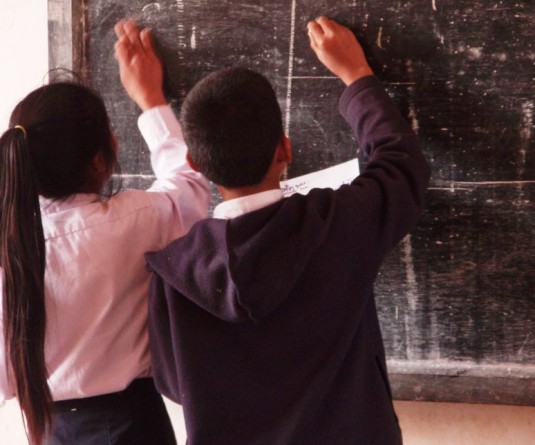
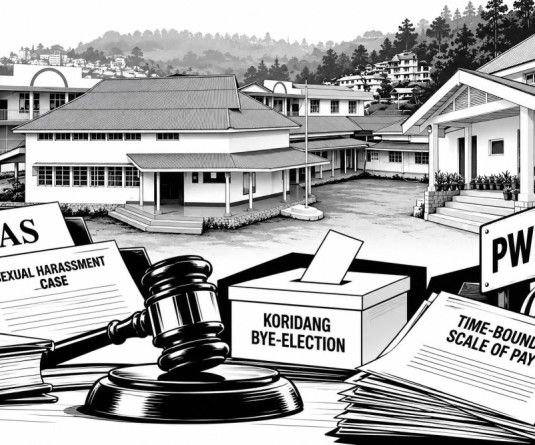
“I should be drawing under the sun, Not working hard till the day is gone. I should be learning A, B, C. But I’m trapped in chains you do not see.” (For representational purpose only)
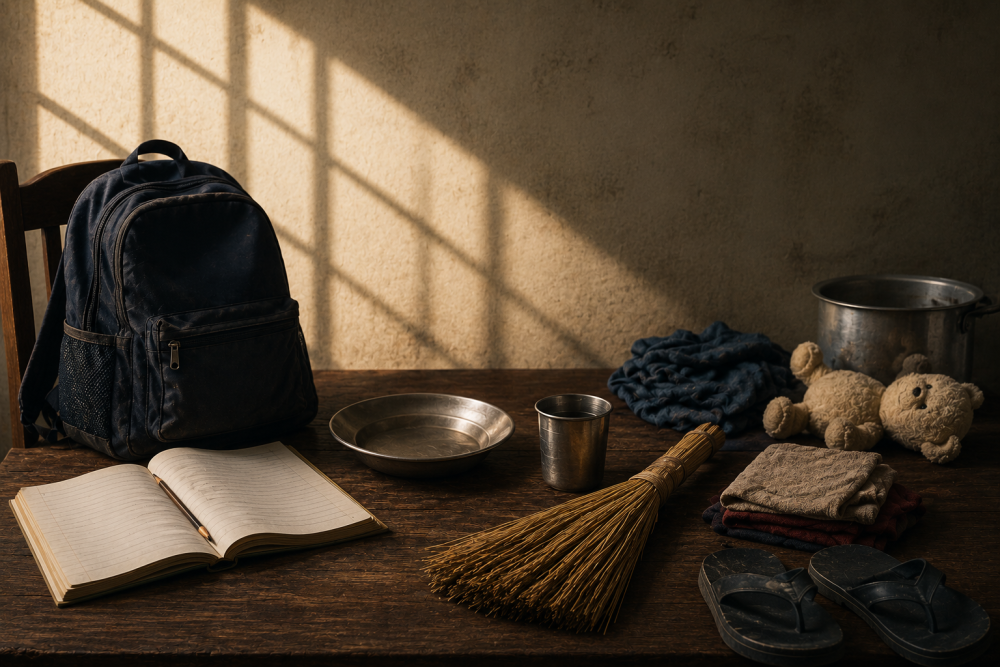
Between education and labour, a hidden arrangement persists for many children in Nagaland
Imlisanen Jamir
Dimapur | June 15
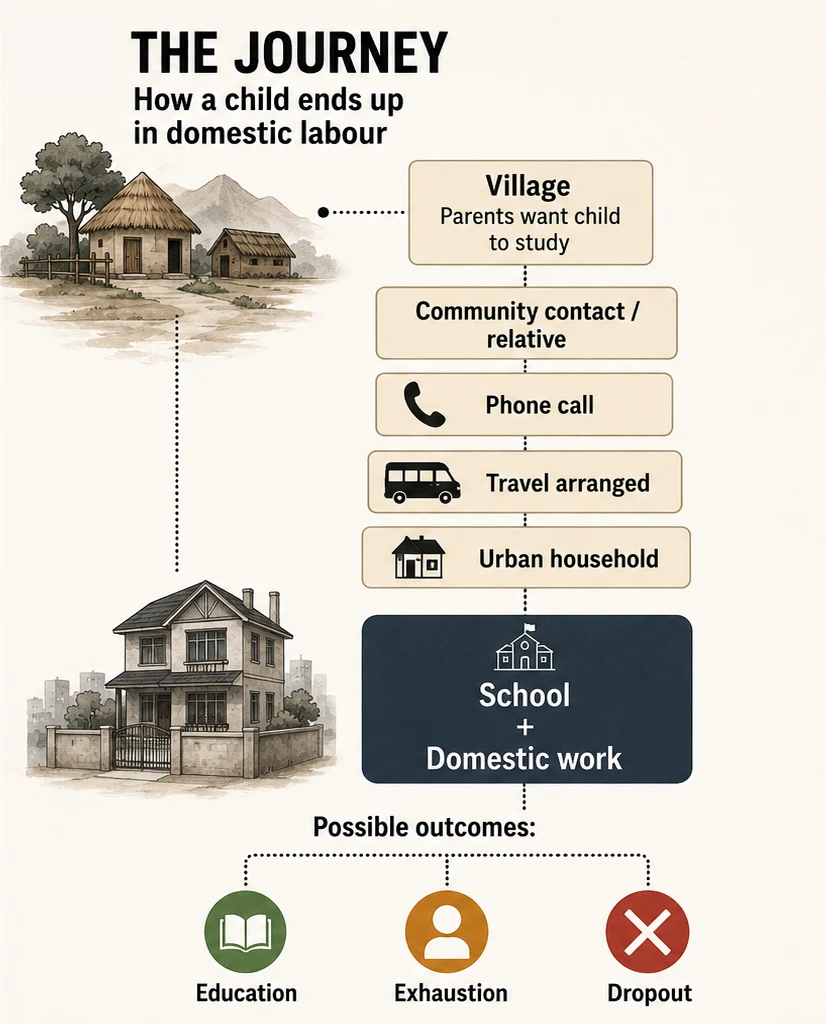
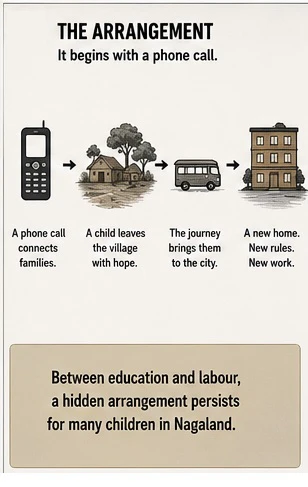
The arrangement is described in simple terms. A family in town needs help in the house. A family in a village needs a school for their child. Someone who knows both families makes a phone call. Travel money is sent and the child arrives.
What happens next depends on which household the child enters.
In some homes, the child attends school, is fed and clothed, and is treated like one of the family. In others, the child wakes before dawn to sweep, cook, fetch water, and mind infants; and then, if there is time and energy left, goes to school.
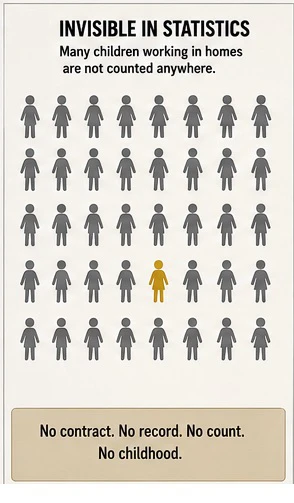
The line between the two is rarely visible from the outside. The arrangement carries no contract, no formal agreement, no official record. It is sealed with a phone call and a trust that is not always honoured.
This is one of the most common and least examined practices in urban Nagaland—and it has a name that most people involved in it are careful not to use: child labour.
‘They said I would go to school’
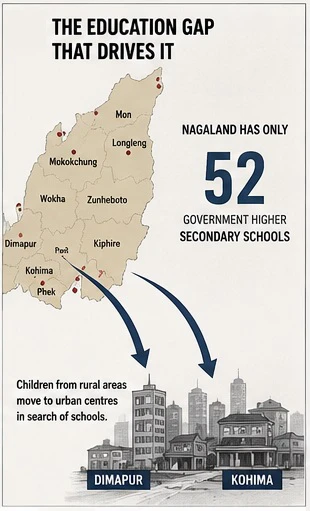
The children who arrive typically come from villages where secondary schools are scarce and higher secondary schools are rarer still.
According to UDISE+ 2023–24, Nagaland has just 52 government higher secondary schools across all districts. For students who want to continue beyond Class X, the arithmetic is stark: there are simply not enough schools near enough to home.
“In our village the school goes up to Class VIII,” said a student currently living with a host family in Dimapur. “My parents were told I could study here. That was what they agreed to. Nobody told them what else I would be doing.”
What else this student does: wakes at 5:00 a.m., sweeps the compound, washes dishes from the night before, prepares breakfast for the household’s younger children, and leaves for school having already worked for two hours. In the evenings, homework competes with cooking and the care of an infant.
“By the time I sit down to study I am already tired,” the student said. “Sometimes I sleep in class. The teacher thinks I am lazy.”
Another student, a girl from a village in eastern Nagaland now living with a family in Kohima, said she had been in the city for two years. She attends school three or four days a week, she said. On other days there is too much to do at home.
“I don’t say anything because I am scared,” she said. “If I complain they will send me back and then I won’t study at all.”
The middlemen
The people who facilitate these arrangements are rarely described as brokers. They are uncles, church contacts, community leaders, acquaintances from the same tribe. Yet the function they perform is transactional: they identify a family with a need, a village with a child, and connect the two.
A man in Dimapur who has hosted children from his home district on two occasions described his own role matter-of-factly.
“A man from my village called me. He said there is a family there whose child wants to study. I spoke to my neighbour, who needed someone in the house since both of them work. We arranged it.”
When asked whether money changed hands, he paused. “The family here gave something for travel. That is normal.”
He did not describe this as a transaction. Neither, in the village, would the child’s parents. But the child arrived in a city she had never visited, to live with people she had never met, in exchange for labour that would be described only as household help.
Inside the household
Ask most guardians whether they practise child labour and the answer is immediate and sincere: No.
“We treat her exactly like our own daughter,” said a woman in Dimapur whose household includes a 13-year-old girl from her husband’s village. “She eats what we eat, she goes to the same school as my daughter. Her parents couldn’t afford to keep her in school there. Here she has everything.”
When asked what the child does in the household, the answer came just as easily.
“Normal things. She helps in the morning before school—makes tea, sweeps. In the evening she sometimes watches the baby while I cook. These are things my own daughter also does. I don’t see the difference.”
When the word child labour was used, she shook her head. “Child labour is factories, construction, that kind of thing. This is family. We are not paying her, we are not employing her. We are giving her a home.”
A woman in Dimapur who has hosted three children over the past decade and speaks of it as a calling, framed the arrangement entirely in terms of what she has given.
“I have given opportunities to children who would have had nothing. One boy who stayed with me is now working in Bangalore. He calls me aunty still.”
When asked how many hours a day the current child, a 12-year-old boy, works before and after school, she paused for the first time.
“I never counted. That is a strange question. Do you count how many hours your own children help at home?”
It is the question that sits at the centre of this entire system. And it has a legal answer that almost none of the people inside these households know exists.
What the law says
While many citizens associate child labour exclusively with heavy industries, the legal reality encompasses both national and domestic child labour. Under the landscape of the Child & Adolescent Labour (Prohibition and Regulation) Act, crucial amendments passed in 2016 established a complete ban on the employment of children below 14 years of age in all occupations and processes. For adolescents between the ages of 14 and 18, the amended law strictly prohibits engagement in any hazardous occupations or work environments.
The penalties for violating these mandates are severe, carrying specific provisions for imprisonment ranging from six months to two years, a fine of Rs 20,000 to Rs 50,000, or both.
The Act does contain one significant exception: children may assist in family enterprises, but only if the work is non-hazardous and takes place strictly after school hours or during vacations.
However, the word “family” appears to offer wide cover where none exists. The Labour Department, Government of Nagaland’s own awareness literature defines family precisely:
“Family: In relation to a child means his mother, father, brother, sister and father’s sister and brother and mother’s sister and brother.”
The legal definition ends there. Cousins are not family under this Act. Family friends are not family. Village acquaintances are not family. A neighbour whose number was given to a parent by a church contact is not family. This means that the overwhelming majority of children placed in Dimapur and Kohima households through community networks are technically engaged in illegal domestic child labour.
The machinery of rescue and rehabilitation
On paper, the state possesses a robust multi-agency framework designed to intercept these vulnerabilities. The implementation and monitoring of the Act fall squarely under the purview of the Labour Department alongside District Magistrates and Deputy Commissioners (DM/DC).
When a child is flagged, whether via the Child Helpline (1098), local police units, the District Child Protection Unit (DCPU), the Department of School Education (DoSE), or the Nagaland State Commission for Protection of Child Rights (NSCPCR), a coordinated network is legally mandated to handle immediate rescue and long-term rehabilitation.
The ultimate authority for the child’s future rests with the Child Welfare Committee (CWC). Crucially, state rules dictate a strict policy regarding the return of a child: there can be no restoration to any non-family entity as defined by the law. If returning to the biological family is impossible or unsafe, the CWC, operating through the DCPU and the Child Helpline 1098, is legally bound to place rescued children into formal Foster Care networks rather than unmonitored households.
An invisible system in plain sight
Despite this extensive institutional framework, the reality on the ground remains stubbornly obscured.
“It is something everyone knows exists,” said Avinuo, a teacher at a government school in Kohima who teaches several students living with guardians. “I have had students fall asleep in class. When I ask them what is happening at home, they go quiet. You learn to read what that silence means.”
This teacher said she had once called the guardian of a student who was regularly absent. She was told the child had been unwell. “Later another student told me she had been minding children at home for several days because the guardian’s regular babysitter had left,” she stated.
“If the child fails repeatedly, sometimes the family decides there is no point,” said Vika, another government school teacher in Dimapur. “The child stays in the house but stops going to school. There is no system to notice. No one comes looking.”
State education data provides some context for how frequently students disappear from the system. According to UDISE+ 2023–24, Nagaland’s overall secondary dropout rate was 11.6 percent—an improvement from 19.4 percent the previous year, and now below the national average for the first time. But the figures measure enrolment, not experience. They cannot distinguish between a child who dropped out for economic reasons and one who was never genuinely attending.
The education gap that drives it
Nagaland’s total student enrolment fell from 5,30,177 in 2015–16 to 4,12,975 in 2023–24—a decline of more than 1.17 lakh students even as the teacher count rose from 30,772 to over 32,600. The pupil-teacher ratio now stands at approximately 13:1, below the national average.
The infrastructure, however, is concentrated in ways that leave rural families with limited options. Of Nagaland’s 2,725 schools, private schools—which accounted for approximately 67 percent of total enrolment in 2024–25—are overwhelmingly located in urban centres. The state has just 52 government higher secondary schools.
“If there was a higher secondary school in my village, my parents would not have sent me here,” said one student. “They sent me because they had no other choice. At least that is what they believed.”
Parents in villages say the decision to send a child to town is not made lightly. Some say they were told clearly that the child would work in the household in exchange for accommodation. A few say they asked and were reassured.
“I asked the woman who arranged it whether my daughter would have to do housework,” said a parent from a village in eastern Nagaland. “She said just a little. She said all children help at home. I believed her.”
A pamphlet, a poem, and a gap
On the front cover of the Labour Department, Government of Nagaland’s awareness pamphlet on child labour, above the legal summary and the definitions and the penalty clauses, there is a poem. It is called “Stolen Days” and reads like this:
“I should be drawing under the sun,
Not working hard till the day is gone.
I should be learning A, B, C
But I’m trapped in chains you do not see.”
However, households are not, in practice, inspected. The children inside them are not counted. The complex state machinery of CWCs, DCPUs, and helplines rarely penetrates the closed front doors of private homes. The informal arrangements that govern their days remain unrecorded anywhere.
Names of the children, parents, guardians and hosts have been left anonymous either due to requests for anonymity or to protect identities.
Disclaimer: This report is part of the ‘Media Fellowship Initiative on Child Protection Awareness and Ethical Public Discourse’ series, supported by DKA Austria and implemented by Prodigals’ Home. The content is intended for public legal literacy and preventive awareness and does not constitute legal advice.