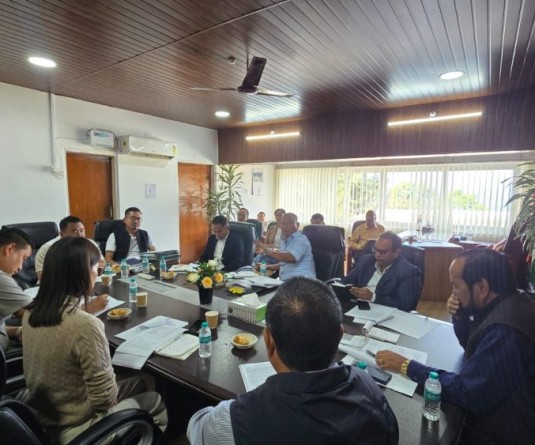
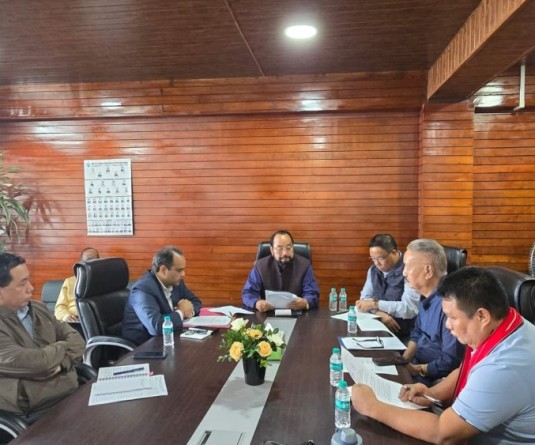
SVEP Entrepreneurs Meet, aimed at promoting an entrepreneurial mindset among SHG members and their families held at Northern Angamimia Mechii Ki, Chiephobozou Town on October 8 last.
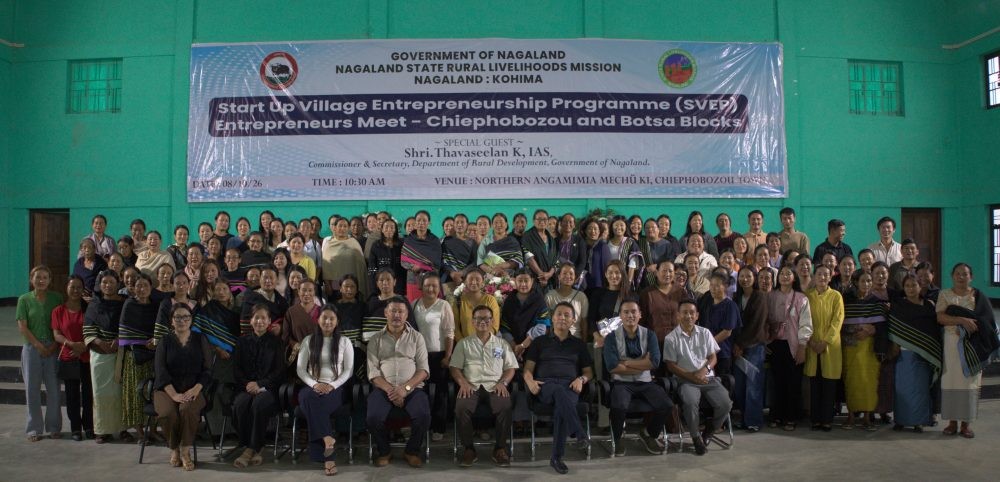
Kohima, October 12 (MExN): The Start-up Village Entrepreneurship Programme (SVEP) Entrepreneurs Meet, aimed at promoting an entrepreneurial mindset among Self-Help Group (SHG) members and their families, was held at Northern Angamimia Mechii Ki, Chiephobozou Town on October 8 last.
SVEP is currently being implemented in Botsa and Chiephobozou Blocks of Kohima District, where 414 entrepreneurs are being supported by the Nagaland State Rural Livelihoods Mission (NSRLM).
The meet sought to strengthen existing entrepreneurs, encourage peer learning and create an enabling ecosystem for sustainable livelihoods and income generation among SHG members and their families in the two blocks, stated a press release.
Moa Sangtam, Joint Secretary, Rural Development Department, and Mission Director, NSRLM, delivered the special guest’s address on behalf of Thavaseelan K, IAS, Commissioner and Secretary, Rural Development Department, who could not attend due to prior official commitments.
In his written message, Thavaseelan said, “Behind the products that you see in a shop in a village, there is courage.” He urged the community to consider the risks taken by those who invest their savings, borrow money or approach banks for loans to start a business despite uncertainty over customers and sales. He said SVEP could be a step towards an entrepreneurial journey.
Speaking in his personal capacity, Sangtam drew a comparison between the traditional occupations of Naga forefathers and the growing need for entrepreneurship today. He said the Naga ancestors led simple lives with agriculture as their primary livelihood, reflecting a close relationship with the land and natural resources.
However, with changing times, evolving aspirations and increasing economic needs, he stressed the importance of diversifying beyond traditional farming and embracing entrepreneurship to create sustainable livelihoods. He encouraged participants to explore emerging business opportunities, develop an entrepreneurial mindset and make effective use of support available under initiatives such as SVEP.
Sangtam said entrepreneurship could play a vital role in generating local employment, strengthening rural economies and enabling the people of Nagaland to become more self-reliant while preserving their cultural values and traditional knowledge.
Menuoneituo Chadi, Chief Operating Officer, gave an overview of the programme, highlighting its objectives, key interventions and role in promoting rural entrepreneurship under DAY-NRLM. He said SVEP focuses on supporting rural individuals, particularly SHG members and their families, in establishing and strengthening sustainable enterprises through business development support, capacity building, financial linkages and market access.
He also underlined the programme’s importance in fostering an entrepreneurial mindset, creating local employment and raising household incomes through viable rural enterprises.
The meet was divided into two sessions. The first was led by Medoneizo Putsure, Managing Director of Bambusa Express and CEO of JOME Foods Pvt. Ltd., who served as the resource person and spoke on the practical knowledge and skills needed to establish, manage and expand rural enterprises.
On identifying business opportunities, Putsure stressed understanding local resources, market demand, consumer preferences and competition, and choosing enterprises that are commercially feasible, locally relevant and capable of generating sustainable income.
On access to finance, he spoke about identifying appropriate sources of capital, including bank credit and other support mechanisms. He stressed that entrepreneurs should understand their financial requirements, prepare realistic business plans, maintain proper records and use borrowed funds responsibly.
On cash flow management, he underlined the need to track money coming in and going out of a business. He explained the need to distinguish between sales revenue and actual profit, manage working capital, control unnecessary expenditure, maintain adequate funds for day-to-day operations and plan timely repayment of loans and other obligations.
On market penetration, he highlighted understanding customer needs, maintaining product quality, adopting appropriate pricing strategies and building customer relationships. He encouraged entrepreneurs to strengthen their presence in local markets while exploring exhibitions, trade fairs, institutional buyers, retail outlets and digital platforms to widen their customer base.
On business growth, he encouraged entrepreneurs to move beyond subsistence-level operations by improving productivity, reinvesting profits, adopting appropriate technologies, diversifying products and services, strengthening market linkages and expanding in a planned manner. He also underscored the need for continuous learning, innovation and sound business management to ensure the long-term sustainability of rural enterprises.