Never before has so much information been available to so many people at such little cost. Today, a student sitting in a classroom in Nagaland can listen to lectures from universities around the world, read the news, learn a new skill, and find answers to almost any question within seconds. A smartphone has become a library, a classroom, a newsroom, and sometimes even a source of advice.
But there is something worth asking: are we becoming better thinkers, or simply becoming better at finding information?
We live in a time when knowing something is easier than ever. If we do not know something, we search for it. If we want to learn, we watch a video. If we hear a claim, we can look it up within seconds.
This easy access to information is among the greatest advantages of our generation. The problem begins when we mistake information for understanding. We scroll, watch, react, and move on.
Sometimes we form an opinion before we have even understood what we are reacting to. We may know many things, yet fail to ask a simple question: Is this really true, and why do I believe it?
This is clearly evident in our news consumption. A headline appears on our screen and, within moments, people begin commenting, sharing, and arguing. Often, the headline is all they have read. A short video may show only one part of an incident, yet people quickly decide who is right and who is wrong.
We have seen this happen even with issues close to home in Nagaland. When an incident becomes widely discussed on social media, different versions of the same story can circulate quickly. A photograph, a short clip, or a forwarded message can create a strong reaction before the facts are properly established.
This is not simply a problem with social media. It is also a problem with our habits.
The internet rewards speed. The faster something catches our attention, the more likely we are to stop and look at it. Anger, fear, and controversy often attract more attention than careful explanation. As users, we can easily become part of this cycle without noticing it.
There is also another side to this problem. We sometimes use technology to avoid thinking for ourselves. Instead of struggling with a difficult question, we immediately search for a quick answer.
Rather than reading a full article, we settle for a summary, opting for quick reactions over proper conversations. Convenience is undeniably useful, but too much convenience can make us intellectually impatient.
This does not mean technology is making our generation unintelligent. That would be an unfair conclusion. Young people today have access to knowledge, opportunities, and ideas that previous generations could not easily reach. A student from a small town can learn from experts across the world. Even with limited resources, anyone can learn music, coding, languages, or other complex skills online.
The real question is what we do with that access.
Information becomes useful only when we know how to examine it. We need to distinguish between fact and opinion, evidence and assumption, information and misinformation. Most importantly, we need to become comfortable with saying, “I don't know yet.”
That simple sentence requires humility.
Critical thinking does not mean doubting everything. It means being willing to ask questions before accepting something as true. Who said this? What evidence supports it? Is there another side to the story? Am I believing this because it is true, or simply because it agrees with what I already think?
Many of our parents and grandparents grew up with very little, without the luxury of having everything available at the touch of a screen. If they wanted something, they had to wait, save, work for it, or simply learn to live without it. Without easy alternatives for life's basic necessities, sustained effort and resourcefulness were unavoidable.
It would be an oversimplification to claim that earlier generations had it better.
Their lives were difficult in ways our generation may not fully understand, and we have opportunities they did not have. Nonetheless, their resilience and resourcefulness still hold vital lessons for the present.
Today, we often casually compromise on things that should matter. We give up too quickly, change our minds too easily, or choose immediate convenience over what is right for us in the long run.
Perhaps having so many choices has something to do with it. If one thing fails, another option is always ready. Lacking that luxury, the older generation had to be patient, deliberate, and committed to making things work, knowing there was rarely an easy way back.
We do not have to live as they lived- the world has changed- but having more choices, comfort, and information should not make us forget how to be patient, hardworking, careful, and content.
These qualities matter beyond personal life- shaping how we treat people, make decisions, and eventually contribute to our communities. Young people are not only consumers of information; we are also becoming the people who will shape our communities, institutions, and public life.
Perhaps the real challenge before us is that having more information than any generation does does not, by itself, make a person wise; we still have to learn to listen, think, work, wait, question, and sometimes admit we were wrong. We do not need to reject technology or return to the way things were, but simply ensure that modern convenience does not take away the qualities that make life meaningful.
Maybe, in a generation that can find an answer to almost anything within seconds, one of the most important things we can learn is to take our time before deciding what to believe, what to value, and how to live.
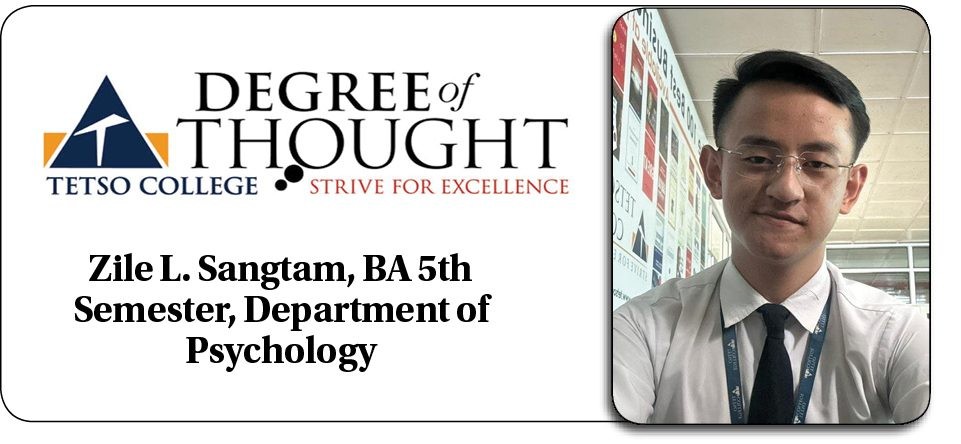
Degree of Thought is a weekly community column initiated by Tetso College in partnership with The Morung Express. Degree of Thought will delve into the social, cultural, political, and educational issues around us. The views expressed here do not reflect the opinion of the institution. Tetso College is a NAAC-accredited, UGC-recognised Commerce and Arts College. The editorial team includes Tenipumei Phom, Asst. Professor Dept. of English, Limajungla Walling, Asst. Professor Dept. of Linguistics, and Munkiri Taro, Multimedia Executive. For feedback or comments, please email: [email protected]