Y Vikheho Swu, Former Minister, Nagaland
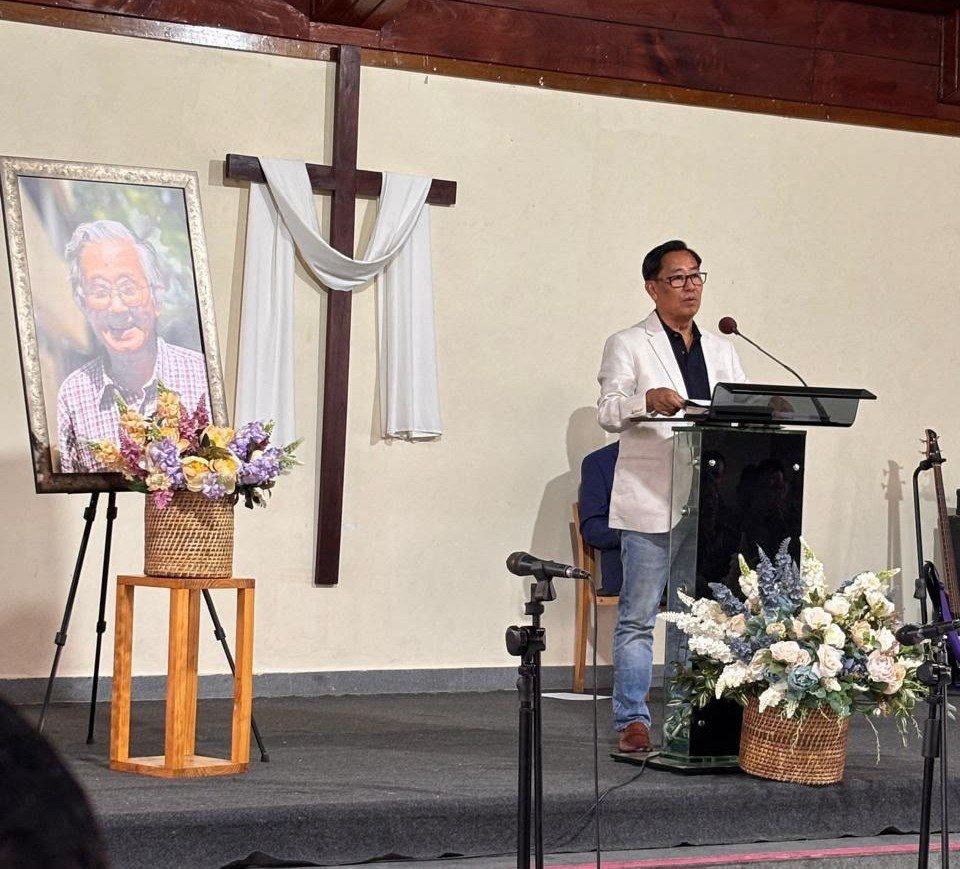
Y Vikheho Swu
Former Minister, Nagaland
The first time I met uncle Niketu was in early 1993, when the Naga Students Federation (NSF) and the Naga People’s Movement for Human Rights (NPMHR) jointly organized the year long UN’s International Year of the worlds Indigenous People which culminated with the celebration of “Naga Week”. He was a member in the organizing committee. I also had the privilege to work closely with him when we were involved in organizing a reception for the mortal remains of the Late Zimik Ramyo who had passed away in the UK. I, as the then NSF President was the Secretary and he was the Convenor of the Funeral Organizing Committee. In my entire tenure as the NSF president he was more or less a mentor to me. During my years with the NPMHR also, he was a source of strength and guide and I had the privilege of sharing platforms with him on some occasion in our efforts for peace and reconciliation.
After I had entered State politics, uncle Niketu was one of the few elders who would call me up simply to encourage me. He followed my work and initiatives and on several occasions called to congratulate or encourage me. Those calls meant a great deal to me and I will always be grateful for them.
In 2014, I missed a formal meeting that he had arranged with some foreign guest at his home Keruni Ki, here in Zubza. For a long time, I carried a deep sense of guilt and regret about it. He however, never held a grudge. When my uncle Isak Chishi Swu died and he had seen the eulogy I had written about my uncle, he had called me up again and told me that I had done well. Uncle Niketu was such a man. He was always there with kind words and encouragement that lifted a person’s spirit and that is what endeared him to many.
After losing touch with him for some years, I reconnected with him in 2024. I signed up for an Initiative of Change meeting, “Naga Youth Gathering” in Barapani Shillong just to catch up with him. Though the program was intended for participants between 25 and 35 years of age, I joined them.
Uncle Niketu’s family and Khonoma also, has a long and special connection with the people of Chishilimi and Pughoboto. His elder sister Zanikhou and husband Megososo Savino were among the first evangelist stationed at Chishilimi, my native village when the Mission Centre was first established there, by the Kohima Field Baptist Mission. Zanikhou is credited with starting the first Sunday School in Sumi area at Chishilimi village. His elder brother Savizo married Nisheli from Mishilimi village. His elder sister Rano M Saizah served as Headmistress during the formative years of Pughoboto Government High School. The first headmaster of Pughoboto Government high School was Zeviesielhou also from Khonoma. Besides this, he was a close friend of my uncle, the late Isak Chishi Swu.
They were classmates at Union Christain College Barapani (Shiloam, Umaim lake) Shillong.
At the “Naga Youth gathering” in Barapani Shillong, two of uncle Isak’s son’s had also signed up and we had the privilege of spending time with him and visiting their old college at Barapani. As we walked through the familiar surroundings, he shared stories and anecdotes from their college days and the years they spend together. The time we spent with him meant a great deal to us.
The Nagas of his generation produced many remarkable individuals who gave so much to the Naga people. Their sacrifices and contributions should never be forgotten.
During the last two years, I had the privilege of spending time with him on several occasions over breakfast and afternoon tea’s. SABAK Pughoboto had also initiated a program at Khonoma for which we also had memorable conversations and sittings. Khonoma’s connection to Pughoboto was not only through the works of Christianity and education, but also the undeniable connection with A Z Phizo. History shows us that after the death of T. Sakhrie, A.Z. Phizo took refuge in the jungles of Pughoboto and it was from there, that the Naga movement, NNC was further strengthened.
In 2002, I attended a course on Conflict Transformation and Peace Building at Eastern Mennonite University in West Virginia. One principal from that experience I gained was that in any conflict situation it is always better to look for “what is right” not “who is right”.
Uncle Niketu spend most of his life striving to live by that very principle. He deeply believed in seeking and doing what was right.
In December 2025, in one of our conversations, I remember him saying, “Idea alone does not work. The thinking you give to the idea becomes sustainable.” How true that is? It made me ask myself, do we give enough thought to the many challenges confronting Naga society today?
In another conversation, he said, “The individual has become so weak in Naga life” Perhaps one of our deepest challenges today is the weakening of our inner and spiritual capacity. This reminded me of my conversation with Prof. Kumar Sanjay who pointed out that Naga’s today have an abundance of cultural capacity which unfortunately can be dangerous. We have retained much of our cultural capacity, but culture without inner strength, reflection and compassion can sometimes become a source of resentment and vengeance. Perhaps we need to return to the strength of our families, our values, our customs and traditions- not simply to preserve them but to live them.
One of the most significant contribution of uncle Niketu is his work with the Khonoma Public Commission, and particularly its approach to reconciliation. That is something I deeply cherish.
When he shared about the reconciliation achieved through the KPC, my immediate thought was – This should not remain only in Khonoma or among the Angami people. It should be shared with the larger Naga family, because reconciliation is required not only among the Naga National Political Groups. All of us need reconciliation. Consciously or unconsciously, we have all contributed to the circumstances in which our society finds itself today and therefore we must also accept responsibility for helping to untangle ourselves.
Uncle Niketu expressed the essence of reconciliation beautifully. “Reconciliation becomes possible when people move beyond seeing only how they have been hurt by others and are willing to recognize where they too may have caused hurt”
Perhaps this is one of our greatest challenges. We remember very clearly how others have hurt us, but we often struggle to recognize where we ourselves may have caused hurt.
What enabled him to do what he did in KPC and beyond perhaps, was his belief in Richard Rohr’s principle of “Hurts not transformed are always transferred”. Those words left a deep mark on me and have given me much to ponder. Uncle Niketu spend much of his life trying to transform hurt rather than transfer it. The Khonoma Public Commission may not be perfect- no reconciliation process in the world is. But its significance lies in showing that people can confront their wounds, acknowledge their own failures, forgive and find a way to live together again. That I believe is part of the legacy Uncle Niketu leaves us.
Therefore the greatest tribute we can offer him is not simply to remember him, but to continue the work he believed in.
To strengthen the individual, to strengthen our families, to learn to disagree without destroying relationship, to have the humility to acknowledge our own mistakes and to transform our hurts rather than transfer them.
It is undeniable, that the long protracted Indo-Naga conflict has its consequences on the minds and psyche of the Naga people today. Suspicions, fear and doubts have dominated our minds. Uncle Niketu is one of the few Nagas who could rise above all this, and earn the trust of people from every section and across the diverse spectrum of Naga society. He was indeed a gem of a person, navigating the complexities of Naga society with wisdom, humility, patience and an extraordinary ability to bring people together.
According to him “No, tribe, society or group should think of happiness by themselves leaving aside the other Nagas”.
For all the conversations, for all the lessons and the encouragements I remain deeply grateful. Thank you uncle Niketu for the life you lived, the wounds you helped heal and the hope you leave behind.
May your legacy continue, not only in our memories but in the society we choose to built.
Rest in Peace Uncle Niketu
Recollections delivered during the ‘Remembering Niketu Iralu’ organized by the Forum for Naga Reconciliation (FNR) at Spicer Hall, Shalom Bible Seminary, Sechü-Zubza on October 3, 2026.