Time-Bound Services Vs Rs 5000 Penalty Cap: Will Nagaland’s Bill deliver?
NLA set to clear ‘Nagaland Right to Public Services Bill 2026'
Moa Jamir
Dimapur | September 2
A proposed law seeking to give citizens a time-bound right to notified public services could make government officials personally liable for delays, but the maximum financial penalty under the Nagaland Right to Public Services Bill, 2026 is capped at Rs 5,000.
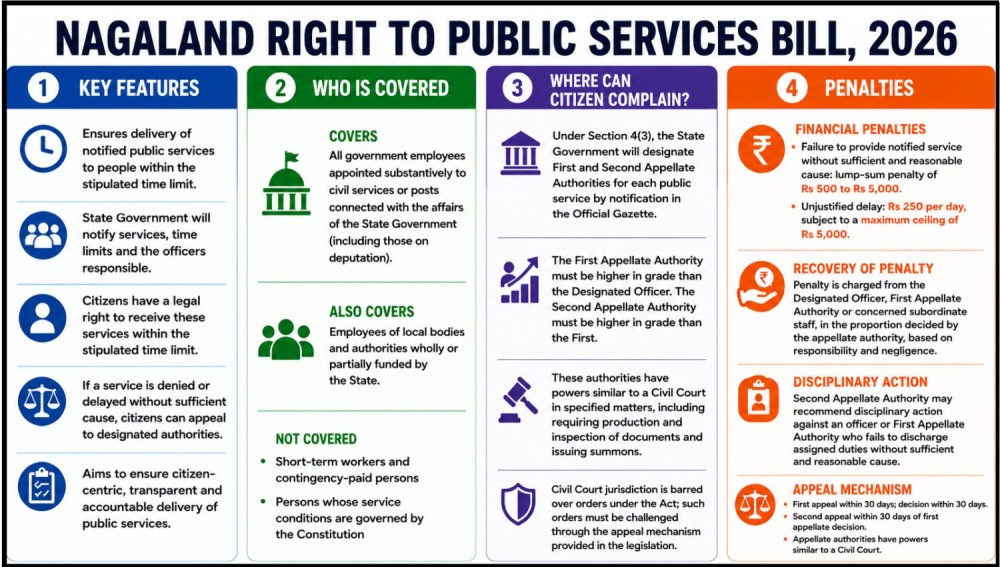
The Bill seeks “to provide for the delivery of notified public services to the people of the State of Nagaland within the stipulated time limit”, while establishing a mechanism to hold officials accountable for failing to deliver those services.
Under the proposed legislation, introduced in the 9th session of the 14th Nagaland Legislative Assembly (NLA) here on September 1, the State Government will notify which public services are covered, prescribe the time limit for each and designate officers responsible for delivering them.
Citizens would have a statutory right to receive such services within the notified period.
Who is covered?
The Bill has a broad scope, applying to all categories of government employees appointed substantively to civil services or posts connected with the affairs of the State Government, including personnel working on deputation.
It also covers employees of local bodies and authorities that are wholly or partially funded by the State Government. Local bodies broadly include municipalities, Development Councils, Town Planning Authorities, Village Councils, Autonomous Bodies and other bodies or authorities vested by law with responsibility for rendering essential public utility services or controlling, managing or regulating such services within a specified local area.
However, it excludes short-term workers or persons paid from contingencies, as well as persons whose service conditions are regulated by or expressly provided for in the Constitution.
Where can a citizen complain?
Under Section 4(3), the State Government will designate First and Second Appellate Authorities for each public service through notification in the Official Gazette.
The First Appellate Authority must be higher in grade than the Designated Officer, and the Second Appellate Authority higher than the First.
The authorities would have Civil Court-like powers in specified matters, including requiring production and inspection of documents and issuing summons for hearings.
The proposed law also bars Civil Court jurisdiction over orders made under it, requiring such orders to be challenged through the prescribed appeal mechanism.
The ‘penalties’
If a Designated Officer fails to provide a service without sufficient and reasonable cause, the First Appellate Authority may impose a lump-sum penalty of Rs 500 to Rs 5,000. For unjustified delays, the penalty is Rs 250 per day, subject to the Rs 5,000 ceiling.
Thus, even if a delay continues for several weeks, the monetary penalty cannot exceed Rs 5,000.
Whether the ceiling provides sufficient deterrence against habitual delays could be one practical test of the proposed law. However, the Bill does not rely solely on financial penalties.
The Second Appellate Authority may also recommend disciplinary action against a Designated Officer or First Appellate Authority who fails to discharge assigned duties without sufficient and reasonable cause.
Two-tier appeal mechanism
The proposed system would also give citizens a two-tier appeal mechanism. An applicant whose service is rejected or not delivered within the stipulated period can approach the First Appellate Authority within 30 days.
A second appeal can then be filed against the First Appellate Authority’s decision, also within 30 days.
The more consequential issue, therefore, may be less the size of the penalty on paper than how effectively the penalty and disciplinary provisions are enforced in practice.
Bill’s justifications
The Bill’s ‘Statement of Objects and Reasons’ identifies delays in service delivery and weak grievance redressal as causes of citizen hardship and eroding public confidence in administration, and describes the framework as citizen-centric, transparent and accountable.
The State Government estimates that implementing the legislation will involve no recurring or non-recurring expenditure from the State’s Consolidated Fund.
Nagaland’s proposed Bill follows a growing trend of time-bound public service delivery laws across India, with reports indicating that over 20 states have enacted or notified such legislation.
At the Union level, the Citizens’ Right to Grievance Redress Bill, introduced in 2011 for time-bound grievance redressal, lapsed in 2014 following dissolution of the 15th Lok Sabha.
Meanwhile, the Department of Administrative Reforms and Public Grievances operates the Centralised Public Grievance Redress and Monitoring System (CPGRAMS), allowing citizens to lodge grievances online with Central Government departments and ministries.
Unlike the proposed legislation, CPGRAMS has no statutory right to time-bound service delivery backed by penalties.