Overspeeding, helmet & seat belt lapses account for over 85% of deaths in 2024 despite low accidents
Morung Express News
Dimapur | December 14
Despite recording one of the lowest numbers of road accident fatalities in the country, Nagaland’s 2024 road safety data show that overspeeding and non-compliance with basic safety norms such as wearing helmets and seat belts were responsible for a disproportionately high share of deaths.
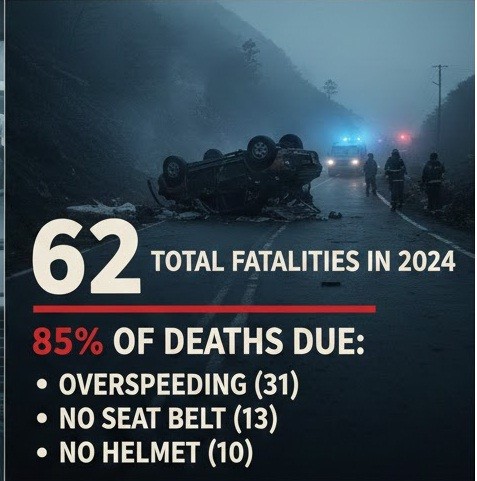
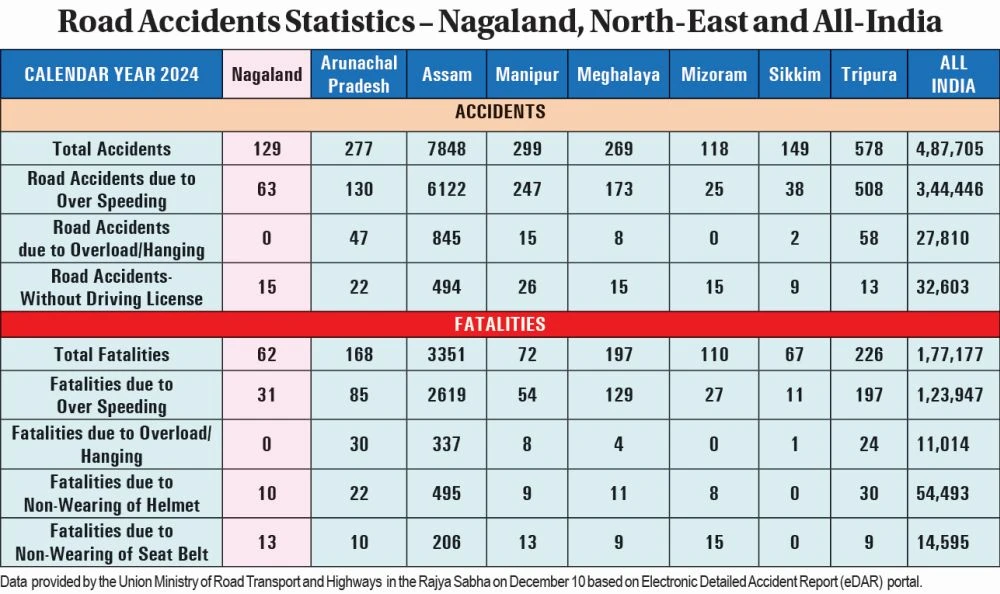
According to data tabled in the Rajya Sabha by the Union Ministry of Road Transport and Highways (MoRTH), Nagaland reported 62 road accident fatalities in 2024, a decline from 86 in 2023.
However, overspeeding alone accounted for 31 deaths, exactly half of the total fatalities recorded in the State during the year.
In terms of accidents, 63 of the 129 road accidents reported in 2024 were due to overspeeding, making it the leading cause of both accidents and deaths in Nagaland.
Fatalities linked to the non-wearing of safety gear were also significant when viewed against the State’s low overall death count.
Ten deaths were attributed to the non-wearing of helmets, while 13 fatalities resulted from the non-wearing of seat belts. Together, these violations accounted for 23 deaths, or over one-third of all road accident fatalities in the State in 2024.
Taken together, overspeeding and failure to comply with helmet and seat belt norms accounted for more than 85% of road accident deaths in Nagaland during the year, underscoring traffic violations as the dominant factor behind fatalities rather than vehicle overloading or unlicensed driving.
In contrast, Nagaland reported zero fatalities due to vehicle overloading or hanging in 2024 and only nine accidents involving drivers without a valid licence, indicating a relatively lower incidence in these categories.
Fluctuating trend
Meanwhile, Nagaland recorded a fluctuating trend in road accidents between 2020 and 2024.
A total of 156 accidents were reported in 2020, which rose sharply to 334 in 2021 before declining to 140 in 2022. The number increased again to 166 in 2023, followed by a significant drop to 63 cases in 2024.
Fatalities linked to road accidents also varied during the period. Twenty deaths were reported in 2020, rising to 30 in 2021 and declining to 25 in 2022.
The toll peaked at 47 fatalities in 2023 before falling to 31 in 2024. However, despite fewer accidents reported in 2024, the fatality count indicates that the severity of road crashes remained a major concern.
Nationally, overspeeding caused 1,23,947 deaths in 2024, while fatalities due to the non-wearing of helmets and seat belts stood at 54,493 and 14,595 respectively.
As per data based on the Electronic Detailed Accident Report (eDAR) portal, India also recorded 4,87,705 accidents in 2024, out of which 1,77,177 were fatal.
Policy measures
Meanwhile, on steps taken to ensure road safety, real-time accident tracking and data-driven policy interventions, MoRTH Minister Nitin Jairam Gadkari informed the Upper House of Parliament that the Motor Vehicles (Amendment) Act, 2019 strengthens road safety provisions by revising penalties for traffic violations, addressing juvenile driving, computerising vehicle fitness and driving tests, recalling defective vehicles, and streamlining third-party insurance.
While the Central Government formulates rules under the Motor Vehicles Act, 1988, enforcement remains the responsibility of State Governments and UT administrations, he pointed out.
To improve driver training, the Ministry administers a network of Institutes of Driving Training & Research (IDTRs), Regional Driving Training Centres (RDTCs) and Driving Training Centres (DTCs) across the country, he added.
The Minister also stated that from FY 2019–20 to FY 2024–25, road safety audits were conducted on 1,36,716 km of roads and noted that audits are carried out at various stages of National Highway projects including design, construction, pre-opening and on existing highways to identify deficiencies.
Short-term corrective measures include improved road markings, signage, crash barriers, road studs, delineators, closure of unauthorised median openings and traffic-calming measures, while long-term steps involve improvements in road geometry, junction upgrades, spot widening of carriageways, and the construction of underpasses and overpasses, he added.
The Ministry has developed the Electronic Detailed Accident Report (eDAR) portal, replacing the earlier Integrated Road Accident Database (iRAD) and he system serves as a central repository for accident data and is integrated with databases such as VAHAN, Sarathi, CCTNS, PM Gati Shakti and health records, Gadkari informed.
The portal enables data-driven policy decisions, identification of accident-prone areas, preventive measures and faster processing of accident claims, thereby reducing settlement time, he maintained.
Road safety continues to be a collaborative effort between the Centre and the States, with a focus on stricter enforcement, infrastructure improvements and technology-driven monitoring, he added.