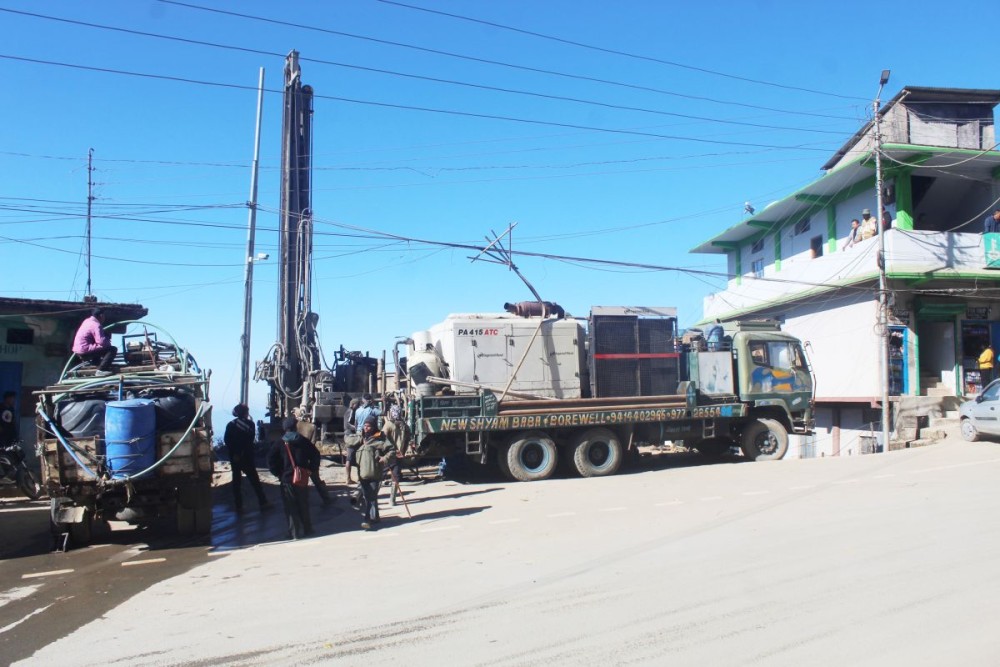
A bore-well drilling rig in Zunheboto town.
Tokavi K Zhimo
Zunheboto | January 30
Water crisis in Zunheboto town continues, the situation worsening year after year. Without a dependable supply from the Public Health Engineering Department (PHED), a large chunk of the town’s population rely on streams or buy from private vendors, and for those who can afford, drill deep bore wells.
.webp)
Drying streams
But even the streams are drying up, according to Ivan Zhimomi, Team Leader of the Tizu Valley Biodiversity Conservation Livelihood (TVBCL). He attributed it to multiple factors among which include rapid town expansion, unchecked tree felling, lack of afforestation initiatives, and plastic pollution.
A farmer from Sukhai village observed that weather patterns have significantly altered, with rising temperatures and strong winds drying up water sources and damaging forests. He recalled that there was a time when seasons were predictable.
Pukhakhu Zhimo of Natha New village highlighted that natural streams, which were once abundant, are going try due to climate change and increasing population pressure.
.webp)
Rainwater harvesting
Given the situation, Tavinto Chishi, President Green Club, an NGO based in Zunheboto, encouraged rainwater harvesting at the household level. According to him, adopting rainwater harvesting is one of the most practical and important steps residents can take to manage water scarcity.
The Fire and Emergency Services has successfully implemented a rainwater harvesting project. According to the Officer-in-Charge (OC) of Fire Station, Zunheboto, K Hamchani Konyak, since the department installed a rainwater harvesting system along with a bore-well in 2024, it has been able to manage till date. He said that the Fire Station, with three fire trucks, has a capacity of storing up to 3 lakh litres.
Before installing the borewell in 2024, the department purchased water from Sukhalu village. “We managed those costs through our own funds,” he said.
However, operational challenges remain. Narrow roads, roadside parking by residents, and limited equipment often hinder emergency response.
The Zunheboto Fire Station covers all subdivisions in the district, including Lumami, VK, Atoizu, Satakha, and Aghunato. A proposal to set up a fire station in Atoizu reportedly remains stalled.
The OC further revealed that the department had earlier discontinued its PHED water connection due to unreliable supply. “Our duty depends entirely on water, and we cannot rely on an inconsistent source,” he said.
He stressed the need to develop reservoirs connected to natural streams to ensure water is available during emergencies.
.webp)
Institutional Efforts
The government is also looking toward long-term conservation. Speaking at the Project Level Watershed Mahotsav 2026, organised by the Department of Land Resources, under PMKSY–WDC 2.0, in Zunheboto, on January 17, District Project Officer, Land Resources Department, I Acato Chishi, emphasised the importance of the Pradhan Mantri Krishi Sinchayee Yojana (PMKSY) in addressing water scarcity in the town. He called for urgent and collective action in watershed management.
At the same programme, Deputy Commissioner, Zunheboto, Dharam Raj noted that despite receiving abundant rainfall, Nagaland continues to face water scarcity due to improper watershed management. According to him, the state has yet to meet the United Nations’ 250 litres of water per person per day.
PHED’s challenges
Er Beto T Jimo, SDO, PHED Zunheboto, highlighted the complexities of water supply in the district due to its challenging topography. He stated that Zunheboto sources its water from natural streams located at Lizutomi village, Melahu, Ngozubo, Kholeboto and Achikuchu. The Kholeboto and Achikuchu sources are however said to be “non-functional.” Meanwhile, timber extraction and other human activities were said to have depleted the Melahu and Ngozubo water supplies.
At present, Lizutomi village remains the only active source.
He added that Zunheboto town has approximately 1,300 consumers, with a meter-based billing system charging Rs 200 per month.
He reported that the district’s total workforce of 118 includes 68 staff in the Zunheboto Division, 23 in Aghunato, 12 in Pughoboto, 8 in Satakha, and 7 in Atoizu.
Public cooperation
Jimo encouraged for more public cooperation, particularly in setting up reservoirs on designated land for improving water supply to the town.
Highlighting the causes of the water shortage, Jimo cited the lack of a centralized regulation system and the logistical difficulty of managing a 37-km pipeline with numerous branches. This extensive network supplies Zunheboto’s 4-lakh-liter reservoir located in North Point.
Jimo also advised households to install taps to regulate flow and prevent waste. He clarified that the water supply is intended to meet basic needs rather than excessive demand, and he urged the public to cooperate.
While stating that Zunheboto district is recognised as one of the best-performing districts in Nagaland under the Jal Jeevan Mission, he stressed the need for implementing a future mega water supply project for the district. Furthermore, he advised villages to establish a revenue system to support infrastructure upkeep and the payment of village-level water staff.