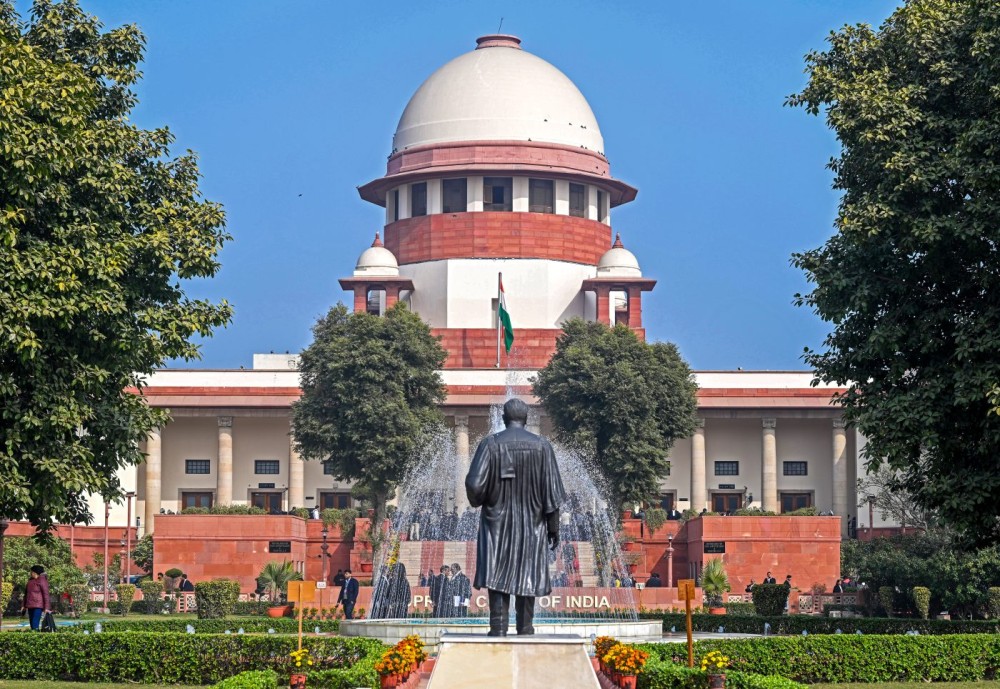
New Delhi: A general view of the Supreme Court of India standing tall under a clear sky, in New Delhi, Monday, January 05, 2025. (Photo: IANS/Deepak Kumar)
New Delhi, April 11 (IANS) The Supreme Court has reiterated that the right to vote and the right to contest an election are not fundamental rights but statutory rights created by law, and can therefore be regulated or restricted through legal provisions.
While upholding eligibility conditions prescribed for candidates contesting elections to cooperative dairy bodies in Rajasthan, a Bench of Justices R. Mahadevan and Sanjay Karol observed that “neither the right to vote nor the right to contest an election is a fundamental right,” clarifying that both rights exist only to the extent conferred by statute.
Drawing a clear distinction between the two, the apex court said the right to vote and the right to contest elections “operate in distinct fields” and cannot be treated as interchangeable.
“The right to vote is the right to participate in the electoral process by exercising franchise; and the right to contest is a distinct and additional right,” the Justice Mahadevan-led Bench said, adding that the latter can validly be subjected to “qualifications, eligibility conditions, and disqualifications.”
The ruling came in the context of a dispute over bye-laws framed by Rajasthan’s District Milk Producers’ Cooperative Unions, which imposed conditions such as minimum milk supply requirements and operational performance standards for candidates seeking election to the Board of Directors.
Setting aside the impugned decision striking down the bye-laws, the Supreme Court held that the Rajasthan High Court had erred in equating restrictions on candidature with restrictions on voting rights.
“The High Court, by equating regulation of eligibility to contest elections with a restriction on the right to vote, conflated two distinct statutory rights,” the Justice Mahadevan-led Bench said.
It further held that the impugned bye-laws only regulated eligibility to contest or continue in office and did not curtail members’ voting rights. “The impugned bye-laws operate solely in the domain of candidature and holding of office, without impinging upon the right to exercise franchise,” the apex court said.
It clarified that statutory rights, unlike fundamental rights, can be shaped, limited, or regulated by legislation to ensure effective governance and institutional integrity.
“The right to contest an election and to vote can always be restricted or abridged, if statute/rules or regulations prescribe so,” the apex court held.
Holding that the eligibility conditions were valid and consistent with the statutory framework governing cooperative societies, the Supreme Court allowed the appeal and restored the impugned bye-laws.