The Nagaland Trade, Investment and Industrial Policy (NTIIP), 2025 promises a decisive economic reset and to build, strengthen and facilitate’ a sound industrial eco-system in the State. (Image Generated via AI Assistance)
30% capital subsidies, 6% soft loans and more as State charts new industrialisation path
Moa Jamir
Dimapur | August 30
“To create a business friendly environment with simplified procedures and improved infrastructures so as to encourage innovative entrepreneurial skills fostering competitive industrial growth and investment, thereby creating employment opportunities and enhancing the State’s economic status resulting in better living standards.”
-Mission Statement, Nagaland Trade, Investment and Industrial Policy (NTIIP), 2025.
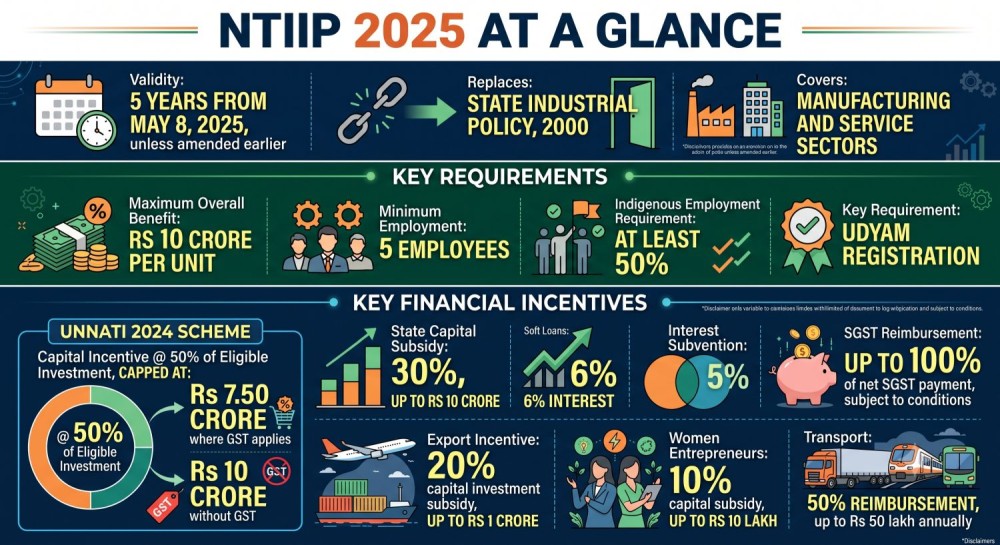
Notified on May 8, 2025, the Nagaland Trade, Investment and Industrial Policy (NTIIP), 2025, has replaced the State Industrial Policy of 2000 after nearly two-and-a-half decades.
As reported earlier, the NTIIP 2025 was ‘quietly rolled out’ (read here) with limited public visibility. Yet, on paper, it promises a decisive economic reset, with business-friendly environment, spur investment and entrepreneurship, generate employment and strengthen the State’s economy.
The Morung Express takes a closer look at what the policy itself offers and its key provisions.
Key objectives and strategy
At its core, policy objectives of the NTIIP 2025 seeks to ‘build, strengthen and facilitate’ a sound industrial eco-system by promoting investment, entrepreneurship and sustainable enterprise growth, generate employment and reduce poverty; balance regional economic growth and improve the economy.
These objectives, among others, are sought to be pursued by nurturing entrepreneurship through innovation and steadfast support to Start-ups; strengthening MSMEs; generating employment; supporting local units; developing industrial clusters; boosting tourism and exports; improving ease of doing business; and strengthening logistics and skilling.
The policy’s strategy includes creating industrial ‘land banks’, leveraging UNNATI 2024 and sustainable finance to attract investment, strengthening workforce skills and entrepreneurship, supporting women and person-with-disabilities (PwDs) entrepreneurs, improving quality certification and market access, and developing industrial infrastructure and sector-specific clusters.
Nagaland Special Development Zone, One District One Product, logistics and cold-chain infrastructure, enhanced incentives, single-window clearances, start-up support, and an Industrial Investment Promotion Cell etc are other focus areas.
Thrust sectors
The policy identified a broad range of thrust sectors. Manufacturing priorities include agro-based and food processing industries, mineral-based industries, textiles, electronics and IT, pharmaceuticals, bamboo products, medicinal and aromatic plants, waste management, start-ups and innovative enterprises, plant-based products, sports and music.
Its service-sector priorities include tourism, hospitality, health and wellness, power and renewable energy, and skilling and capacity building.
What is on offer?
Among the more substantial provisions are capital investment incentives.
The first is the Capital Investment Incentive (CII) under the Union’s UNNATI 2024 scheme. Eligible new and expanding manufacturing and service units may receive 50% of eligible investment in plant and machinery, or in buildings and other durable physical assets for services, capped at Rs 7.50 crore where GST applies and Rs 10 crore where it does not.
Likewise, small and medium enterprises either new or undertaking substantial expansion and registered under NTIIP 2025 may be eligible for a State Capital Investment Incentive (SCII) which offer 30% subsidy, subject to a maximum of Rs 10 crore.
The policy also provides for soft loans at 6% interest for technology upgradation and expansion for existing viable tiny, micro and small enterprises. For tiny and micro units, there is soft loans at 6% interest, capped at Rs 10 lakh, while small enterprises may receive up to Rs 50 lakh.
Of the targeted loan provision, 25% is reserved for women entrepreneurs and 5% for PdDs while units pursuing Zero Defect Zero Effect (ZED) compliance and certification will receive priority.
New units in thrust sectors may access up to Rs 20 lakh for tiny and micro enterprises and up to Rs 1 crore for small enterprises. Retail and service enterprises may receive soft loans of up to Rs 10 lakh.
Another substantial provision is the State Capital Interest Subvention Incentive (SCISI), under which eligible units may receive a 5% subsidy on the interest charged on qualifying loans (Interest subvention).
New manufacturing, retail and service units with a valid GSTIN and a minimum investment of Rs 50 lakh may receive reimbursement of 100% of their net State GST payment for five years from the commencement of commercial production or operations.
National Skills Qualifications Framework (NSQF)-accredited institutions may receive up to Rs 10 lakh for training tools and equipment.
The policy also provides 50% reimbursement, up to Rs 50,000 per event, for participation in up to two domestic trade fairs or exhibitions outside the State annually; assistance for quality certification, including 50% of certification costs up to Rs 1 lakh and full reimbursement for ZED certification; and support for power infrastructure, with up to Rs 10 lakh for drawing a 33/11KV power line to eligible units.
Other provisions include a one-time Rs 2 lakh R&D grant; a 20% capital investment subsidy, up to Rs 1 crore, for 100% export-oriented units; and special 10% capital subsidies, up to Rs 10 lakh, for women and PwDs entrepreneurs, with the latter also eligible for a 50% rental subsidy in government industrial estates and parks.
The package further offers a 50% stamp-duty and registration-fee exemption for five years; a 25% power tariff reimbursement, up to Rs 5 lakh annually for five years; support for brand building and intellectual property filings; and a 50% transport subsidy for moving goods outside the State, capped at Rs 50 lakh annually.
Who can benefit?
Eligibility comes with conditions. Depending on the incentive sought, units may need to be located in Nagaland, registered under the Ministry of MSME’s Udyam Registration, and meet prescribed employment and other criteria.
The policy generally requires eligible units to employ at least 50% indigenous inhabitants of Nagaland and maintain a minimum workforce of five employees, while public sector undertakings are excluded. Additional requirements vary by incentive.
Service-sector industries must generally be new units to claim benefits, while purchases of plant, machinery and other eligible assets must meet prescribed documentation requirements. Cash transactions are not eligible for incentives.
The policy also caps the maximum benefit from all incentive components at Rs 10 crore per unit, subject to applicable conditions. If an enterprise receives similar support under the Uttar Poorva Transformative Industrialization Scheme (UNNATI), 2024, the State incentive may cover only the difference rather than duplicate the assistance.
While the policy offers 18 broad categories of incentives and assistance, eligibility, limits and conditions vary and a category-wise checklist is provided in the policy document. (Check here)
How does the process work?
The framework envisages online registration and applications, followed by multiple levels of scrutiny and approval.
Applications are to be examined at the district level before moving through the District Industrial Facilitation Committee. An expert committee then re-scrutinises proposals before they are placed before the State Industrial Development and Facilitation Committee for final approval.
Soft-loan applications, however, are to be handled through nominated banks and financial institutions.
The policy also provides for an Industrial Investment Promotion and Development Cell to act as a link between the government and investors, while District Industries Centres are expected to provide handholding support to new enterprises and start-ups.
The operational guidelines, supposedly effective from May 8, 2025, and are intended to remain in force for five years.
With the policy now publicly available, the question is how its promises will translate into investments, applications and assistance on the ground.