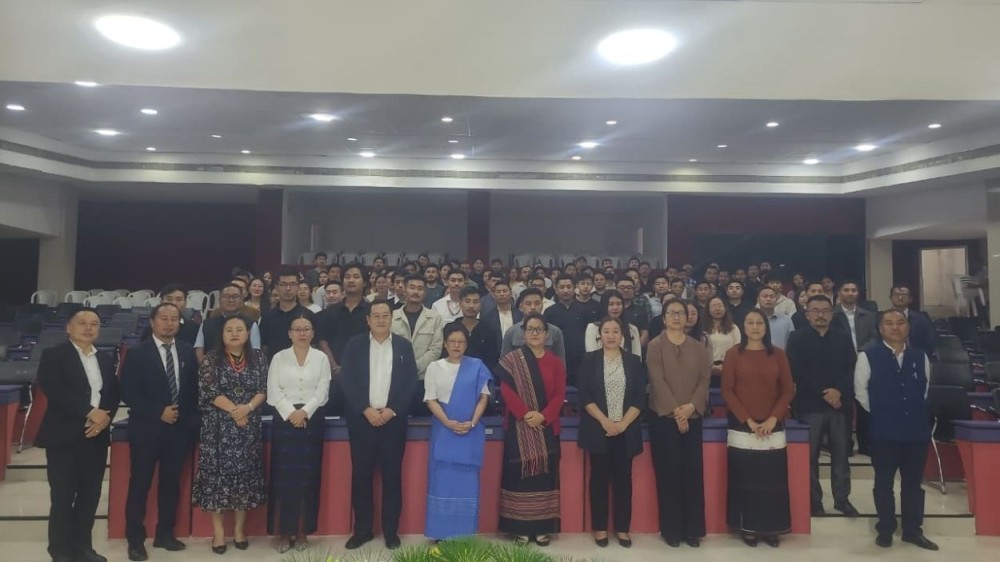
Dignitaries with participants of the state level observance of World No Tobacco Day- cum- Sensitization of Youth Ministry leaders in Kohima on May 31. (Morung Photo)
Focus on addressing growing problem of nicotine, tobacco addiction
Our Correspondent
Kohima/Dimapur | May 31
Through the state level observance of World No Tobacco Day cum Sensitization of Youth Ministry leaders here today, Nagaland today focused on addressing the growing problem of nicotine and tobacco addiction among young people and strengthening community participation in tobacco control efforts.
The programme was organised by the Department of Health & Family Welfare, Government of Nagaland, through the State Tobacco Control Cell, National Tobacco Control programme Nagaland under the theme- “Unmasking the Appeal: Countering Nicotine and Tobacco Addiction” at the Capital Convention Centre, Kohima.
Speaking on the occasion as the special guest, S. Tainiu Secretary, Health & Family Welfare, Nagaland, said that tobacco control in Nagaland is moving beyond awareness programmes and becoming a stronger administrative and enforcement effort.
She said that tobacco and nicotine market today is no longer just about old-fashioned cigarettes, bidis and pan masala containing zarda.
She said that public health departments now have to fight against aggressive online advertisements, hidden marketing on social media, colorful and high-tech product designs like e-cigarettes and vapes, and clever tactics designed by companies “to break our laws and target our young children.”
Tainiu said that the voice and influence from churches and youth ministries can make sure that “our neighborhoods stay alert against illegal shops and predatory marketing aimed at minors.”
“With strong law enforcement, teamwork across departments, and unified leadership from our faith- based organization leaders, we will secure a healthy, tobacco-free future for the youth of Nagaland,” she added.
Increasing use of tobacco products in Nagaland
Dr Mereninla Senlem, Principal Director, Department of Health & Family Welfare, shared concerns over the increasing use of tobacco products among both youth and adults in the state.
She also highlighted the rising number of oral cancer cases linked to smokeless tobacco products and called upon church leaders and youth ministries to actively support tobacco prevention efforts within their communities.
She said that tobacco is the number one cause of early deaths and in India alone, nearly 1.35 million people lose their lives every single year because of diseases caused by tobacco.
“The damage to health is terrible. In the Health Department, we see every day how tobacco ruins almost every organ in the human body. It is the direct cause behind our high numbers of oral cancers, heart attacks, brain strokes, and severe lung diseases,” she said.
In North East region, the habit of using smokeless tobacco, like gutkha and paan masala, is the single biggest reason why so many of our people develop painful oral cancers and pre-cancerous sores in their mouths, she said.
Dr. Senlem said that the department of Health & Family Welfare have set up Tobacco Cessation Centres in District Hospitals and at CIHSR. These centers give free counseling and Nicotine Replacement Therapy, like nicotine gums, to help people handle withdrawal.
‘Work as one team to fight tobacco’
Dr. Keveduyi Theyo, Mission Director, National Health Mission, stated that faith-based youth groups and community organisations can play an important role in guiding young people towards healthier choices and positive lifestyles.
“For a very long time, people thought that fighting tobacco was only a job for doctors, nurses, and hospitals. But today, the ways young people get addicted to nicotine are changing fast. Because of this, we must look outside our hospital walls,” Dr. Theyo said.
He stressed on the need to bring different groups of people together to fight this problem as one team.
Under the NHM, the National Tobacco Control Programme is working every day in all the districts of Nagaland, he said adding that the district team visit schools and train the enforcement officers to make sure that the schools and communities follow the Tobacco-Free guidelines prescribed by MoHFW.
Stating that the church and its youth wings have a deep connection with the people in Nagaland, he said “You have the power to change habits, challenge peer pressure, and teach our youth to choose a healthy life.”
Protect children and youth
Talking on the theme “Unmasking the appeal- countering nicotine and tobacco addiction,” Dr. I. Simon Sumi, State Nodal Officer, National Tobacco Control Programme, highlighted the growing influence of nicotine and tobacco products among youth and increasing novel products being made available.
Dr. Simon said that this year’s theme highlights how tobacco and nicotine companies continue to target children and young people through attractive and misleading products such as e-cigarettes, nicotine pouches, and synthetic nicotine devices.
Stating that tobacco industry constantly changes its marketing strategies to attract new users, he said “Many youngsters are influenced by the false belief that these products are safe or healthier than cigarettes. However, these products still contain nicotine, which is highly addictive and harmful to health.”
He said that as per the Prohibition of Electronic Cigarettes (production, manufacture, import, export, transport, sale, distribution, storage and advertisement) act, 2019 also known as PECA 2019, the Government of India has completely banned the production, manufacture, import, export, transport, sale, distribution, storage, and advertisement of electronic cigarettes and similar vaping devices in India.
He said that the 2026 campaign calls for stronger action to protect children and youth from tobacco and nicotine addiction, adding that it encourages stricter regulation of flavours, advertising, promotion, packaging, and digital marketing of nicotine products.
Shift from isolated to integrated approach
Dr. I.Arenla Walling, Director (Dental), Department of Health & Family Welfare emphasized on the changing trends and challenges in tobacco control over the years.
“We recognize that tobacco control is not only a health issue, but also a social, moral and community responsibility. In this regard, the influence and leadership of the church are extremely important,” she said.
Having spent many years in the field of tobacco control initiative in Nagaland, Dr. Walling said that she witnessed the landscape of tobacco control shifting from isolated to integrated approach.
“Over the years, through the guidance of MOHFW, participation of NGOs we were able to establish certain key policy initiatives, tobacco cessation centres and tobacco free community initiatives,” she said.
The technical presentation on the theme was made by Dr. Lovika P. Shikhu, Assistant Professor, Department of Psychology, Nagaland University.
Tokivi P. Swu shared his success journey towards healing, inspiring the youth to stay away from addictive harms.
The programme was chaired by Dr. Neiphrezo Sorüno, Dental surgeon, NHAK while Bideno Kikon, Secretary, Christian Education NBCC invoked God’s blessings.
Vote of thanks was proposed by Dr. Reyosalu Lase, Additional Director (Dental), Department of Health & Family Welfare.
The programme concluded with an anti-tobacco pledge and a joint discussion on strengthening community-based tobacco control initiatives across the districts of Nagaland.
In Zunheboto, Retainer Lawyer Easter H Yepthomi highlighted key provisions of the COTPA Act, 2003, including restrictions on smoking in public places, tobacco advertising, and the sale of tobacco products to minors and near educational institutions, while urging greater community involvement in protecting youth from nicotine addiction.
In Dimapur, NTCP observed World No Tobacco Day at St. John Higher Secondary Residential School, where speakers highlighted the addictive nature of nicotine, the health risks of tobacco use, and the need for collective efforts to combat tobacco addiction.
The Lions Club of Dimapur Elite organised a youth awareness programme and oratory competition at Pilgrim Higher Secondary School, with students learning about the dangers of tobacco and substance abuse and the importance of healthy lifestyles.
In Peren, the PDLSA and NTCP conducted awareness programmes at the College of Veterinary Science and Animal Husbandry, Jalukie, and Jalukie Town Local Baptist Church, focusing on tobacco control laws and the theme of countering nicotine and tobacco addiction.
In Wokha, speakers at a programme organised by the District Tobacco Control Cell highlighted tobacco industry marketing tactics, the health consequences of tobacco use, and ongoing efforts to prevent tobacco consumption, while Bethsaida School was declared a Tobacco Free Educational Institution.
In Mon, Dr. S. Ngampa Sangme, MD, PMR, District Hospital Mon highlighted how tobacco and nicotine products are often made appealing through attractive packaging, flavours, advertisements and peer influence, creating a false impression that they are harmless or fashionable. He noted that tobacco products contain addictive substances linked to cancer, heart disease, lung diseases and oral health complications.