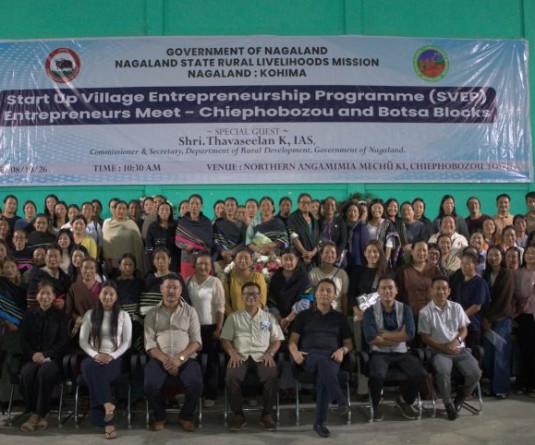
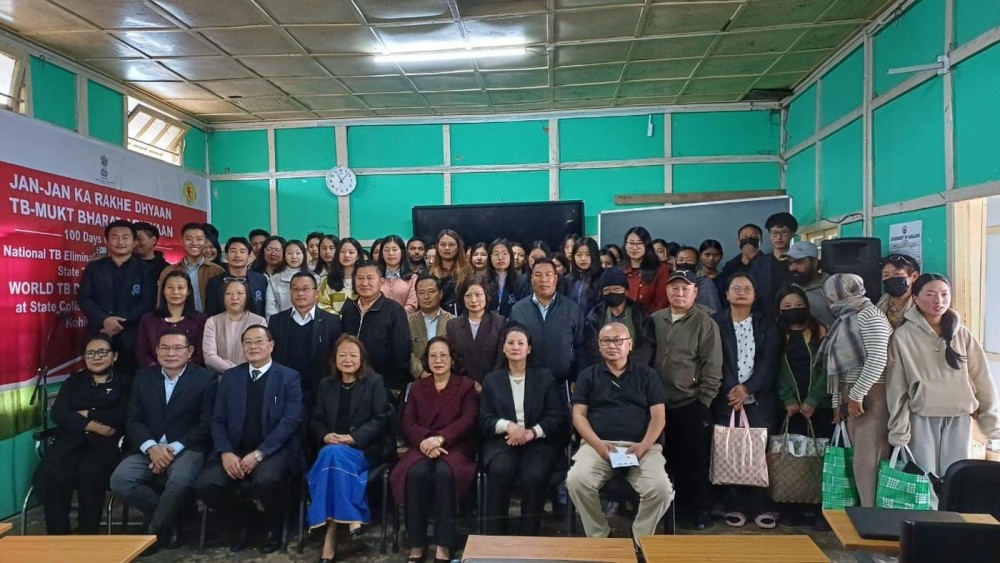
Dignitaries and others during the observance of World Tuberculosis Day 2026 in Kohima. (Morung Photo)
Our Correspondent
Kohima | March 24
The National Tuberculosis Elimination Programme (NTEP), under the Directorate of Health & Family Welfare, Nagaland, observed World Tuberculosis Day 2026 on Tuesday at the State College of Teacher Education in Kohima.
Held under the theme, “Yes! We Can End TB: Lead, Empower, Deliver,” the gathering renewed its pledge to work collectively toward a TB-free society, aligning with India’s goal of eliminating the disease. The event reaffirmed the commitment to ending tuberculosis through awareness, early detection, political will, and community participation.
State TB Officer Dr Akum Jamir highlighted the ongoing efforts under NTEP and underscored the importance of early diagnosis and treatment adherence in combating tuberculosis. Noting that TB remains a major public health concern, he emphasised, “it is curable with timely and proper medical intervention.” India has committed to ending TB by 2030, in line with the global Sustainable Development Goals (SDG) target, he added.
Dr Jamir recalled that the Prime Minister had launched the TB Free India campaign at the Delhi End TB Summit on March 13, 2018, calling for a social movement focused on patient-centric and holistic care through integrated actions. Achieving the End TB targets requires a multi-sectoral collaborative effort, he asserted.
“Government stewardship backed by bold policies and supportive systems, along with innovative and current approaches to integrated, patient-centred care and prevention are essential,” Dr Jamir said. He noted, “a strong coalition of civil society and communities in owning the programme would contribute significantly to bending the curve.”
End TB to strengthen health security
Tuberculosis remains one of the world’s deadliest infectious diseases, with progress hampered by funding gaps and uneven global efforts, said Dr Swuduvelu, Medical Officer, on World TB Day 2026.
Stressing the need to strengthen grassroots awareness and patient support systems, she called for turning global commitments into action. “Over decades, the world has made repeated commitments to end TB. Yet progress remains uneven across countries and increasingly challenged by funding gaps and global uncertainty,” she said.
Dr Swuduvelu emphasised that investing in TB is a strategic political and economic decision. “With sustained political will and committed financing, countries can strengthen health systems and turn the tide on ending TB,” she added.
She noted that the disease is driven by social, economic, and structural inequities, disproportionately affecting the poorest and most vulnerable. Ending TB requires coordinated multisectoral action backed by strong accountability mechanisms, she said.
Integrated primary health centre-level TB services must be accessible, affordable, stigma-free, and community driven, Dr Swuduvelu said, adding that engaging civil society and those affected by TB ensures policies truly meet people’s needs.
“Let us turn the tide on the world’s deadliest infectious disease and ensure a TB-free future for all,” she added.
Detect, Treat, Prevent and Build
Nagaland Mission Director Dr Keveduyi Theyo on Tuesday stressed the need for collective responsibility and community-driven efforts to achieve TB elimination targets.
Speaking on the National TB Elimination Programme (NTEP), he said the goal is to achieve a rapid decline in TB incidence and mortality through four key approaches, Detect, Treat, Prevent and Build.
He informed that the state has expanded molecular diagnostics, including CBNAAT and Truenat machines, to nearly every health block. Ultra-portable handheld X-ray machines are now available in all districts. Free treatment is being provided for both drug-sensitive and drug-resistant TB cases, along with nutritional support under the Nikshay Poshan Yojana.
Dr Theyo noted that under the TB Mukt Bharat Abhiyaan, India has registered a 21% decline in TB incidence since 2015, more than double the global average.
He reiterated that the 2026 campaign is focused on the final push toward India’s goal of eliminating TB by 2025-26, five years ahead of the global target of 2030.
A major highlight for 2026 is the 100 Day National TB Elimination campaign, a stratified strategy aimed at identifying ‘missing’ TB cases, reducing mortality, and preventing new infections through accelerated action.
A testimony shared by a TB survivor highlighted the importance of timely treatment and social support. The programme was chaired by Thungchanbeni M Humtsoe, State IEC Officer, while the welcome address was delivered by Dr Runi Nakro, Vice-Principal of SCTE-K. The vote of thanks was proposed by Dr Apichetla Amer, Assistant Programme Officer. Later, IEC materials were distributed to promote public awareness.