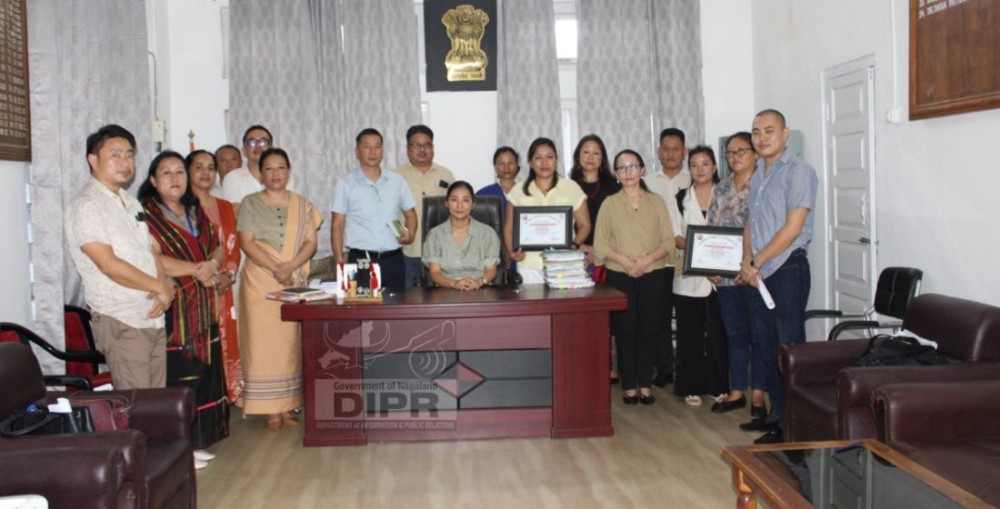
ADC Dr Diana Patton, along with other officials during the DLCC meeting held at the ADC’s office chamber in Dimapur on August 6. (DIPR Photo)
Dimapur, August 6 (MExN): The District Level Coordination Committee (DLCC) of the National Tobacco Control Programme (NTCP) on Thursday reviewed the implementation of tobacco control measures in Dimapur district, with officials calling for stronger enforcement of the Cigarettes and Other Tobacco Products (COTPA) Act, 2003, and greater community participation.
The meeting, held at the office chamber of the Additional Deputy Commissioner, was chaired by Additional Deputy Commissioner Dr Diana Patton and attended by representatives of government departments, educational institutions, law enforcement agencies and civil society organisations.
Welcoming newly inducted members, Dr Patton highlighted the important role of women and civil society organisations in strengthening tobacco control initiatives.
She said women play a key role in addressing social issues at the grassroots level and stressed that Nagaland's community-based social structure requires active participation of civil society organisations for the success of tobacco control programmes.
She urged civil society organisations to include awareness programmes on the COTPA Act, 2003, in schools as well as communities and villages. While the government has constituted enforcement squads to implement tobacco control laws, their effectiveness depends on public cooperation, she said, adding that all stakeholders must work together to build a tobacco-free society.
District Nodal Officer, NTCP, Dr Esther Chophy called for stronger enforcement and greater administrative support to improve implementation of tobacco control measures across the district.
Presenting the district's tobacco control status, she said sustained awareness campaigns, enforcement drives and community participation have contributed to a decline in tobacco use in Nagaland.
Citing findings of the Global Adult Tobacco Survey (GATS), she said overall tobacco use in the state declined from 56.8 per cent in 2009-10 to 43.3 per cent in 2016-17. Smoking prevalence dropped from 31.5 per cent to 13.2 per cent during the same period, while smokeless tobacco use fell from 45.3 per cent to 39 per cent.
Dr Chophy outlined key provisions of the COTPA Act, including the ban on smoking in public places, prohibition on the sale of tobacco products to or by minors, and the restriction on the sale of tobacco products within 100 yards of educational institutions.
She urged schools, parents and communities not to send children to purchase tobacco products and stressed the need for regular enforcement drives involving the police and district administration.
Highlighting resource constraints, Dr Chophy said the programme receives only Rs10,000 for three months, which she described as insufficient for regular inspections and enforcement activities. She appealed to the district administration for additional financial and logistical support to strengthen tobacco control efforts.
She also informed the committee that 151 educational institutions in Dimapur district—comprising 138 schools and 13 colleges—have been declared tobacco-free under the Tobacco-Free Educational Institutions initiative. In addition, four villages in the district have been declared tobacco-free, reflecting increased participation by educational institutions and communities in tobacco control efforts.
The committee reviewed the implementation of the National Tobacco Control Programme in the district and discussed measures to strengthen enforcement of the COTPA Act through enhanced inter-departmental coordination, greater public awareness on the harmful effects of tobacco use and stricter compliance with tobacco control regulations.