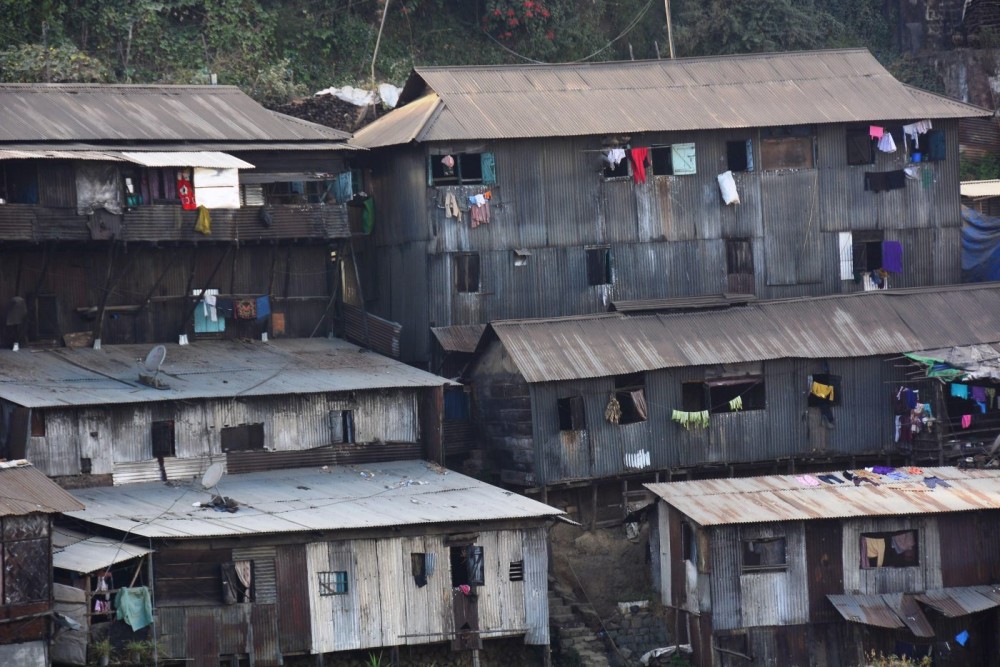
In Nagaland, inherited land creates a ‘pseudo-middle class’, low income, but no housing cost. By disposable income, the real middle class is far smaller. (Morung File Photo: For Representational Only)
Morung Express News
Dimapur | May 16
A sharp income disparity in Nagaland, where the top five% of households earn an average of Rs 71,028 per month against a mere Rs 1,639 earned by the bottom half, has generated discourse, with residents pointing to corruption, unemployment, over-dependence on government jobs, and poor governance as the deeper roots of the crisis.
Responding to The Morung Express weekly public opinion poll, 48% respondents identified the income gap as the primary driver of inequality, an equal number of 48% said it was a symptom of broader structural failures rather than the cause itself. Four per cent respondents disputed the data outright.
The figures, based on the ‘Report on Income Disparity in Nagaland 2025’ released by Department of Economics and Statistics, place the richest 5% earning more than 40 times the income of the poorer half of Nagaland’s population, a disparity that respondents called “alarming” and potentially destabilising.
“The gap between rich and poor is only getting wider and this will create a volatile situation that will create more instability in Naga society,” said one respondent.
Broken system, broken State
Across both camps, political corruption and a broken governance structure emerged as the most frequently cited culprits.
“Corrupt State, Church and Underground as well as nepotism with privileged entitled family members have wreaked this chasm through Naga society. Unless and until it is dismantled from top to bottom, CM to DBs and GBs, it is a free for all and 75% remain disenfranchised,” said one respondent.
Another drew attention to the “salary industry” model, arguing that government departments consume public development funds in salaries for non-performing employees. “Nagaland can only see real development when the present trend of salary industry is converted into a producing industry by financing genuine entrepreneurial youths and farmers,” they said.
Youth unemployment and white-collar preference
Several respondents turned criticism inward, suggesting what they expressed as a deep-seated dislike to manual labour among Naga youth.
“Most of the labourers are earning on average Rs 700 per day, so in a month it comes to Rs 21,000. On average we have around 1,000 labourers working every day, so if we calculate 700 x 1,000 = Rs 7 lakh per day of our Naga money is earned by non-local labourers. Why can’t our so-called unemployed youth earn this money?” asked one respondent.
“Naga people only want easy, fast money-earning jobs and when they don’t get their delusional demands they will go waste parents’ money on alcohol and drugs instead,” another added.
Article 371A, land policy as investment barrier
A systematic issue highlighted by multiple respondents was Nagaland’s land ownership laws under Article 371(A), which restricts outside investment.
“We take Article 371A as a means to protect our land and that is good in one way, but the bad side is that no company can invest in our land, which could possibly bring lots of employment. We must rethink and lease our land for companies which can benefit our people,” said one respondent.
Others called for opening the economy to private players, with one noting, “Only government job, Hornbill Festival and music cannot help, we need industry and big-time private players to help the per capita income of every citizen.”
Education, skilling gaps
Respondents also raised concerns on the failure to reform education and build vocational skills as a long-term driver of economic exclusion.
“While the top five per cent sends their kids to top universities and colleges, the rest cannot even afford basic primary education,” said one respondent, adding that the National Education Policy 2020’s vocational training provisions had not been meaningfully implemented.
Another called for an overhaul of learning itself, “Not everyone is good in studies, so our government and educational institutions should introduce new forms of learning, such as vocational training or professional courses.”
A fragile ‘Pseudo-Middle Class’
One respondent offered a nuanced reading of class in Nagaland, arguing that land ownership creates a misleading impression of economic stability.
“Nagaland has a huge swathe of what I call pseudo-middle class. Ownership of land skews the perception of class because most land has been passed down. You could be making a negligible income but because cost of housing or shelter is a non-issue due to land ownership, mere survival is possible. If we go by disposable income, the middle class shrinks drastically,” they said.
Calls for policy action
Several respondents moved beyond analysis to recommendation, demanding that government prioritise job creation, infrastructure and institutional accountability over relief measures.
“We need jobs and development, not free ration. Free things should be education and health care,” said one respondent.
Another directed pointed criticism at the political class, “The main question should be, what is causing this huge income gap? We cannot continue depending only on public sector jobs or going out of the state in search of opportunities. We must find ways to generate more employment avenues within our own state.”
Summing up a widely held view, one respondent said, “Bridging this divide requires addressing the uneven distribution of public resources and prioritising the developmental needs of long-neglected places, while simultaneously building a private industry that creates pathways for all citizens to thrive.”