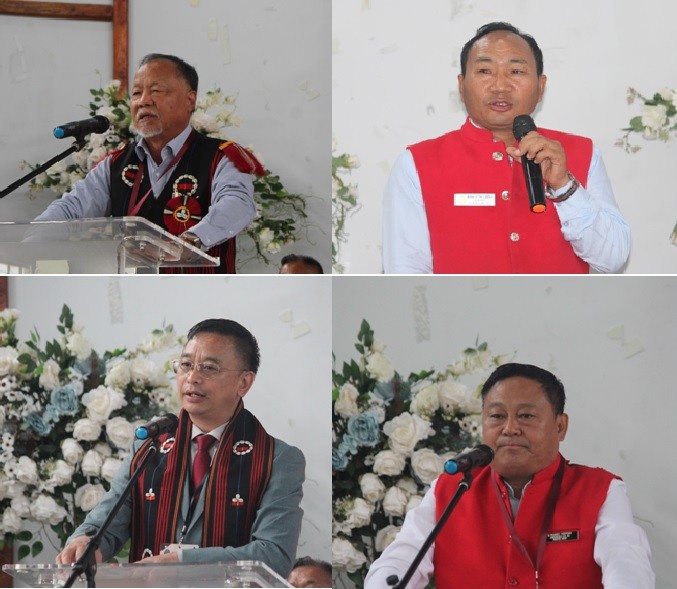
(Clockwise from Top left) MLA Picto Shohe; SKH President, Hetoho S Zhimomi; Nagaland Deputy Speaker S Toiho Yeptho; and President Sümi Hoho Dr Vihuto Asumi address the Baghi Hoho of the The Sümi Kükami Hoho on May 16 in Zunheboto. (Morung Photo)
Morung Express News
Zunheboto | May 16
The Sümi Kükami Hoho (SKH) Baghi Hoho convened at the Multi Purpose Hall, Zunheboto on May 16, bringing together tribal leaders, legislators, village chieftains and community members to deliberate on Sümi customary practices, governance and social reforms.
In his keynote address, Dr Vihuto Asumi President Sümi Hoho said the Sümi community follows a unique hereditary kingship tradition, noting that among Naga tribes, only the Sümi and Konyak continue to maintain such systems.
He clarified that Gaon Buras (GBs) are government-appointed, while hereditary kingship remains a customary institution.
Dr Asumi said the Sümi Hoho works closely with the SKH in decision-making and urged the community not to lose its identity, integrity, and traditional values.
Citing Article 371A and the Nagaland Village and Tribal Council Act 1978, he said these organisations function as statutory bodies under customary law.
He recommended that hereditary chieftains avoid accepting GB titles and instead preserve the traditional system.
He also informed the gathering that documentation of Sümi traditional attires has been completed, and efforts are underway for patenting and Geographical Indication (GI) recognition.
In his welcome address, SKH Advisor, Kashito H Yeptho raised concerns over smart meter installation in Zunheboto district, arguing that the district should not be a testing ground unless the system is implemented uniformly elsewhere.
On vehicles symbols
On the proposed ban on religious symbols and stickers on vehicles, he defended the role of churches and NGOs in addressing societal issues before police or administration intervene, stating such symbols represent identity and service.
He argued, “If such symbols are banned, government and departmental insignias should face similar restrictions,” he added.
He emphasised that the Sümi community follows a hereditary system.
Nagaland Deputy Speaker S Toiho Yeptho clarified the distinction between hereditary kingship and the government-appointed GB system, noting, “GBs are selected periodically in towns while kingship remains hereditary by tradition.”
He spoke on the customary practice of regency, where a wife temporarily assumes leadership after her husband’s death until a rightful male heir matures.
However, he asserted that Sümi customary law has no provision for women to permanently assume kingship roles, and such matters must be understood within traditional customs.
“Leadership is a responsibility, not an opportunity, and emphasised the importance of family and village institutions,” he asserted.
MLA Picto Shohe also noted that the Sümi community possesses a distinct identity “dating back to the British era” and urged the people to revive and preserve those traditions.
“The traditional attire worn today by the GB’s evolved from historical recognition and identity associated with the Sümi tribe,” he remarked.
Earlier, the programme was chaired by SKH President, Hetoho S. Zhimomi. A group song was presented by Lizu New Village led by Nikheshe and Ghovishe while the vote of thanks was delivered by Khehovi Chophy, President of the Western Sümi Kukami Hoho.
The Constitution and Resolution was presented by Kavito Yeptho, General Secretary SKH.