Front row from left, Kenile Thong, Occupational Therapist, Dr Asunu Thong, MS DTCD, Hospital Khuzama, Daniel Thong Seb, VP, SCERT, Beni Seb Chishi, Künri Dimapur, Avono Mekro, AHM JFIS, Keyokhole Ltu Lcho, Admin, JFIS along with the participants. (Photo Courtesy: SCERT Nagaland)
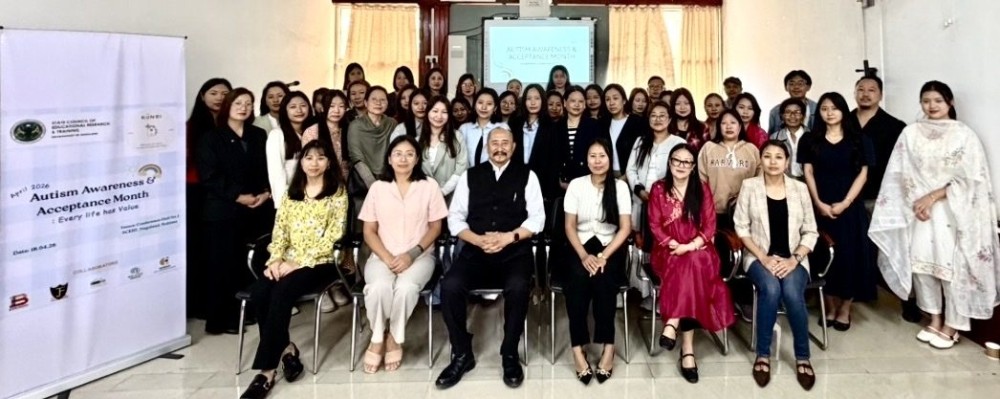
Kohima, April 18 (MExN): As the world observes Autism Awareness and Acceptance Month this April, the State Council of Educational Research and Training (SCERT), Nagaland, in collaboration with Künrin ABA Centre for Autism, Dimapur, and Jo Foundation Inclusive School (JFIS), Kohima, organised a workshop on April 18 on the theme “Understanding Behaviour from a Compassionate Lens: Applied Behaviour Analysis (ABA) and Autism.”
The workshop, held at SCERT, Nagaland, Kohima drew approximately 50 participants from diverse backgrounds, including therapists, special educators, parents, teachers and researchers from various schools and non-governmental organisations, stated a press release received here.
Delivering the keynote address, Daniel Thong Seb, Vice Principal and Head of ICT and Inclusive Education, SCERT, Nagaland, underscored the urgency of such initiatives. “Parents and teachers struggle a lot and if not equipped properly, they grope in the dark without any valid solution,” he said, adding that people under the Autism Spectrum deserve to be respected and not mistreated.
He expressed the department's commitment to collaborating with NGOs to foster a deeper understanding of the behavioural challenges faced by children with special needs, both at home and in schools. He also extended gratitude to SCERT Director Kerüüpfeü Rüpreo for her continued support towards the special education community.
The resource person was Beni Seb Chishi, a Qualified Behaviour Analyst and founder of Künrin, an ABA centre for Autism and developmental delays based in Dimapur. Drawing on over a decade of voluntary social service and professional experience, including specialised training in the United States, Chishi introduced participants to the autism spectrum and its associated symptoms, emphasising that those on the spectrum are frequently misunderstood due to communication difficulties.
“By looking at them from a different lens when they throw a tantrum or create any behavioural problem, the gap becomes less and they also open up for communication,” she said, stressing the need for a compassionate and analytical approach to behavioural intervention.
The session was followed by a lively question-and-answer round in which parents, teachers, and practitioners raised pressing concerns. Responding to a common question, how to handle a child who cries incessantly or throws tantrums, Chishi advised caregivers to pause before reacting. “Ask yourself, is the child doing it to get attention, or is it because of other factors? Once the cause is ruled out, the answer is not far behind,” she said.
The programme concluded with a vote of thanks delivered by Avono Mekro, Assistant House Mother, JFIS.
The workshop underscores the growing recognition in Nagaland of the need for evidence-based, compassionate approaches to supporting individuals on the autism spectrum, and the critical role of inter-institutional collaboration in building an inclusive society.