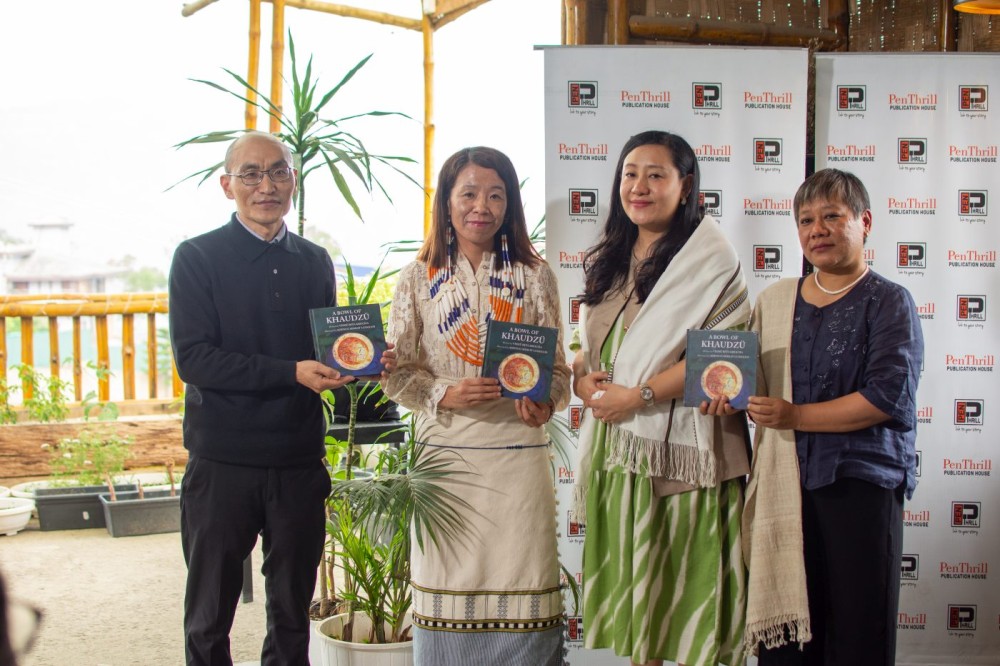
Asalie Lese with author Vishü Rita Krocha, illustrator Adenuo Shirat Luikham and Dr Vizovono Elizabeth during the launching of the book ‘A bowl of Khaudzü’ on April 18 at Kohima. (PC Jabu Krocha)
Morung Express News
Kohima | April 18
Kohima witnessed a heartfelt literary gathering as ‘A Bowl of Khaudzü’ a collaborative work by writer, author and publisher, Vishü Rita Krocha and illustrator Adenuo Shirat Luikham was launched, bringing together food, memory and storytelling in a deeply personal way.
Officially launching the book on April 18 at The Local Harvest, Kohima, Deputy Secretary, Asalie Lese remarked that the book goes far beyond narrating a traditional dish, describing it as a meaningful effort to preserve and carry forward Naga culture and lived experiences.
Lese said that while the book centres on a specific food item, it reflects much deeper layers of life. “It is not just about the dish,” he noted, adding that within its pages are stories of family relationships, as well as glimpses of the social and economic life of a community. “It shows why and how people in a particular culture do things in certain ways,” he said, appreciating the book’s ability to capture these nuances.
Stressing on the importance of documentation in keeping traditions alive, Lese said, culture cannot sustain itself unless it is recorded and passed on to future generations. Congratulating the author and the team behind the book, he expressed happiness at seeing such efforts take shape.
Lese also pointed out that Naga culture is often narrowly represented through visible symbols like traditional weapons and attire. “Our culture is not limited to the dao, the spear, or the shawls we wear during festivals,” he said. “It is also in the language we speak, the food we eat, and the way we relate to one another.”
Drawing a comparison with popular global literature such as comics and children’s stories, he observed that while such works have their place, there is a growing need for more local stories that people can instantly relate to. He encouraged writers to explore everyday experiences from village life and festivals to traffic, food habits, and social realities as potential stories worth telling.
Love, served in a bowl
Sharing her reflections on the book, Dr Vizovono Elizabeth, Independent Editor and Researcher described it as more than just a piece of writing, calling it “a beautiful work of art” that captures the essence of love as expressed through food in Naga culture.
Dr Elizabeth spoke about how the book resonated with lived experiences, how, in Naga society, love is often not expressed in words but through acts of care especially through food, adding that the book gently reminds readers of this unspoken cultural truth.
Despite its brief length of just 19 pages, she said the book is layered with emotion and imagery following the narrator’s memories of spending summers with her grandmother working in the fields, sharing meals, and bonding over stories centered around Khaudzü, a traditional dish.
She appreciated the author’s decision to retain local names of ingredients without translation, calling it an important step in preserving indigenous language and identity.
The collaboration with illustrator Adenuo, she added, enhances the experience significantly. The visuals, she described, are vivid and evocative, allowing readers to almost “see, smell and taste” the dish, while deepening the emotional connection to the story. She also underlined the importance of passing such stories forward, especially at a time when traditional knowledge and practices are slowly fading.
The healing bowl
Speaking at the event, author Krocha shared that the book had been years in the making. She said her love for the dish deepened over time as she began to understand the stories and cultural values embedded in traditional food.
Recalling moments from her childhood, Krocha spoke about rainy days and Sundays in Kohima, when families would gather to cook and share Khaudzü, creating memories of warmth and belonging.
She expressed concern that many traditional foods are disappearing from everyday life, with younger generations often unfamiliar with dishes that once held cultural significance.
“This book is not just about a recipe,” she said. “It is about preserving memory, identity and the stories that come with our food.”
She also highlighted how Khaudzü was traditionally associated with care and healing prepared for the sick or even offered to grieving families in times of loss.
Krocha credited Luikham for bringing the story to life through her illustrations, describing her work as “magical” and transformative. She also thanked her family, friends, and the literary community for their support, as well as those who participated in the event.
The book, which marks PenThrill’s 120th publication, is a tribute to ancestral knowledge and a call to reconnect with cultural roots. As the author expressed, she hopes it inspires readers especially younger generations to rediscover traditional foods and the stories that define who they are.