Reviews by Esther Syiem
Professor (Retired), Dept. of English, NEHU, Shillong
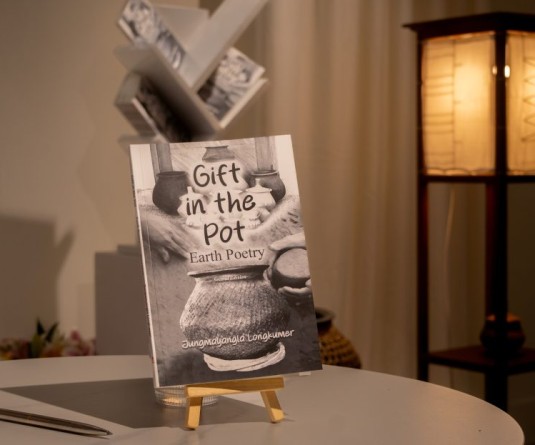
There is starkness about the poems in Gift in The Pot Earth Poetry by Jungmayangla Longkumer (2014). Photographic images on one side of the book create verbal resonances within the poems on the right. The vignettes are juxtaposed to each other and tell their stories through thirty poems. These are the women potters of Changki, Longjemdang and Japu villages of the Mokokchung District in Nagaland.
Jungmayangla Longkumer or Ayang, as she is better known to me is also a trained sociologist who works as Professor in the Department of Agricultural Extension Education, SAS, Nagaland University, Medziphema Campus. Her earlier book Pottery: Earth Stories (Dimapur: NEZCC 2010) documents the women potters of a few villages in Nagaland. In order to better appreciate the recent collection of poems by her, one would have to understand that her association with these women potters goes far beyond the confines of the strictly academic or the purely scientific. She has allowed them to touch her in a way that reaches beyond her present status and their present circumstances, to enable her to meet them in that poetic space where in her “grateful soul” they “live on”.
So do they inspire her in the first poem “Inspiration” which is dedicated to a grandmother “Azao” who is also her muse and the muse of all such earthy creations. The photograph on the left focuses strongly upon a woman with competent hands and strong feet, able to walk the distance to fetch the clay that will give shape to her pots. And as one turns on to the next page one is warmed by the curing fires of the potter’s hearth; “moulding the essence of our being”, says the poet as she finds a place for herself in the company of women, at ease with one another; defined by their roles as mothers, sisters, aunts, friends, grandmothers; bound to each other and to the poet, through the earthy dimensions of baking pots: “ Allow me to sculpt you / And feel your silkiness/ Against my roughened hands”.
The journey continues, as do the stories that unravel to the earthy essence of pot-making. There is functionality about the women whose elements are of clay and earth itself. Their wisdom is reflected in an attitude of willing submission that serves none of the chimerical godsof the present age.“I am the master. I am the servant”, says the woman whose “soul” is “consumed” by her “craft” and who asks Earth to “accept” her “unconditional love” in a narrative of unconditional giving that speaks of a relationship fostered with assiduous patience and care.
Historically, women such as these who are the “backbone/That sustains the ancestry / So prized and coveted” have struggled on for generations without expectations of any kind. It is in being able to give words to their craft that the poet facilitates, in visual images and poetic metaphors, a public viewing of the deservingness of women such as these. They are ordinary; yet extraordinary in their dedication to a craft that is surely dying out. The poems inscribe incredible moments of pot making that connects with a distant past:
Words cannot always convey/Language cannot encompass/All that is in our souls
But we can lose ourselves/ In the warm, healing earth/Defining our essence
…For a while we are young again
The public and private, the personal and extra personal, the physical and metaphysical, the mundane and mystical, shape the realities of women who see beyond the “putty” in their hands into “The miracle/Of the living earth” The essence of these poems is a kind of visionary perception that is Blakean in spirit and that sees “a world” in a “Grain of Sand” and “Heaven in a Wild Flower” (Auguries of Innocence).
Their lyricism springs from the tension between celebration and introspection. And the journey that the poet has chosen to undertake brings her close home to the hearts of the women whose histories are “etched” in the “fineness” of their “craft”, in the “whiteness” of their hair, the “stoop” of their shoulders, the “gnarls” in their hands, the “deep lines” in their skin that chronicle the narratives
like the flowing river never still, never faltering, never giving up.
For the poet, discovery is identity. Her own journey follows the trajectory of an earthen pot, circular and cyclical. It takes her back to herself, back to her grandmother, back to the earth and to the source of all being.
The dynamic of work and play, and human exchanges that takes place within the poems, interrogates everything else that is not consonant with it. The poems are not fragments. If at all they shed light on a society that has lived close to nature. In a patriarchal structure these women are committed to the feminist values that have withstood the toughest test. Their strength lies in their commitment to earth, to nature itself. That society must emulate their spirit, is, it would seem the understated truth. In their inclusiveness lies their strength.
The photographs on the left are the black and white etchings of a photographer, none other than the poet’s husband, Temjenmenba, whose keen eye captures the inner sense of an “earth poetry” embedded deep within the psyche of women whose communitarian sense of pot making is art in a truly shared sense. The black and white images profile women who contribute towards a sense of living history; women, unselfconsciously female and free.
The collection of poems is an important addition to the creative writing that has been coming out of Nagaland. They speak of a dimension that has rarely been spoken of in the face of vast political turmoil in the past. Paradoxically it is the poet’s training as a sociologist that gives her poems poetic clarity as each work-as-art related detail is recounted, retold and reinvented with the thoroughness of a skilled observer. Her poetic simplicity matches the simplicity of women whose vision conquers the complex and unduly complicated. The pots are an extension of them. They are not by any means empty. They contain within them the souls of the women potters of Changki, Longjemdang and Japu villages of the Mokokchung District in Nagaland.