Book review by Inakali Assumi
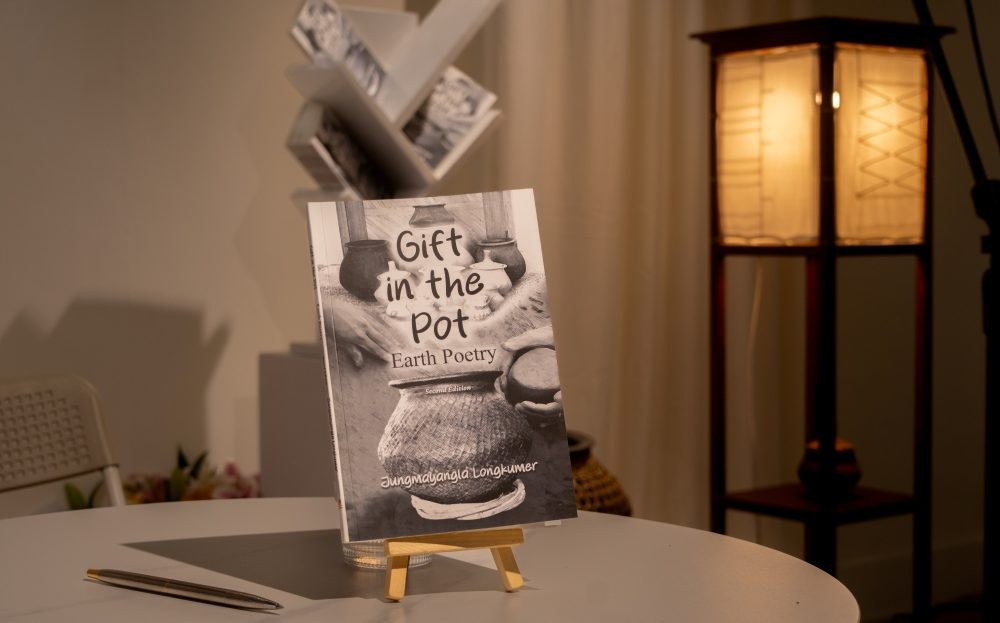
Gift in the Pot: Earth Poetry begins with the warmth of the poet’s love for her grandmother, while also depicting the inheritance of an art that sustained life for ages. In a society where men inherit the hills and the lands, Gift in the Pot: Earth Poetry brings a narrative of an inheritance that surpasses the material possessions. The book tells stories through poetry, about women of Changki, Longjemdang, and Japu villages of the Mokokchung district in Nagaland, who had been inheriting the art of pottery from their mothers and grandmothers, an inheritance that made them self-reliant and independent, an inheritance that solely belongs to them.
The book skillfully elaborates the labor that goes into the making of earthen pots that may deceivingly appear, “unassuming, plain, simple”, but only a pot maker knows how those pots were born out of labouring hands that molded each pot with patience and persistence. It voices for the nourishing hands that had preserved a vulnerable, almost dying heritage.
The book entails stories of women whose gifted hands, for generations, have shaped thousands of pots and sustained families and contributed to the social economy. The book is a song of the pot makers sung through the voice of the poet who shares an affinity with them.
The most beautiful thing about this book is the way it carries the history of women inheriting art, or the gift of art, just as the poet herself has inherited the gift of writing. Another notable thing about the book is that the process of pottery is not told in the monotonous prosaic way, but through verses and images:
The “Joy” of pottery is thus expressed as;
Earth and water pliant in her hands/ Muddied fingers teasing, playful/ Splashing sprays of sludge/ Catching the sun dangling on shimmering rays/ Grandma humming as her gleeful fingers waltzes.
Ursula K. Le Guin writes, “Before the weapon that cuts or the spear that throws, there was the vessel: the holder of space, the container of generations. To pass on the craft of the pot is to pass down the very first technology of holding the life together.” The pot makers of Changki, Longjemdang, and Japu have been passing down a knowledge system through bodily memory, hands that remember how every clay must be curved and shaped, and fingers that remember the rhythm of the clay. This is a remarkable technology that existed long before written records or intuitional archives, wherein women crafted history of survival and resilience through the art of pottery. It is in this art that we find the greatest gift of nature, the gift of earth; the earth that always sustains and provides, and teaches.
The book ends on a poignant note leaving the readers to reflect and rethink on the vanishing art of pottery as the poet writes in the poem “Sadness”
Mournfully great-grandma said/ our tradition of pottery/ will go back to where I am going/ back to the earth.
There’s a sense of loss in this poem as the decaying voice mourns the future of pottery, an art that once was vibrant but its future seems uncertain.
In “Requiem,” the poet writes, I was just seventeen when I was married off/ this is the last of the 12 pots my mother made/ to take with me to my new home/ I can’t help but smile when I touch this/ for I feel my mother’s love/ and I am 91/ but this pot is just like me.
The poet through this book leaves an inheritance in the hands of each reader, for us to revisit the potters who kept this art alive, the potters who have passed on this inheritance in the hope that there won’t be a day where we will have to send off the last potter to where all the ancient pot makers now dwell.