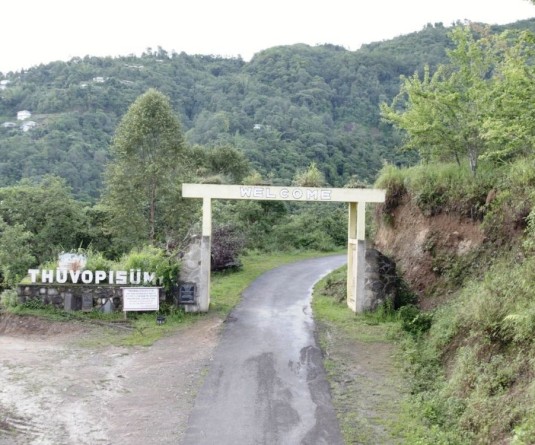
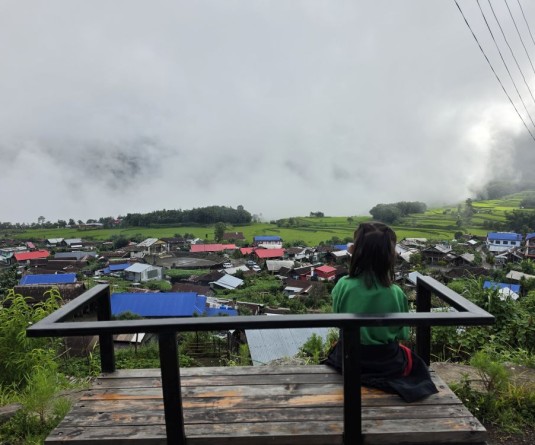
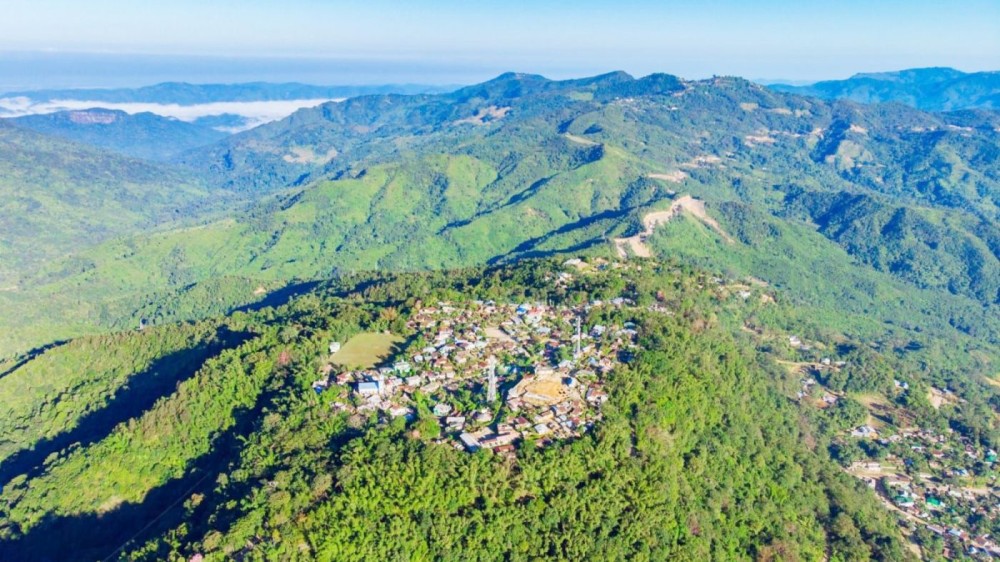
A bird’s-eye view of Tseminyu, where ‘Forest Futures,’ a project by the Kenono Foundation, is underway and aims to promote community-led conservation and sustainable livelihoods. (Photo Courtesy: Kenono Foundation)
‘Forest Futures’ project targets degraded jhum landscapes
Morung Express News
Tseminyu | March 22
Forests are central to both ecological balance and human survival. Yet, as global conversations around deforestation and climate change intensify, the question remains: What does forest conservation look like in places like Nagaland?
In Nagaland, the answer lies not in distant policies but in community stewardship. One such initiative is the Kenono Foundation in Tseminyu district. The Kenono Foundation is a nonprofit organization dedicated to conserving forest biodiversity while improving the livelihoods of indigenous communities. Rooted in a community-first approach, the foundation works closely with village councils and local institutions to strengthen Community Conserved Areas (CCAs), promote sustainable land-use practices, and develop green enterprises such as coffee value chains and ecotourism.
With its vision of creating “an equitable quality of life in harmony with nature,” the organization represents a growing movement in Nagaland that links conservation with community empowerment and long-term sustainability.
One of their foremost restoration initiatives is the “Forest Futures” project. Launched in 2025, it marks a key intervention by the Kenono Foundation in the Tseminyu district, where local indigenous communities are at the center of implementation.
“The project focuses on transforming fallow and degraded jhum landscapes into productive agroforestry systems while strengthening ecological connectivity. So far, the team has mapped potential areas for plantation with the aim of creating biodiversity corridors that connect existing CCAs, thereby enhancing landscape-level conservation in the Tseminyu district,” said Ruchinilo Kemp, Chief Executive, Kenono Foundation.
He said that afforestation activities are set to begin during the upcoming monsoon in 16 villages in Tseminyu district, with an emphasis on planting native species. “The long-term benefit of the project will be to restore major forest landscape, which was earlier deforested majorly through logging, and increase the overall fauna species biodiversity through local species plantation; this will also introduce keystone species for better wildlife food source ecology,” he added.
When asked how the idea came about for the project, Kemp answered that the idea for the initiative emerged from interaction with local communities, who expressed a strong interest in conservation but lacked practical models that could simultaneously meet ecological and economic needs.
The project also addresses the economic realities of rural communities. By integrating crops such as coffee within agroforestry systems, the project seeks to create sustainable income opportunities directly linked to the land. This approach ensures that conservation is not seen as a restriction but as a viable pathway for long-term livelihood security.
“In many villages, people are interested in conservation, but they also depend on the same land for their livelihoods,” he said. “The challenge is to develop models that can address both ecological restoration and economic needs.”
According to him, agroforestry offers a practical pathway in this regard. By integrating tree plantation with crops, the approach allows communities to restore degraded lands while maintaining productivity. “This is not about replacing existing systems, but about improving them in a way that benefits both people and the environment,” Kemp said.
The Kenono Foundation already has a coffee initiative in Tseminyu district, which aims to develop coffee farming in the region through collective farming practices, market linkages, and product development. “We help farmers in the entire coffee value chain, from planting to marketing. We provide extensive farmer training, cultivation support, quality improvement, and market linkage strategies, ensuring sustainable agricultural practices and premium quality coffee production,” the chief executive added.
According to him, this move towards agricultural diversification and local economic empowerment is already showing results, benefiting over 200 farmers and supporting the plantation of more than 3.8 lakh plants, an encouraging sign of its potential as a primary cash crop.
Apart from the “Forest Futures” project, the Kenono Foundation has its for-profit social enterprise venture Zunpha MPCS Ltd., which is employing over 47 people with an annual turnover of over 2.2 crore INR and engaging the people in other livelihood-oriented initiatives such as Kenono garments, the Zunpha Poultry Unit, the Zunpha Carpentry Unit, Artifex Ka- printing and designing unit, and the Biodiversity Education Experience Centre. Kemp said these efforts are designed to complement conservation work by creating sustainable income opportunities, thereby reducing pressure on forest resources.
Kuchinilo Kemp pointed out that one of the key challenges lies in addressing common perceptions around conservation. “One of the biggest misconceptions is that the common people think there will be a project and we will get money through conservation. Kemp said. “In reality, conservation is a long-term investment in both nature and people.”
He added that the model being implemented places emphasis on patience, community ownership, and sustained engagement. Looking ahead, Kemp observed that similar models could be replicated in other parts of Nagaland and beyond, provided there is adequate support and collaboration.
“There is strong potential to scale up, but it will require partnerships between community-based organizations, NGOs, and government agencies,” he said. “At the same time, it is important to ensure that indigenous peoples and local communities remain at the center of decision-making and implementation.”