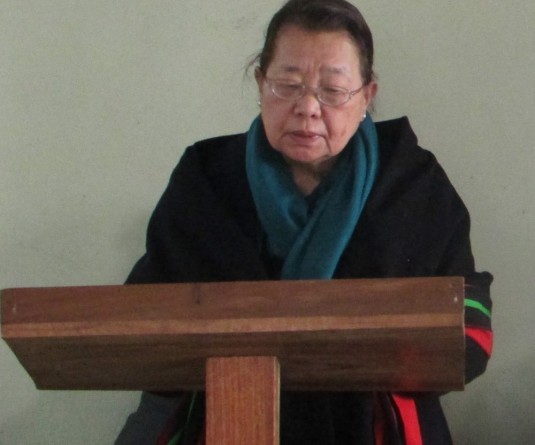
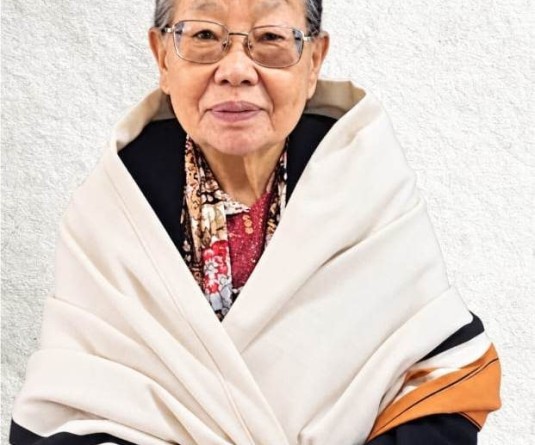
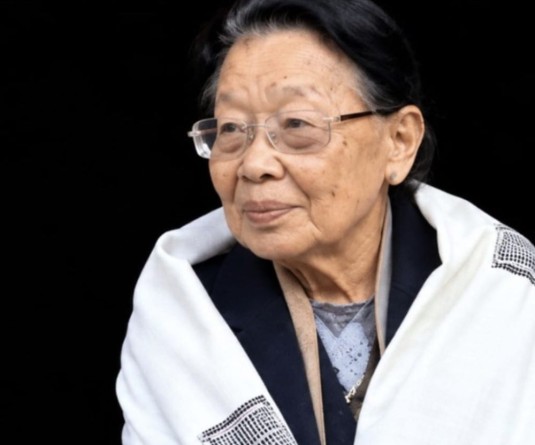
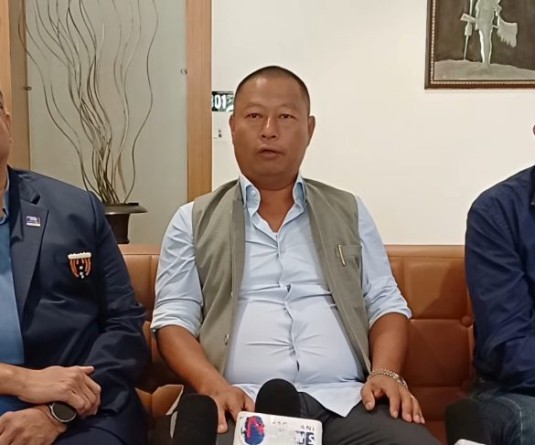
NEZCC Director Alobo Naga with Commissioner & Secretary, Art & Culture, Bodeno S Colo, and officials during the Living Morung Initiative Programme at State Academy Hall, Kohima, on August 19. (Morung Photo)
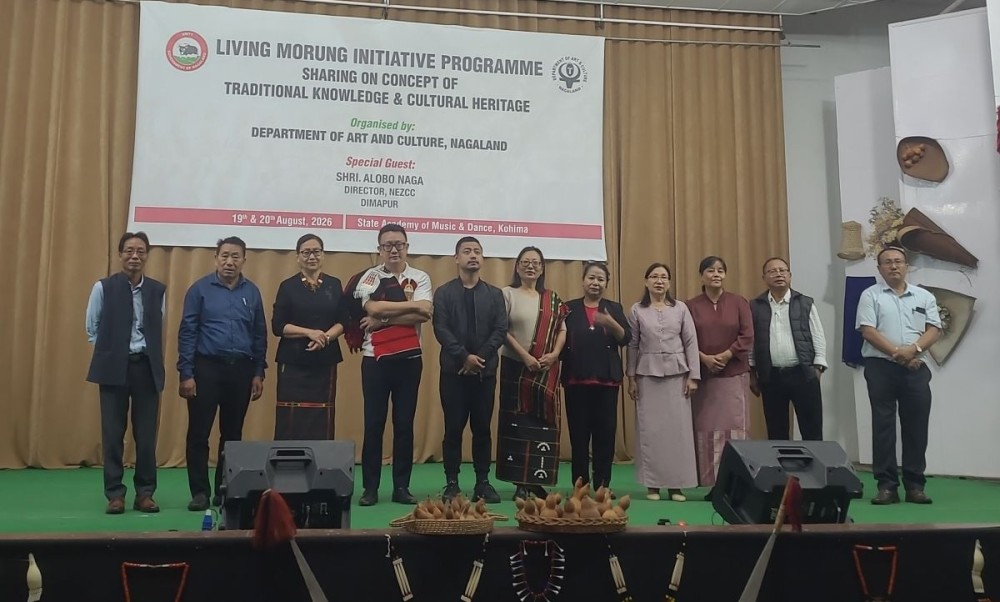
Living Morung seeks to bridge Naga tradition and modernity
Our Correspondent
Kohima | August 19
Students from various educational institutions across Kohima on Wednesday experienced Naga cultural heritage at the Living Morung Initiative Programme organised by the Department of Art & Culture, Nagaland, at the State Academy Hall in Kohima.
The programme, held under the theme “Sharing on Concept of Traditional Knowledge & Cultural Heritage,” focused on traditional knowledge, cultural practices and the importance of passing them on to younger generations.
Addressing the inaugural programme, Alobo Naga, Director, North East Zone Cultural Centre (NEZCC), Dimapur, said culture was not something that should simply be preserved but something that must be kept alive.
“As the Director of NEZCC, I have a greater responsibility to look at culture not only as heritage, but also as an opportunity for learning, empowerment and connection,” he said.
Drawing parallels with the traditional morung, Alobo said it was historically a place of learning where elders passed knowledge, stories, songs, skills and values to younger generations.
“That spirit is still relevant today,” he said, adding that traditional songs, dances, crafts, weaving, languages, stories and indigenous knowledge were not merely things of the past but integral to Naga identity.
“Knowledge survives only when it is shared,” Alobo said, cautioning that if elders stopped sharing and young people stopped listening, centuries of knowledge could be lost within a single generation.
He stressed that the responsibility of the present generation was not only to preserve heritage but also to document, share and teach it and make it relevant to the next generation.
“Tradition and modernity do not have to compete,” he said, adding that technology and contemporary creativity could be embraced while remaining firmly rooted in heritage.
Alobo said he envisioned cultural institutions becoming stronger platforms for preservation, promotion and collaboration while creating opportunities for artistes, traditional knowledge holders and communities.
‘Culture is what we carry into the future’
Touching on living cultural practices such as traditional horn blowing, folk songs, bamboo crafts, loin loom weaving and folk dance, Alobo said these were not merely performances or demonstrations but knowledge systems passed down through generations.
He urged young people to learn from elders and familiarise themselves with traditional songs, dances, crafts, stories and languages.
“You are not only the future custodians of our culture. You are its custodians today,” he said.
He also commended elders and traditional knowledge holders for keeping cultural traditions alive.
“We don't preserve culture by putting it behind glass. We preserve culture by giving it life,” Alobo said, adding that culture was not only what people inherited from the past but what they carried into the future.
He described the Living Morung as a potential bridge between elders and youth, tradition and modernity, and the Northeast and the wider world, while congratulating the Department of Art & Culture for the initiative.
He also stressed the need to continue preserving heritage, celebrating diversity and passing knowledge from one generation to the next.
Concern over loss of indigenous knowledge
Adela Moa, Director, Art & Culture, Nagaland, said the morung had traditionally functioned as an indigenous learning centre where lived experiences, including discipline, defence skills, social responsibilities, moral values, folk songs, art and crafts, were passed from elders to younger generations.
However, rapid modernisation had contributed to the decline of the institution, resulting in the loss of indigenous knowledge, traditional skills and cultural identity, she said.
Recognising this gap, the state government introduced the Living Morung Initiative in 2025-26 to establish a morung-inspired cultural revitalisation platform where intergenerational learning, skill training and heritage conservation could take place, ensuring that traditional wisdom was passed on to future generations, Moa said.
Accordingly, the department has been conducting the Living Morung Initiative in different villages across the state, she added. Earlier, Bodeno S. Colo, Commissioner & Secretary, Department of Art & Culture, inaugurated an exhibition and demonstration stall featuring handloom, bamboo and crafts.
The first session featured traditional horn blowing by Lhüvepra Venyo; a folk song by Tobu Area Shekho Ukhong, Kohima; sharing of traditional knowledge on bamboo and bamboo crafts by Petekolie Khawakhrie; a folk song with Tati by Rüsokhrie Krotho, Kohima; and sharing of traditional knowledge on loin loom weaving by Neivozonuo Kire.
The programme also featured a special performance by Moko Koza, folk dance by the Soyim Students' Union, Kohima (Ao), and cultural performances by the Benreu Students' Union, Kohima; Tavesüh Tetseo; Tamlu Cultural Troupe, Kohima; Kükuveyi Venyo; Mejungsungkum Longkumer; Lotha Yachummaro Cultural Club; Wekhazü Kreo; Tikhir Union, Kohima; Kuwe-ü & Weshe-ü Kreo; Keyake Chakhesang Youth Cultural Group; and Nyutsü Nyusou.