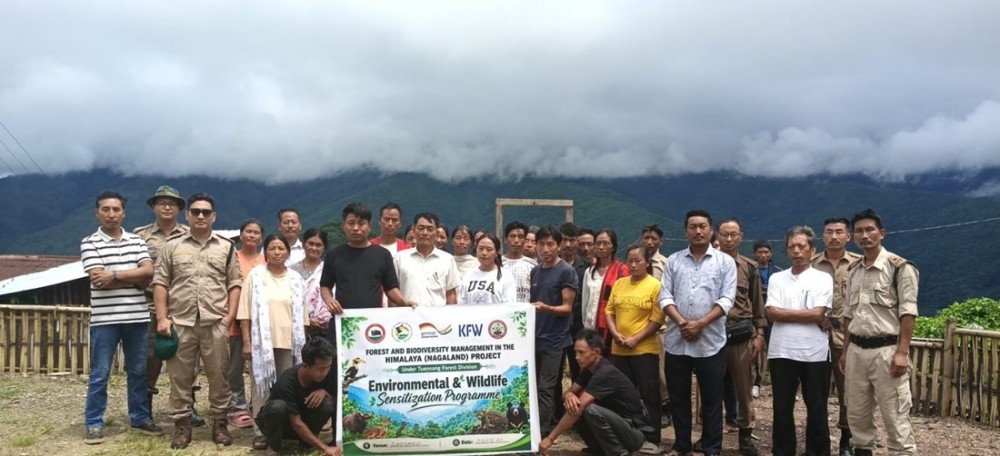
Tuensang, August 10 (MExN): The Tuensang Forest Division organised a comprehensive ‘Environmental & Wildlife Sensitisation Programme’ at the Saoshou Village Community Hall on August 8, under the Forest and Biodiversity Management in the Himalaya (Nagaland) Project (FBMP), which is co-financed by the Federal Republic of Germany through KfW.
The day-long programme began with a guided nature walk aimed at identifying local flora, fauna and wildlife signs, followed by a sensitisation session chaired by T Surotsa Sangtam, FGD, stated a press release.
In his introductory address, Menya Wongto, RFO, emphasised the crucial roles and shared responsibilities of various societal groups, specifically highlighting the church, Community Conservation Area (CCA) committees and students as key players in environmental protection.
Speaking on local governance, K Chuba, VCC, detailed local rules, village council resolutions and the community's enforcement methods, stressing that the council's regulations are being strictly implemented within the CCA with a complete ban on all kinds of hunting and cutting down of trees.
The vital role of women in conservation efforts was highlighted by I Chingyang, who spoke on behalf of a local Self-Help Group (SHG). Drawing inspiration from the historic Chipko movement, she encouraged all attendees to plant more trees, actively avoid deforestation and strictly follow the forest department's guidelines.
A critical technical session on illegal hunting and wildlife crime, referencing the Wildlife Protection Act (WPA) of 1972, the Biodiversity Act of 2002 and Article 371(A) of the Constitution, was conducted by N Imlong Chang (FGD, INP). He clarified that hunting, selling, eating and killing wild animals and birds are strictly restricted by law, and that Article 371(A) does not automatically permit unrestricted resource exploitation as the State Assembly has passed acts to protect wildlife under the WPA 1972.
Special emphasis was placed on protecting endangered and critically endangered species with clear warnings regarding severe and strict punishments for wildlife crimes. Officials also reminded the gathering that any environmental crimes or forest fires must be reported immediately to the rightful authorities.
The programme concluded with an interactive session between villagers and forest department officials, followed by a vote of thanks by I Khamba, GB.