Officials along with the participants during the training programme on “New Pond Management Practices” held at Sakhabama in Kohima on May 7. (DIPR Photo)
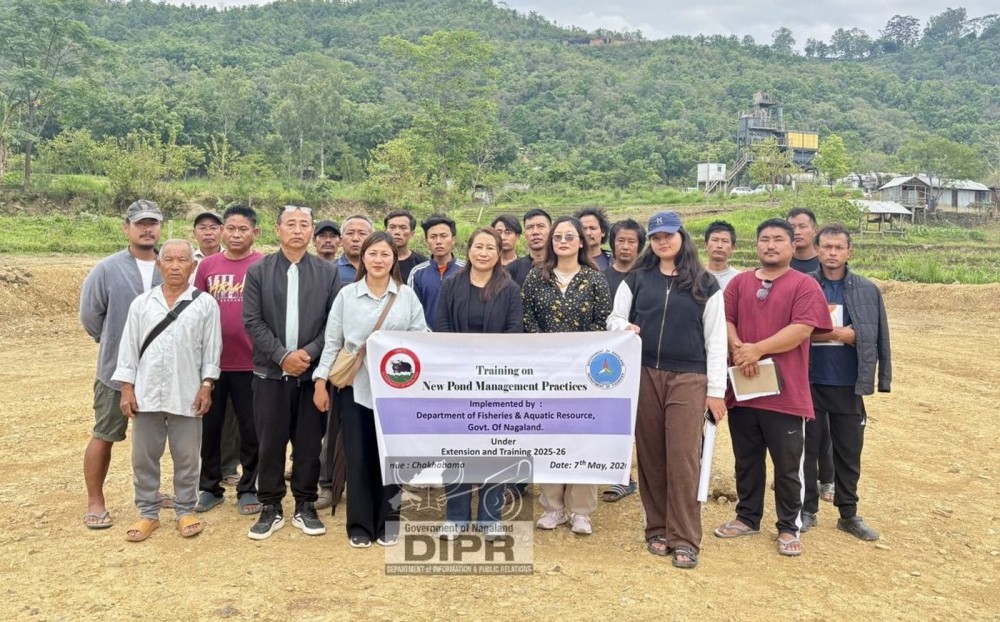
Kohima, May 7 (MExN): A training programme on “New Pond Management Practices” was conducted at Sakhabama on Thursday to sensitise farmers on scientific fish rearing methods under the Extension and Training Programme 2025-26 implemented by the Department of Fisheries and Aquatic Resources, Government of Nagaland, a DIPR update stated.
During the technical session, Sentinaro, DFO, spoke on modern pond management practices and stressed the importance of mixed fish culture for better utilisation of pond resources.
She stated that rearing only one species of fish in a pond is not economical as different fish species occupy different feeding zones, including the surface, middle column and bottom layers of the pond.
Participants were informed that before stocking fish, ponds should be properly prepared by applying powdered lime around the pond corners and leaving it for three days.
For larger ponds measuring around 100x100 feet, a mixture of mustard oil cake (MOC), urea and single super phosphate (SSP) was recommended to improve soil fertility and promote plankton growth before filling the pond with water and releasing fingerlings.
Sentinaro also spoke on supplementary feeding practices, explaining that young fish require higher protein intake and that feed composition should be adjusted as the fish grow.
Farmers were advised to feed fish regularly at fixed timings, preferably in the morning, and to distribute feed evenly in the pond to ensure equal access.
She further highlighted the importance of phytoplankton and zooplankton development in ponds through the application of organic and inorganic nutrient mixtures.
Participants were also sensitised on fish disease prevention measures, including the use of salt, lime and potassium permanganate during seasonal changes.
Speaking on cultivable fish species suitable for Nagaland, Neikonuo, AFI, informed the participants that Catla and Silver Carp are surface feeders, Rohu occupies the middle water column, while Mrigal and Common Carp are bottom feeders. Grass Carp, she said, can utilise all layers of the pond.
She also elaborated on Paddy-cum-Fish Culture (PFC), explaining that the integrated farming system enables farmers to cultivate paddy and rear fish simultaneously, thereby increasing productivity and income from the same area of land.
The training programme highlighted that terrace paddy fields in districts such as Kohima and Phek are suitable for integrated fish farming.
According to the resource persons, advantages of the system include improved pest management, enhanced soil fertility, reduced fish production costs and better utilisation of available resources.
Participants were informed that fish species such as Catla, Rohu, Mrigal and Common Carp are suitable for PFC systems as they can tolerate shallow water and fluctuating environmental conditions.
The session also covered site selection, pond specifications, stocking density and the role of fish in improving paddy cultivation through natural fertilisation and pest control.
The programme concluded with practical demonstrations on fish feeding conducted by Zakiesiele, Fishery Inspector, and soil testing demonstrated by Neikonuo. Around 30 farmers attended the training programme.