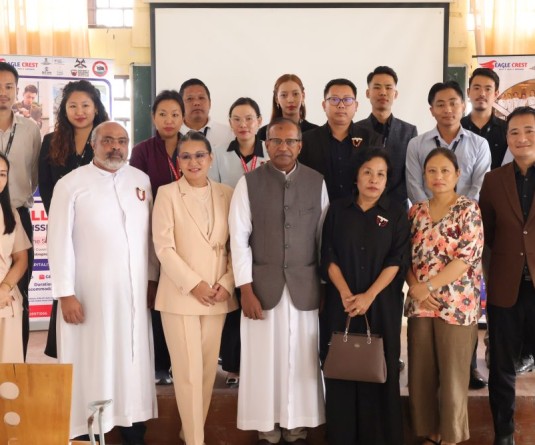
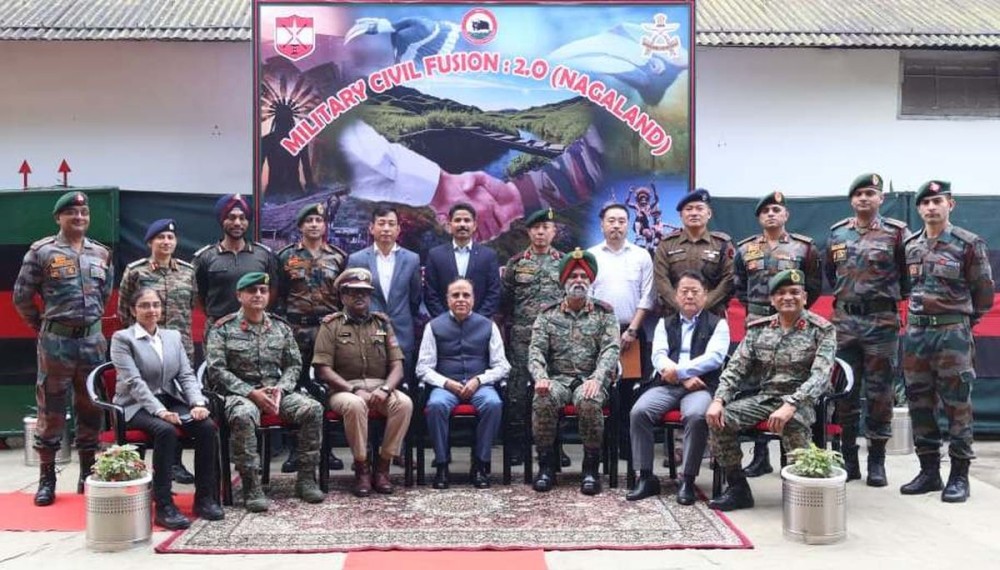
Major General H S Mavi , Gregory Thejawelie and others on day-one of Military Civil Fusion 2.0 seminar in Kohima on October 8.
Our Correspondent
Kohima | October 8
Top civil administration officers, military leadership and police authorities converged in Kohima on October 8 for the two-day Military-Civil Fusion (MCF) 2.0 seminar, aimed at strengthening coordination between defence forces and civilian governance towards the development of Nagaland.
The seminar, organised by Headquarters Inspector General Assam Rifles (North) under the aegis of Spear Corps, commenced at the Sainik Institute of HQ IGAR (N), Kohima.
Held under the theme “From Dialogue to Delivery—Institutionalising Civil-Military Partnerships for a Future-Ready Nagaland,” the seminar seeks to institutionalise military-civil collaboration through structured partnerships, thematic working groups, policy recommendations and measurable outcomes contributing to the long-term peace, stability and prosperity of the State.
In his opening address, Major General H S Mavi, Inspector General Assam Rifles (North), emphasised the need for greater synergy and institutional coordination among security and civil stakeholders in addressing emerging challenges.
He stressed the importance of interacting with one another and understanding each other's perspectives, while maintaining that security and development were equally important.
Mavi said Nagaland had witnessed a fairly secure environment in recent years and stressed that all stakeholders were equal partners in ensuring that security and development progressed together.
Representing the Home Department, Gregory Thejawelie, Commissioner, Nagaland, outlined the respective roles of civil administration, police and security forces.
He said the civil administration was focused on local governance, public welfare and district administration, while the State Police managed law enforcement, criminal investigation and maintenance of public peace. The Assam Rifles and Central forces, he said, guarded borders, secured key areas and provided specialised support during critical security challenges.
“Each of these forces brings unique strengths, skills and resources. When all agencies move together with a shared understanding, the entire State becomes safer and more resilient,” Thejawelie said.
Thejawelie said the Home Department's responsibilities included traditional border management, maintenance of law and order, crime prevention, disaster response and building community trust.
Under the constitutional framework, maintaining public order and supporting the rule of law remained a primary responsibility of State civil governance, he said.
Security must protect public development
Thejawelie described the Home Department as a neutral bridge between civil and military leadership, facilitating dialogue so that military operational requirements and civil administrative priorities complemented each other.
He said this also involved ensuring legal alignment, with security actions by all organisations respecting statutory frameworks, local laws and fundamental civil rights.
He stressed the need to harmonise everyday public peace and security so that security deployments supported the safety, dignity and economic lives of citizens.
“Through oversight, the Home Department helps ensure that every security force operating within the State works toward a single unified goal, i.e. serving the public good,” he said.
The Commissioner identified miscommunication as one of the biggest obstacles in multi-agency operations and stressed the need for clear and continuous communication channels at both leadership and field levels.
He also stressed that security measures should support rather than hinder everyday civilian life, adding that effective coordination could help protect public development and economic growth and enable communities to prosper in a peaceful environment.
From dialogue to delivery
During the seminar, Poolicharla Ramanaiah, IPS, SP, Narcotics and Cyber Crime, PHQ, deliberated on anti-narcotics and drug trafficking, including the capabilities and limitations of civil-military coordination.
Sandeep M. Tamgadge, IPS, ADGP (Law & Order), shared perspectives on strengthening law and order coordination and enhancing synergy among security and civil stakeholders.
Lieutenant General A.S. Bedi, PVSM, UYSM, YSM, VSM (Retired), Chairman, Ceasefire Monitoring Group, spoke on law and order coordination in a post-ceasefire, multi-group environment.
Dr Pritpal Kaur, IPS, Dy IGP (CID), PHQ, highlighted the importance of strengthening intelligence sharing for effective border security and counter-infiltration.
Er. Lanu Jamir, Superintendent Engineer, Office of the Chief Engineer, PWD (R&B), NPWD, Kohima, shared perspectives on strengthening infrastructure connectivity in remote areas.
Dr Thomas Keppen, Deputy Director, DHFW, highlighted the need for improved healthcare access and joint medical response in remote areas.
The deliberations reaffirmed the commitment of the participating stakeholders to move “From Dialogue to Delivery” and strengthen civil-military partnerships for the long-term peace, stability, resilience and prosperity of Nagaland.