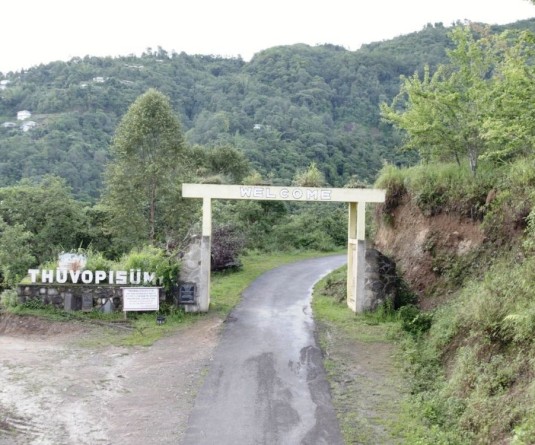
In Bade village, shops operate without shopkeepers, fixed hours, or immediate payment, a unique reimagining of rural commerce. (Morung Photo)
.png)
H Anguvi Chishi
Bade | April 29
In a time when retail is increasingly guarded by surveillance cameras, digital tracking and constant oversight, a small village in Nagaland offers a quiet but powerful counterpoint — one where commerce unfolds not under watchful eyes, but within an unwritten pact of trust.
In Bade village under Chümoukedima district, the idea of a shop has been reimagined. Here, there are no shopkeepers seated behind counters, no fixed hours of operation, and no insistence on immediate payment. Instead, rows of modest roadside stalls, known locally as “Honesty Shops,” sell organic fruits and vegetables on a simple principle: take what you need, and leave what you owe, whenever you can. It is a system that seems fragile on the surface, yet continues to endure, held together by faith, community values and everyday acts of integrity.
At the heart of this practice is 83-year-old Shevotso Keyho, who began running his shop in 2021. For him, the absence of supervision is not a risk, but a reflection of trust.
.webp)
“We don’t keep track of time. It is all self-service, and we sell only organic produce,” he says, describing a routine where customers help themselves and drop money into a box kept at the stall.
Payments are not always immediate, and that, Keyho insists, is part of the system’s strength rather than its weakness. “Sometimes when customers don’t have money, we allow them to take the items and pay the next time. Sometimes they take the items and pay later on their own, which is also fine by me.”
In fact, he recalls moments when trust has been rewarded beyond expectation. “There was once a customer who left a thousand rupees as a tip,” he says, with a quiet smile.
Rooted in faith and ethics
For Keyho, the shop carries a deeper message rooted in faith and ethics. ‘Nagaland is a Christian state. Stealing is not good for anyone. We believe in living in good faith with one another,’ he explains. “Running an open shop is like preaching in the church — it is an indication of trust and faith.”
There is also a practical advantage. Without having to sit at the shop all day, he is free to attend to other responsibilities, confident that most customers will act honestly.
A similar balance of necessity and belief shapes the experience of Riteu Khamo, a mother of four who has been operating her honesty shop for more than three years after relocating within the village.
“We cannot keep waiting at the shop, but people don’t steal, they help us in many ways,” she says.
.webp)
Her customers, she notes, often leave handwritten messages in the money box when they fall short of cash, promising to pay later. More often than not, they return to settle their dues.
For Khamo, the shop is both a source of livelihood and household support. “It is not only for my children but also helps with our daily kitchen needs,” she says.
Yet, she does not deny that the system has its imperfections. “Sometimes, just sometimes, there are a few instances where someone steals fruits or vegetables, or even from the money box,” she admits. But her resolve remains firm. ‘People are not the same. There are more good people than bad. So I will keep running the shop and look after my children.’
Her daily income varies significantly, from Rs 200 to Rs 500 on slower days, and rising to Rs 2,000 or even Rs 3,000 when produce is plentiful, a fluctuation she has learned to accept.
Faith in community, strangers
Another villager, Wekulo, has been part of this trust-based system for four years, drawing on Bade’s natural abundance of bananas and other fruits.
“Trusting in God, and placing my faith in the community and even strangers, I started this open shop,” he says. “I honestly don’t think people will lie or steal from us.”
Each night, when he checks the money box, he finds reassurance in its contents. “There is always money in the box. Maybe people love us or feel for us in a good way and leave extra,” he says.
For Wekulo, the benefits extend beyond earnings. “Since the start of the shop, my relationship with neighbours and the community has improved,” he notes, pointing to a strengthening of social ties.
While there were three instances of theft in the past, he says simple modifications to the money box have since prevented further incidents. Even so, his faith in the system remains unshaken.
‘This model can work anywhere. All we need is faith in God and trust in the community,’ he says, adding that anyone who steals ultimately bears the burden of guilt. “It is something of value, and if someone takes it dishonestly, it is they who will feel it.”
He remains unconcerned about occasional losses or fluctuations. “If there is not much income one day, it is fine. There is always tomorrow to fill the box,” he says.
Like others, he has witnessed customers leaving notes when they cannot pay immediately, returning later to honour their word — a small but significant act that sustains the system.
He also sees a lesson for the younger generation. “We should all aspire to work and eat, not just in this work, but in whatever we choose to do,” he says.
Back in Bade, these unattended stalls, modest in structure but profound in meaning, continue to function as quiet symbols of a different kind of economy, one where moral values and mutual trust hold as much weight as currency. In a world often marked by caution and control, Bade’s “Honesty Shops” offer a rare and enduring reminder: that when a community chooses to trust, it can create not just a way to trade, but a way to live.