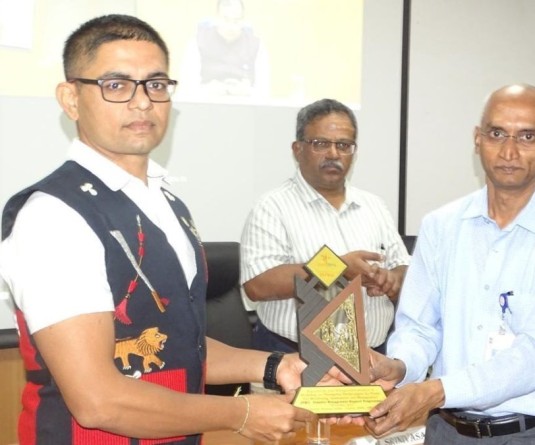
Dipankar Jakharia
Guwahati
My daughters have always been fascinated by the Land of the Rising Sun. They grew up with Nobita and Shinchan and are now devoted anime fans. My younger daughter learnt to read Japanese while she was still in Class II. My elder daughter even earned an opportunity to spend a year in Japan as an exchange student in Class XI. Like countless dreams, however, that plan was derailed by COVID.
As a somewhat passive father, I simply admired their admiration.
Then, during a visit to Kohima, something changed. We visited the Japanese war memorial church built in memory of the soldiers who fell during the Battle of Kohima. As we walked around, my younger daughter effortlessly read parts of a Japanese inscription on an information board.
That evening I asked, "How did you learn to read that?"
"Internet," she replied casually.
She went on to explain that Japanese uses three writing systems—Kanji, Hiragana and Katakana—and that the inscription was largely in Katakana. It was then that I realised their fascination with Japan ran much deeper than cartoons and anime.
Soon I developed an admiration of my own. Japan's transformation after the Meiji Restoration, when it opened itself to ideas from the outside world, remains one of history's greatest success stories. Even more remarkable was its post-1945 recovery. Within a few decades of total devastation, Japan had rebuilt itself into the world's second-largest economy. Its discipline, collective thinking and long-term vision are qualities from which India can learn immensely.
Although the Japanese Prime Minister's proposed visit to Guwahati was cancelled, it gives us an opportunity to look at something Japan has quietly mastered for over a century—personal finance.
In 1904, journalist Hani Motoko introduced a household budgeting system called Kakeibo, which literally means "household financial ledger." More than a budgeting tool, it is a philosophy of mindful spending that continues to guide millions of Japanese households.
The principle is remarkably simple: write down every rupee you earn and every rupee you spend. The act of writing creates awareness, discourages impulsive purchases and keeps your long-term financial goals in sight. In an era of budgeting apps and AI-powered finance tools, Kakeibo still champions the humble pen and notebook.
At the beginning of each month, decide how much you want to save. At the end of the month, review how closely you achieved that goal. To make the process easier, expenses are divided into four categories.
• Needs - cover unavoidable expenses such as food, rent, transport, school fees and utilities. While these are largely fixed, Kakeibo encourages finding small efficiencies wherever possible.
• Wants - include holidays, dining out, clothes, gadgets and entertainment. This is where the line between need and desire often blurs. The objective is not to eliminate enjoyment but to spend consciously.
• Culture - is Kakeibo's most distinctive category. It sets aside money for books, museums, music lessons, libraries, historical sites and other activities that enrich the mind. In Assam, that could mean visiting Rang Ghar or the Assam State Museum, or becoming a member of a local library. Kakeibo reminds us that investing in culture is as valuable as investing in material comforts.
• Extras - account for irregular expenses such as car repairs, birthday gifts, weddings or medical emergencies.
What makes Kakeibo powerful is that it goes beyond arithmetic. It encourages self-reflection.
When you write down a Rs 3,000 restaurant bill under "Wants" and your daughter's Satriya lessons under "Culture," your subconscious begins asking uncomfortable but important questions. Did the dinner provide as much value as the dance lessons? Could some of that money have been saved instead?
Those quiet conversations with ourselves are often the beginning of financial wisdom.
Sometimes, the best financial adviser isn't an expert on television or an investment app. It is simply a notebook, a pen, and the honesty to look at where our money really goes.