Officials during the high-level coordination meeting on ‘MSME as Engines of Growth’ held at the Chief Secretary’s conference hall, Nagaland Civil Secretariat, Kohima, on March 30. (DIPR Photo)
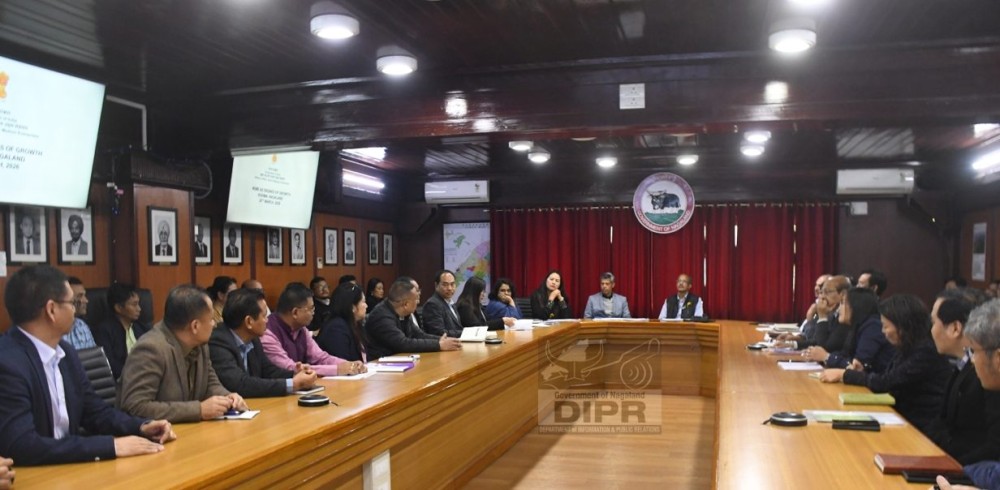
Kohima, March 30 (MExN): A high-level coordination meeting on ‘MSME as Engines of Growth’ was held at the Chief Secretary’s conference hall, Nagaland Civil Secretariat, Kohima, on March 30, bringing together officials from the Government of India and various agri. and allied departments of the State.
The meeting was chaired by Additional Chief Secretary and Agriculture Production Commissioner, V Shashank Shekhar (IAS), who said the objective was to bring all concerned departments onto a common platform to enhance synergy between the Centre and the State for maximising benefits to the people. He stressed the importance of convergence and collective efforts for effective implementation of developmental programmes, stated a DIPR report.
Secretary, Ministry of Micro, Small and Medium Enterprises (MSME), Government of India, SCL Das (IAS), emphasised the need for stronger coordination, convergence and collaboration among various departments to accelerate MSME growth in Nagaland.
In his opening remarks, Das clarified that the meeting was not a review exercise but a platform for dialogue and partnership, aimed at aligning the Centre’s support with the State’s development vision. He noted that Nagaland’s progress as part of India’s broader growth story is fully supported by the Government of India.
Highlighting the nature of MSMEs, he said the sector is not confined to a single department but is a classification that cuts across multiple sectors such as textiles, food processing, steel, electronics and other industries. He pointed out that MSMEs contribute significantly across sectors, including a substantial share in steel production, underscoring their importance in the national economy.
Das stressed the need to break departmental silos and work through convergence, as multiple ministries and departments at both the Centre and State levels run schemes that benefit MSMEs. “Greater convergence is essential to maximise impact and ensure that the benefits reach the intended stakeholders,” he said.
He further informed that the meeting would provide a brief overview of schemes available under the MSME Ministry, while also acknowledging that several other central initiatives, including those under different ministries, support MSME development. He expressed hope that the State government would be able to leverage these schemes more effectively for greater benefit.
Emphasising a collaborative approach, Das said the interaction would also focus on understanding the State’s needs and identifying areas where coordination and cooperation can be strengthened to achieve shared objectives.
Describing the meeting as an “initiation”, he expressed optimism that such engagements would continue through regular and institutionalised follow up meetings.
MSME outlines 2047 Vision for Nagaland
Mercy Epao, Joint Secretary, Ministry of MSME outlined the Ministry’s vision of developing globally competitive MSMEs as a key driver of India’s economic growth.
She highlighted enablers like formalisation, access to credit, technology, digitisation, infrastructure, and skilling. She also detailed flagship schemes including PM Vishwakarma, PMEGP, and the Credit Guarantee Scheme.
Focusing on women entrepreneurship, Epao highlighted the Yashasvini initiative, which aims to achieve 3% public procurement from women-owned MSEs and support women entrepreneurs from informal to formal enterprises.
Outlining the Viksit Bharat 2047 roadmap, she said the vision is to build a modern, globally competitive MSME sector, with strategic goals including boosting exports, promoting sustainable technologies, and strengthening rural industries like Khadi and Coir.
The presentation also underscored the need to empower women, traditional artisans, and crafts people by enabling enterprise creation and ensuring inclusive growth across sectors, it added.
Various departments presented updates on their ongoing activities while also highlighting key challenges in marketing and exports. They further outlined the support required to scale up and expand their products.
The Secretary in his concluding remarked assured that the grievances raised would be addressed, noting that such meeting provides opportunity to identify areas for collaboration and collective progress. Emphasising the importance of coordination, the Secretary called for regular meetings to ensure effective implementation. Decisions that are immediately actionable will be carried out without delay, while identified bottlenecks will be resolved promptly, he added. Secretary also underscored the need for follow-up meetings to review progress and sustain momentum moving forward.
Development Commissioner, Departments including Industries & commerce, Tourism, Horticulture, Fisheries, RD, Finance, IT & C, Land Resources, Women Development, Forest, Nagaland Bamboo Mission, Employment & Skill Development, Youth Resource & Sports, Seri culture, Agri department attended the meeting.