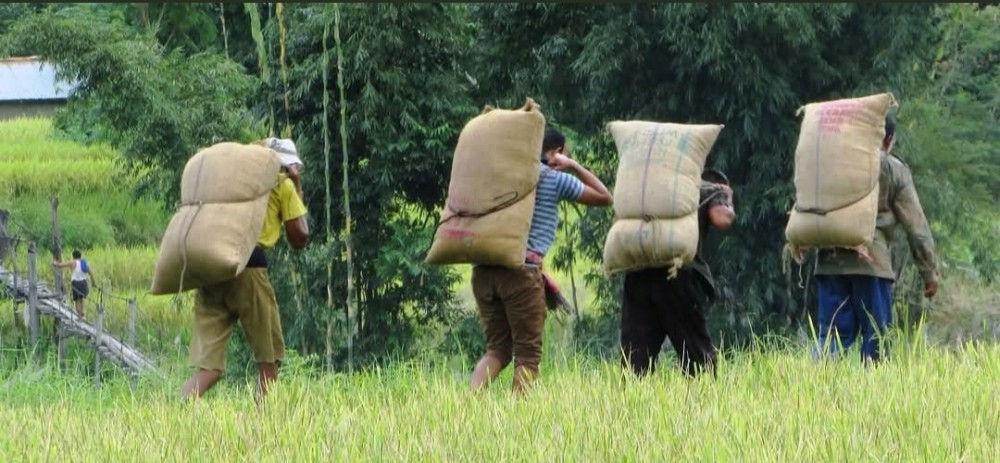
Naga farmers carry harvested paddy. (Morung File photo)
Our Correspondent
Kohima | September 20
Nagaland’s cooperative sector is undergoing a transition from traditional, paper-based operations to digitally enabled and professionally managed entities, in line with recent national initiatives such as the computerisation of Primary Agricultural Credit Societies (PACS) and the formation of new multipurpose cooperatives.
This was stated under “Strategic Mission Pillar III – Making Cooperative Future Ready” in the Nagaland Cooperative Policy, 2026, tabled during the recent 9th session of the 14th Nagaland Legislative Assembly (NLA) in Kohima.
To harness this momentum and align with Pillar III of the National Cooperative Policy 2025, the State has adopted a dedicated policy to make cooperatives future-ready, competitive, transparent and sustainable economic institutions.
The key objectives include achieving full computerisation and ERP-based operations of all functional PACS and other primary cooperatives within a defined timeframe; establishing State-level infrastructure compatible with the “National Cooperative Database” and other digital public platforms; professionalising cooperative management through structured human resources, training and performance systems; and strengthening risk management, cybersecurity, internal controls and compliance frameworks.
Digitalisation and cooperative stack integration
The strategy is to ensure 100% computerisation of functional PACS and priority primary cooperatives, building upon the first and second phases of implementation already initiated in Nagaland.
It also aims to adopt and implement the National Level PACS Software (NLPS)/ERP and other approved applications to standardise accounting, MIS, loan operations, procurement, marketing and member services.
The policy proposes creating a Nagaland Cooperative Digital Platform that integrates with the National Cooperative Database, credit bureaus and relevant State databases, while providing dashboards for the Department, Registrar of Cooperative Societies (RCS), SCDC/DCDC and federations for real-time monitoring and decision-making.
It further seeks to promote digital payments, mobile-based member interfaces, SMS/IVRS alerts and online grievance redress systems in cooperatives, especially PACS, dairy, fisheries, handloom and producer cooperatives.
Cooperatives above a defined business threshold will also be encouraged to appoint full-time professional CEOs, IT-skilled staff and sector-specific experts in areas such as agri-business, dairy, tourism and logistics.
The policy also aims to develop a Standard HR Framework for cooperatives covering recruitment, performance appraisal, incentives, ethics codes and training obligations, in consultation with federations and stakeholders.
For capacity building, training and cooperative education, the policy proposes a multi-tier capacity-building plan aligned with the National Cooperative Policy, covering governance, digital literacy, ERP usage, financial management and compliance for board members and staff.
It will also partner with national institutions such as NCUI, NCDC, NABARD and NDDB, as well as regional training centres, to deliver regular, modular training programmes in physical and virtual modes.
The policy further proposes integrating cooperative education, entrepreneurship and digital skills into youth-focused initiatives, drawing on recommendations of the Nagaland Cooperative Conclave and Vision 2030 documents.
Business expansion, sectoral diversification strategies
The objective is to promote cooperatives in emerging and non-traditional sectors highlighted in the National Cooperative Policy, including tourism, green energy, transport such as taxi and logistics services, food processing and other services.
It also seeks to encourage cluster-based cooperative models and value-chain cooperatives linked to local commodities, including horticulture, spices, non-timber forest products (NTFP), livestock, weaving and handicrafts, in alignment with Nagaland’s economic priorities.
The policy further proposes facilitating partnerships between cooperatives and private players, start-ups and SHG platforms such as the Nagaland State Rural Livelihoods Mission (NSRLM) for innovation, branding, marketing and technology adoption.