• Awaiting public appraisal
• Higher rates for postpaid
• Lower rates for prepaid
Imkong Walling
Dimapur | August 9
The Department of Power Nagaland (DoPN) is proposing yet another tariff hike. This time, it is for the October 2026 to March 2027 period. The previous hike was affected in 2025 for the 2025-26 financial year.
If the Nagaland Electricity Regulatory Commission (NERC) approves the proposal, electricity rates for postpaid consumers will rise by as much as 6.4 percent. While the department has proposed raising the prepaid rates as well, it would remain lower than postpaid.
The DoPN has an estimated 3.5 lakh consumers in its registry. As per the NERC March 2025 Tariff Order, the state consumed 448.81 million units of energy during the 2023-24 fiscal.
Here is a glimpse into what the latest tariff proposal from the DoPN would translate into.
Postpaid trap
The DoPN employs a relatively aggressive telescopic — also known as progressive — billing system for its postpaid consumers.
It practically means households with a history of energy consumption on the higher side would have to shell out more. It is like high-income individuals getting higher income tax bills.
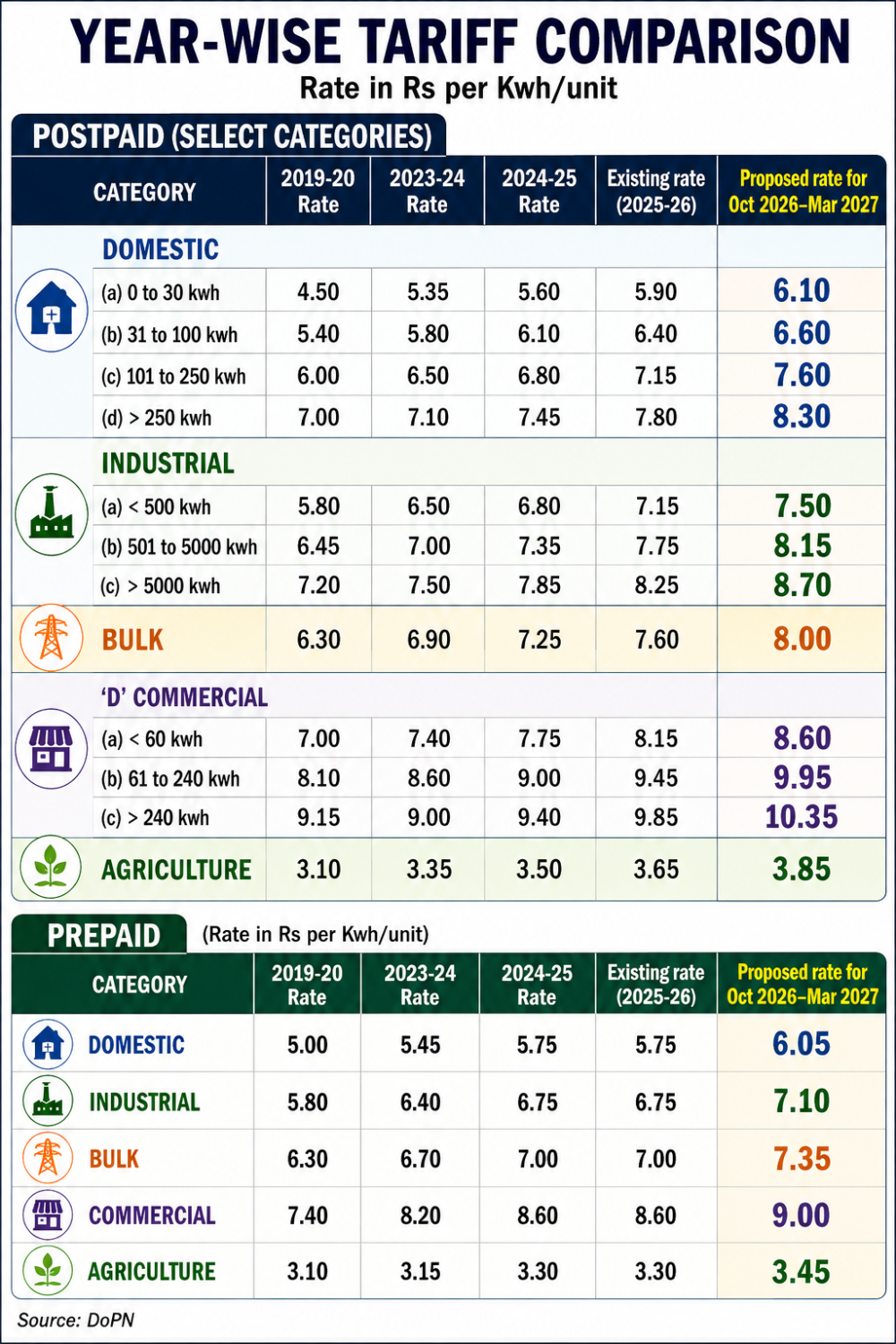
Households that consume 100 units a month should expect 20 paise per unit increase or 3.1 percent. Households that use up to 250 units face 45 paise or 6.29 percent hike per unit. Energy-guzzling consumers who consistently break the 250 units a month barrier faces an absolute increase of 50 paise or 6.41 percent. Post the 250 unit mark, the consumer will be charged Rs 8.3 for every unit consumed from the prevailing Rs 7.8 per unit.
For example, a family consuming 300 units a month, currently paying Rs 2087.5, would see their monthly bill rise to Rs 2200 (excluding meter rents and street-lighting charges) post October 2026.
Commercial and Industrial consumers are also looking at a 5 percent to 5.5 percent increase. They would likely see a climb of 50 paise with the rate climbing up to Rs 10.35 per unit for high-end commercial users. Industrial consumers will be charged up to Rs 8.7 per unit.
The rate for consumers in the ‘Bulk’ category would increase to Rs 8 from the existing Rs 7.6 per unit. (Refer Image)
Prepaid lure
The DoPN continued its bid to transition to prepaid smart energy metering system even as public apprehension prevails. Per the latest tariff proposal, it seeks to keep energy charges lower for prepaid consumers like in the previous years, a manoeuvre intended to woo postpaid consumers playing hard to get. The rate proposed for domestic prepaid is Rs 6.05 per unit and for Bulk consumers, Rs 7.35 is the proposal. (Refer Image)
Charged at Rs 8.30 a unit, postpaid consumers would pay more than those on prepaid meters, who will pay a flat Rs 6.05 per unit regardless of the amount of usage. As per the data provided in the petition, there are 26,752 prepaid consumers.
Revenue target
The DoPN has revised its “Aggregate Revenue Requirement” for 2026-27. In its previous December 2024 Multi-Year revenue and tariff (2025-26 to 2029-30) petition, the projected target was Rs 1013.79 crore to break even for the 2026-27 fiscal. As per the latest filing, the projected revenue requirement for the year has been revised to Rs. 889.17 crore, exclusive of “non-tariff income.”
Aggregate Revenue Requirement (ARR) refers to the projected total revenue a power distribution company needs to generate in a given period to cover operational costs, including power purchase and generation, maintenance, staff salaries and planned investment. Essentially, it is the total amount they need to earn through electricity tariffs to break even. Tariff Proposal is a proposal for revising the existing electricity rates.
The total power purchase cost approved by the NERC, as per the March 2025 Tariff Order, for 2026-27 was Rs 599.28 crore, inclusive of transmission costs. This has been revised to 581.59 crore in the latest ARR and Tariff petition filed by the DoPN in November 2025.
Public vetting
The DoPN had submitted its Aggregate Revenue Requirement (ARR) and Tariff proposal for October 2026 to March 2027 to the NERC in November 2025.
The proposal was notified to the public, as required by the law, on August 4, which was subsequently published by the newspapers. It invited suggestions and comments from “stakeholders” (consumers) before August 14, 2026. The Electricity Act of 2003 requires tariff proposals are put through a vetting process, including by the public, before it is approved by the state electricity regulatory commissions.
Consumers can send their views via email to [email protected] or [email protected], or submit written copies to the Deputy Director, NERC, Kohima, alongwith a copy to the Chief Engineer (Distribution & Revenue), DoPN.
Writer’s Note: This report originally stated prepaid rates would remain unchanged. In fact, the DoPN has also proposed increasing the rates for prepaid consumers for the October 2026–March 2027 period. The text has been corrected in the main report to reflect this. The oversight is regretted.