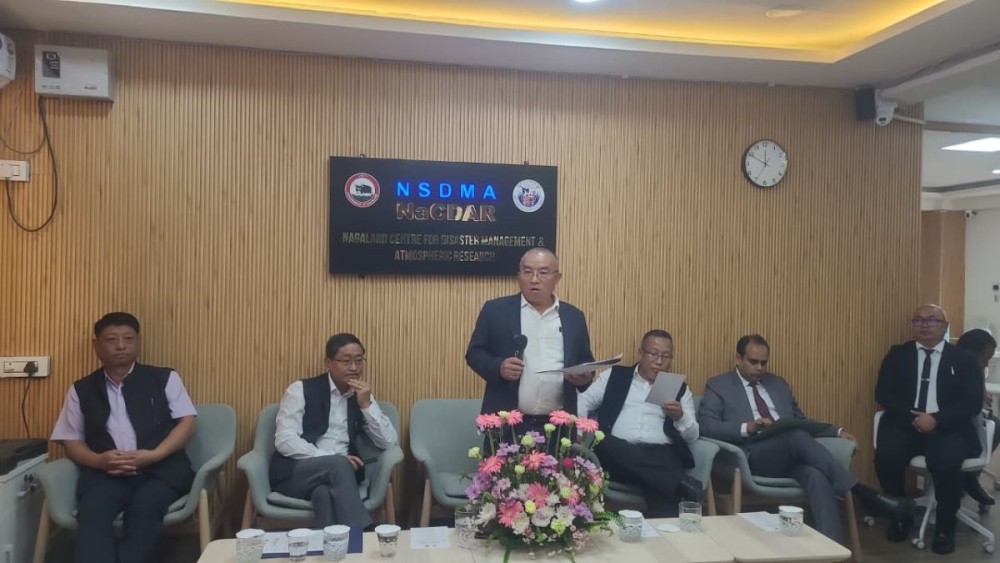
NSDMA & NRE Advisor Z Nyusietho Nyuthe addressing the official launch of ELIONA in Kohima on May 21. (Morung Photo)
Our Correspondent
Kohima | May 21
The Nagaland State Disaster Management Authority (NSDMA) on Wednesday launched “ELIONA”, a state-level Artificial Intelligence (AI) supercomputing facility aimed at strengthening climate resilience, disaster preparedness and technology-enabled governance in Nagaland.
Speaking at the launch programme in Kohima, NSDMA Joint Chief Executive Officer Johnny Ruangmei said ELIONA symbolically represents “the convergence of intelligence, foresight, resilience and technological advancement for safeguarding humanity against emerging climate and disaster risks”.
He said the name ELIONA is derived from Hebrew origin, meaning “God is gracious” and “God has answered”.
Developed by the NSDMA, the facility will function as the computational backbone for weather and climate modelling, 3D digital hazard intelligence, earth observation analytics, disaster simulation frameworks, AI and machine learning-based scientific research, and decision intelligence systems.
According to Ruangmei, the platform enables near real-time weather prediction, climate anomaly detection, terrain-aware hazard modelling, disaster impact simulations, dynamic risk computation and AI-assisted operational forecasting.
He said the strategic vision of the NSDMA is to establish ELIONA as one of India’s leading AI-powered climate and disaster intelligence supercomputing platforms, enabling predictive governance, scientific resilience and autonomous disaster intelligence for future generations.

Officials said ELIONA marks a significant step in the evolution of disaster management in Nagaland by placing advanced computing, scientific intelligence and predictive capability at the centre of public decision-making.
They noted that climate-induced disasters are increasing in frequency, intensity and complexity globally, requiring vulnerable regions to adopt anticipatory and data-driven systems beyond conventional response mechanisms.
Given Nagaland’s terrain and vulnerability to extreme rainfall, landslides, floods and seismic risks, the state requires an approach integrating science, technology and operational preparedness, officials said.
The facility is expected to strengthen the state’s capacity to generate localised insights and improve decision-making during preparedness as well as emergency response phases.
By integrating advanced computing capability within the institutional framework of the NSDMA, ELIONA will support faster interpretation of weather intelligence, satellite imagery, hydrological data, terrain information and operational inputs crucial for disaster risk reduction.
Officials said ELIONA would also complement wider scientific and technological initiatives undertaken by the NSDMA and the Nagaland State Centre for Disaster Risk Reduction (NaCDAR), including automated weather monitoring networks, drone-enabled terrain mapping, climate analytics and public-facing information systems.
The initiative reflects a transition from reactive disaster management to predictive and intelligence-led governance, enabling authorities to prepare before disasters occur, coordinate more effectively during emergencies and strengthen recovery planning, they added.
The NSDMA said the establishment of ELIONA aligns with national and international priorities relating to disaster risk reduction, climate adaptation, resilience-building and technology-enabled governance.
The authority added that ELIONA is envisioned not merely as a state infrastructure project but as a future regional AI and climate resilience hub for the Northeast and a scalable model for technology-driven disaster governance across climate-vulnerable regions.
Building a safer and more resilient Nagaland
Nagaland Chief Secretary Sentiyanger Imchen said that with its advanced computing capacity, ELIONA will enable NSDMA and the government to process large volumes of weather, satellite, terrain, climate and disaster-related data.
“Most importantly it will support high-resolution weather modelling, hazard mapping, flood and landslide analysis, damage assessment and climate risk studies,” he said.
Lauding the efforts of the NSDMA in establishing this facility, Imchen stated that the success of ELIONA will depend on how effectively we integrate with field-level systems, district administrations, line departments, researchers and communities.
Nagaland Home Commissioner Abhijit Sinha said that ELIONA form as an important decision support system for building a very safe and more resilient Nagaland.
Terming the launch of ELIONA is an important milestone for NSDMA and for the state of Nagaland, Sinha said ”ELIONA represents a major step forward in strengthening the capacity for disaster preparedness, early warning, scientific analysis, and evidence-based decision-making.”
As disaster risks become more complex due to changing climate patterns, extreme rainfall, landslides, flash floods, seismic risks, and other hazards, it is essential that we equip ourselves with advanced tools and technologies to support timely and informed action, he said.
Sinha said that ELIONA, established as part of the NaCDAR, will serve as a powerful computational platform for weather modelling, climate risk analysis, satellite data processing, geospatial hazard mapping, artificial intelligence applications, and disaster impact assessment, adding that it will support the state in improving hazard detection, risk assessment, forecasting, and planning for effective disaster risk reduction.
Stating that the platform will also contribute to important initiatives such as the Nagaland State Disaster Management Information System, parametric insurance and disaster risk financing, flood and landslide modelling, urban resilience planning, and community-based preparedness, he said that ELIONA is not only a technological asset, but also a decision-support system for building a safer and more resilient Nagaland.
The Home Commissioner hoped that ELIONA will greatly enhance the state’s ability to apply science, technology, and data for stronger disaster preparedness and climate-resilient planning.
The launching programme was chaired by Jonjibemo Odyuo, Assistant Manager (Relief, Recovery & Mitigation), NSDMA while Rev Dr K Benry Lotha, Senior pastor, Kohima Lotha Baptist Church invoked God’s blessings. Vote of thanks was proposed by Dr Noyingbeni Kikon, Project Coordinator, (GIS & Remote Sensing), NSDMA.