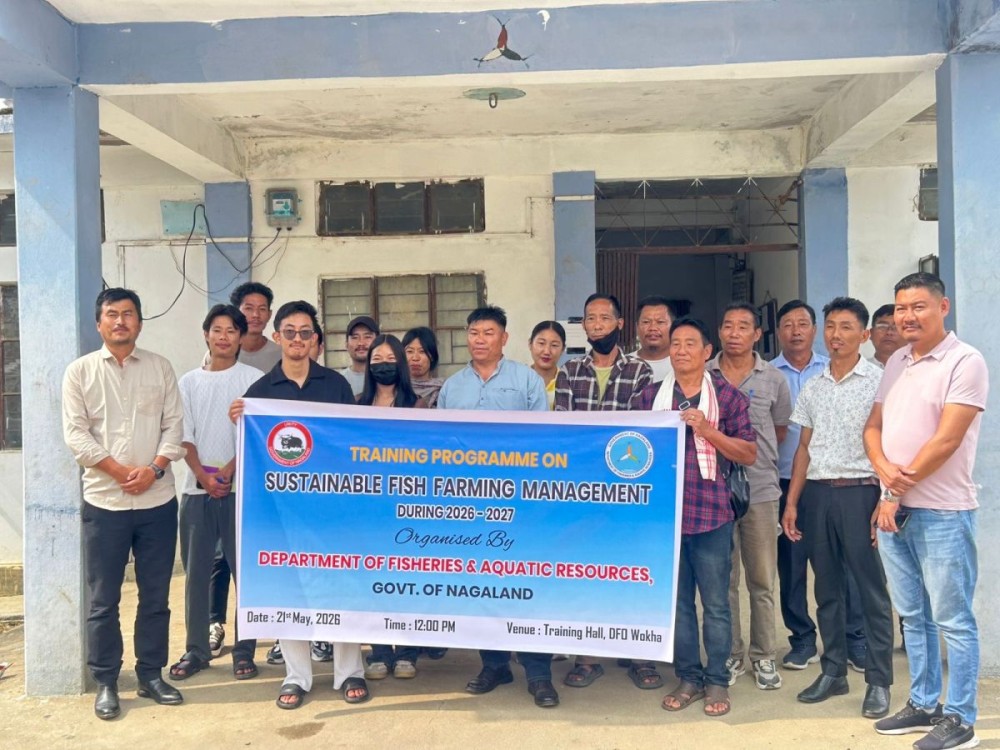
Officials along with the participants during the one-day training programme on sustainable fish farming management at District Fisheries Office, Wokha on May 21. (Morung Photo)
Morung Express News
Wokha | May 21
The District Fisheries Office in Wokha organised a one-day training programme on sustainable fish farming management on Thursday to enhance farmers’ knowledge of scientific fish farming techniques and sustainable aquaculture practices.
Addressing the programme, District Fisheries Officer Rulanthung Ezung stressed the need for scientific fish farming to improve livelihoods, ensure better economic returns and strengthen nutritional security.
He also emphasised the importance of adopting sustainable practices for the protection and preservation of aquatic ecosystems.
During the technical sessions, Assistant Fisheries Inspector Riimachang Aier spoke on composite fish culture and pond management.
He explained the concept of rearing multiple fish species in a single pond according to their feeding habits and water levels to ensure optimum pond utilisation.
According to him, Catla feeds at the surface level, while Rohu and Grass Carp are middle-column feeders. Mrigal and Common Carp feed at the pond bottom, making composite fish culture an efficient method for maximising pond productivity.
Aier also highlighted the importance of water quality management, balanced fish stocking and proper pond maintenance for improving fish production.
In another technical session, Assistant Fisheries Inspector Khriezeto Zatsu discussed fish healthcare and post-stocking management.
He encouraged farmers to adopt proper feeding methods, maintain pond hygiene and regularly monitor water quality to minimise fish mortality and ensure healthy fish growth.
Officials informed participants that Nagaland currently meets ‘only around 30 per cent of its fish demand through local production,’ underlining the need to strengthen fish farming practices in the state.
As part of the practical session, participants were also given a demonstration on testing water pH levels and informed that pH levels above 9 could adversely affect fish culture.
The programme concluded with an interactive session followed by a vote of thanks delivered by Fisheries Inspector Konri Magh.