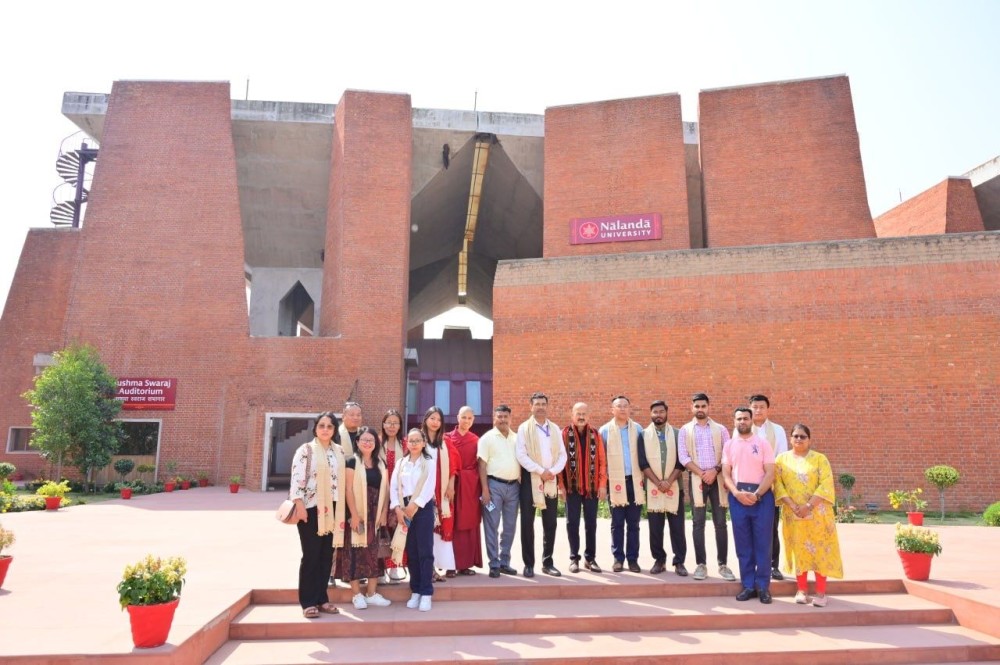
The media delegation from Nagaland with officials and others during the visit to Nalanda University.
Morung Express News
Nalanda | March 19
On Day 3 of the Press Tour to Bihar, organised by the Press Information Bureau (PIB) under the Ministry of Information and Broadcasting, a seven-member media delegation from Nagaland, led by P Sophie, Head of Office, PIB Kohima, visited the Nalanda Archaeological Site, Bhimrao Ambedkar Residential School, and Nalanda University.
The visit was facilitated with strong support from the district administration, which ensured smooth coordination and arrangements throughout the day’s engagements.
At the Nalanda Archaeological Site, the delegation was briefed by tour guide Anil Kumar, who has been associated with the site for several years. He provided detailed insights into the layout and significance of the ancient university complex, including the monasteries, temples, and the Sariputra Stupa.
He highlighted that Nalanda hosted around 10,000 students and 1,500 teachers from across Asia, including China, Sri Lanka, Korea, and Southeast Asia.
The site features remains of lecture halls, residential cells, stupas and shrines, reflecting its role as a major centre for studies in philosophy, medicine, astronomy and logic.
Today, Nalanda attracts visitors from around the world, particularly from Buddhist-majority countries, and remains an important symbol of India’s ancient educational heritage and cultural exchange.
The delegation also visited Bhimrao Ambedkar Residential School, an all-girls residential institution focused on holistic education.
Students showcased a robotics exhibition, presenting a variety of innovative, student-made projects. The exhibition reflected their practical understanding of science and technology, highlighting the emphasis on experiential and skill-based learning.
The delegation later visited Nalanda University, re-established in 2010 and operational since 2014, which seeks to revive the ancient spirit of interdisciplinary learning.
The university currently operates six schools, including historical studies, philosophy and Buddhist studies, management, international relations, sustainability, and languages. It hosts around 650 residential students, many of whom are international.
A key highlight is its net-zero sustainable campus, where fossil fuel use is minimised, rainwater harvesting is practised, and eco-friendly construction materials are used. The campus also features extensive water bodies and green landscapes.
Officials emphasised that the university promotes an integrated model of education, blending sciences with humanities, inspired by its ancient legacy. It also engages with nearby villages through education, skill development, and sustainability initiatives.
In addition, Nalanda University is gradually strengthening its engagement with India’s Northeast region. Officials informed that students from states such as Assam and Meghalaya are already part of the academic community.
The university has hosted dedicated sessions focusing on the Northeast during development dialogues, reflecting its intent to build stronger institutional linkages. Its flexible academic structure also allows scope for research related to the region.
Officials further noted that expanding partnerships, increasing student participation, and enhancing research collaboration with the Northeast remain key focus areas moving forward.
The delegation will continue its tour on Day 4 with visits to Rajgir, Bodhgaya, and other key locations in Bihar.
.jpg)
.jpg)
.jpg)