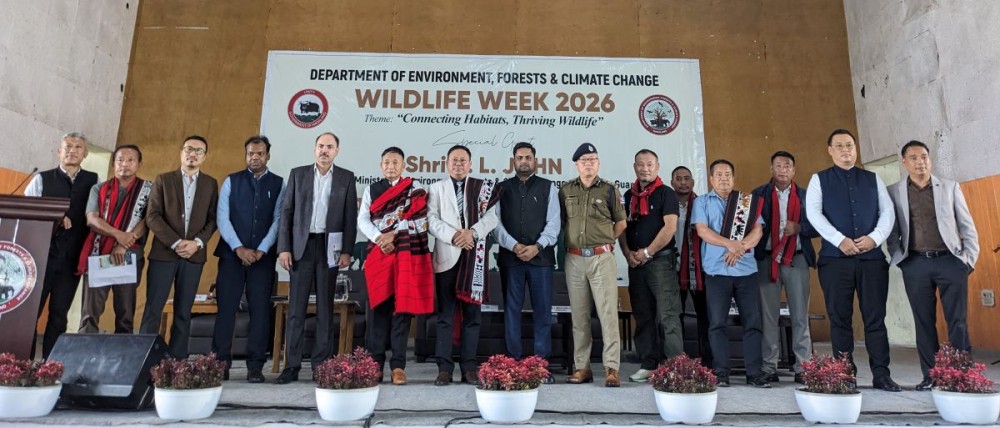
Officials and participants during the Wildlife Week 2026 programme at Town Hall, Mokokchung, on October 6. (Morung Photo)
Morung Express News
Mokokchung | October 6
Senior officials of Nagaland’s Department of Environment, Forests and Climate Change on Tuesday mounted a strong defence of the Wildlife (Protection) Act, 1972, insisting that it is fully applicable in the State and that capturing or keeping wild birds and animals without permission is illegal.
Speaking at the Wildlife Week 2026 programme at Town Hall, Mokokchung, Principal Chief Conservator of Forests and Head of Forest Force Vedpal Singh said he could not disclose details of an ongoing wildlife case because it was sub judice. However, he cautioned, “what you are looking at is not the complete picture.”
Singh said public discussion had wrongly reduced the matter to a question of taking photographs and uploading them on social media. According to him, the accused had been charged with two alleged offences: taking a bird from the wild and keeping it in captivity.
He said the definition of hunting under the law was broad and covered not only killing, but also direct or indirect capture and causing harm to wildlife.
Singh questioned whether bringing a bird from its natural habitat and keeping it inside a cage, restricting its freedom, could be described as an act of love.
“If we allow people to capture birds from the jungle and keep them in captivity, how many people will do it?” he asked, explaining that such conduct was made an offence to prevent the systematic removal of wildlife from forests.
Singh said the Wildlife (Protection) Act, 1972 was adopted by the Nagaland Legislative Assembly on December 18, 1981. He said its applicability in Nagaland should therefore not be a matter of confusion or speculation linked to Article 371A.
He further stated that wildlife, whether alive or dead and its parts were government property under the law. According to Singh, keeping wildlife without a government permit was illegal.
‘Social media is not government’
Development Commissioner and Principal Secretary to the department Y Kikheto Sema also took a firm position, saying government decisions could not be dictated by social-media campaigns.
“Social media is also important, but social media is not government,” Sema said. He added that running an office according to repeated social-media demands was not part of the government’s “syllabus”.
Sema said the Wildlife Act had been adopted by the Nagaland Assembly and had to be implemented. He stressed that it had not been forcibly imposed by the Government of India and had been in force in Nagaland for 45 years.
He said the Act had been amended in 1982, 1986, 1991, 1993, 2002, 2006 and 2022. The Wildlife Crime Branch, he added, was opened in 2015 in response to the need for stronger action against wildlife offences.
Sema said the law allowed penalties of up to Rs 5 lakh, depending on the case and the authority concerned. He added that leniency could be shown where a person sought forgiveness, but cases could also be sent to court when accused persons refused to accept responsibility.
According to figures presented by Sema, 74 wildlife-related cases had been compounded since 2015. Of these, 69 had been settled outside court, while five had gone to court. Two of the court cases had been settled and three remained pending.
From 2025 to October 2026, Sema said, 50 persons had been caught in related wildlife matters. Of them, 49 had been penalised, with Rs 31.35 lakh collected and deposited into the government account.
However, Sema acknowledged that the department itself had failed to provide sufficient public awareness about the amendments and changes in the law.
He called for wildlife legislation to be explained in every local language and introduced through schools, elementary education, church sermons and other public institutions. He described the church as the strongest institution in Nagaland.
Sema also criticised what he described as a weakening of public regard for government authority, saying “NGOs have become GO and GO have become NGO”.
He said people increasingly wanted complete control over their land and resources but turned to the government when human-animal conflicts occurred.
The officials’ defence comes amid unresolved questions surrounding the wildlife case involving Porba resident Vezhoto Hesuh. Chakhesang organisations have alleged arbitrary detention and a demand for Rs 1 lakh for his release, claims now subject to a CID preliminary inquiry. The Great Barbet seized from Porba has since been returned and released in the Porbami Reserved Forest, but the demand for withdrawal of the case and clarity over the alleged money demand remains pending.