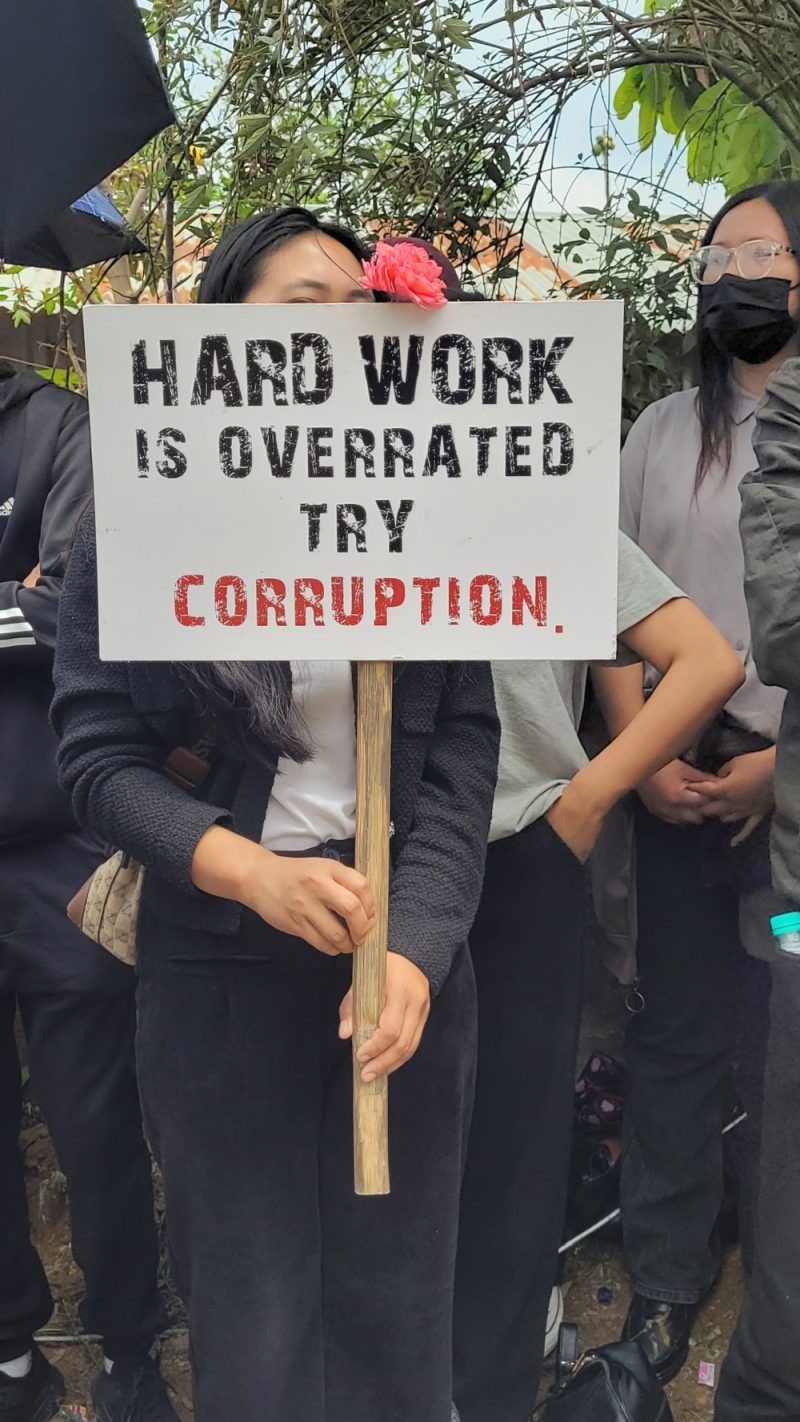
A protestor holding up a placard during the protest against the regularisation/absorption of contractual 147 Assistant Professors in Kohima on April 21, 2025. (Morung File Photo)
• Directs State Govt to create regular posts
• Orders Strict Compliance with UGC Ratios and NPSC Recruitment
Morung Express News
Dimapur | September
The Gauhati High Court Kohima Bench (GHCKB) has barred any further extension of the contractual services of Assistant Professors in Nagaland's 15 Government colleges, while directing the State Government to take effective steps to create adequate posts and fill regular vacancies through the Nagaland Public Service Commission (NPSC).
In a significant judgment on September 23, the Division Bench of Justice Devashis Baruah and Justice Helen Daungliani declared the appointments and numerous annual extensions of the contractual Assistant Professors to be in violation of Articles 14 and 16 of the Constitution and Regulation 13 of the UGC Regulations, 2010 and 2018.
Accordingly, it set aside two judgments of the Single Judge dated November 12, 2025, which had dismissed petitions challenging the contractual appointments on the ground of locus standi.
The Court, however, did not disturb the latest extensions already granted, citing the need to avoid disruption in the colleges and adverse impact on the teacher-student ratio.
However, “no further extension shall be granted to their contractual services,” stated the order uploaded on GHCKB’s website this week.
Background of the case
The dispute has its roots in a series of challenges to contractual appointments made by the Nagaland Government.
In 2015, Against Corruption and Unabated Taxation (ACAUT) filed PIL No. 11/2015 challenging the appointment of 706 Class-I and Class-II Gazetted posts, alleging that the appointments had been made through the “backdoor” without advertisement.
While the PIL was pending, the State issued an Office Memorandum dated June 6, 2016 titled “Ban on appointment on contract basis.”
The State informed the Court that, following the memorandum, contractual appointments would be treated as null and void and vacancies would be requisitioned through the NPSC. The PIL was subsequently closed on August 5, 2016, with liberty to approach the Court if the memorandum was violated.
Despite this, contractual appointments continued. ACAUT and Public Service Aspirants of Nagaland (PSAN) subsequently filed WP(C) No. 145/2017 challenging contractual appointments to 706 posts across 32 departments.
The petition was dismissed in 2018 on maintainability grounds, while the Single Judge directed that persons who had completed three years of continuous contractual/ad hoc service should not be regularised under the relevant Office Memorandums.
The State's appeal, WA No. 16/2018, was dismissed on February 7, 2019, with the Division Bench relying on the Supreme Court's Constitution Bench judgment in Secretary, State of Karnataka v Umadevi.
The dispute subsequently focused on contractual Assistant Professors. The Nagaland NET Qualified Forum (NNQF), along with 19 qualified candidates, filed WP(C) Nos. 12/2019 and 65/2019 challenging the contractual appointment of 208 Assistant Professors, including the private respondents in the present appeals.
Those petitions were dismissed on maintainability grounds, following which subject-wise petitions were filed challenging the contractual appointments.
The petitions were eventually dismissed by the Single Judge on November 12, 2025, again on the ground of locus standi.
A separate petition, WP(C) No. 340/2022, also challenged the appointment of the private respondents as Assistant Professors on contractual basis, including on the ground that some of them did not possess the requisite qualifications at the time of appointment. The petition too was dismissed on November 12, 2025 on locus standi grounds.
The Single Judge had not entered into the merits of the constitutional challenge. The petitions were dismissed principally because the petitioners had not challenged the extension orders issued during the pendency of the proceedings.
The present batch of writ appeals challenged those November 12, 2025 judgments.
Court rejects technical dismissal
The Single Judge had dismissed the petitions without examining the merits, holding that the petitioners had not challenged subsequent extension orders issued during the pendency of the cases.
The Division Bench held that this was not justified, as the substantive challenge was to the alleged backdoor appointments and their continuation through repeated extensions.
The Bench observed that the State had continued the appointments for years and that “infractions to Article 16 of the Constitution are being perpetuated by granting extensions after extensions.”
It further held that contractual or temporary appointments cannot escape Article 16 merely because they are for a fixed term or against non-sanctioned posts.
“Every qualified candidate has a right under Article 14 and Article 16 of the Constitution to be considered for appointment to any office under the State,” the Court said.
UGC conditions not followed
Meanwhile, State had relied upon Regulation 13.1 of the UGC Regulations, which permits contractual appointments when absolutely necessary to meet deficiencies in the student-teacher ratio.
However, the Court found that the State had failed to comply with the other conditions attached to such appointments and observed that that “the Respondent State in order to fulfill one component of student-teacher ratio have violated the other four conditions” governing contractual appointments.
As per the Regulation 13.1, contractual appointments are limited to 10% of total faculty positions.
Against this, based on the submission of State Government, the Court found that 145 of the 636 Assistant Professors were contractual or about 23%.
Meanwhile, it noted that the State's own affidavit recorded that 32 Assistant Professors had initially been appointed without the minimum requisite qualifications.
Subsequent notifications requiring them to obtain the qualifications within two to three years indicated that the State intended to continue the contractual appointments for years, it said.
The Court further found that contractual teachers were being paid “not even one third of the gross salary for Assistant Professor” while the Regulation 13.1 stated that it should not be “not be less than the monthly gross salary of a regularly appointed Assistant Professor.”
It also noted that the appointments and extensions were being made year-wise rather than in accordance with the academic-session framework under Regulation 13.1.
Courts directions
Accordingly, the Court ultimately set aside both November 12, 2025 judgments, declared the contractual appointments and numerous annual extensions violative of Articles 14 and 16 of the Constitution and Regulation 13 of the UGC Regulations, 2010/2018.
It did not, however, cancel the latest extensions already granted, noting that doing so could create a chaotic situation in the colleges and affect the teacher-student ratio.
Instead, it directed that no further extension be granted to the contractual services of the concerned Assistant Professors, with strict action against the Head of the Department of any authority that grants an extension contrary to the order.
At the same time, the Court directed the Government of Nagaland to take effective steps to create adequate posts in the 15 Government colleges to maintain the required teacher-student ratio.
While acknowledging that creation of posts is the prerogative of the Executive, it observed that the demonstrated need for posts was a relevant consideration and that “it is high time that the State of Nagaland should create posts.”
For regular vacancies, the Court directed that Assistant Professor posts be requisitioned through the Nagaland Public Service Commission (NPSC).
Where the State is unable to create the required number of posts because of financial constraints, it may resort to contractual appointments, but only strictly in conformity with Regulation 13.1 of the UGC Regulations, 2018, including due advertisement, it added.
On the question of regularisation, the Court recorded reservations in view of the Supreme Court’s Umadevi judgment but refrained from deciding the contractual appointees’ claims, as they were not before the Bench specifically seeking adjudication of their regularisation rights. It left those rights open to be raised before an appropriate forum.
HC on locus standi:
“These challenges were based upon the violation to Article 14 and Article 16 of the Constitution… Article 14 and Article 16 which is a facet of Article 14, are basic features of the Constitution. Under such circumstances, the learned Single Judge with humility in our command ought not to have non-suited the Appellants on technicalities as the challenge was not to the respective extension orders but to the action of making backdoor appointments and thereupon continuing the illegalities.”
UGC norms
“It seems that the State of Nagaland had only taken cognizance of the first sentence of Regulation 13.1 of the Regulations of 2010 /Regulations of 2018 inasmuch as, it appears that the State of Nagaland have failed to take note of the remaining conditions in the Regulation 13.1.”
Nagaland Assistant Professors Issue: A Timeline |
|