

NSLSA Member Secretary Neiko Akami, NJS, with senior trainers Reema Bhandari and Rita Das Mozumdar of MCPC, Supreme Court of India, along with trainees during the certificate distribution ceremony in Kohima.
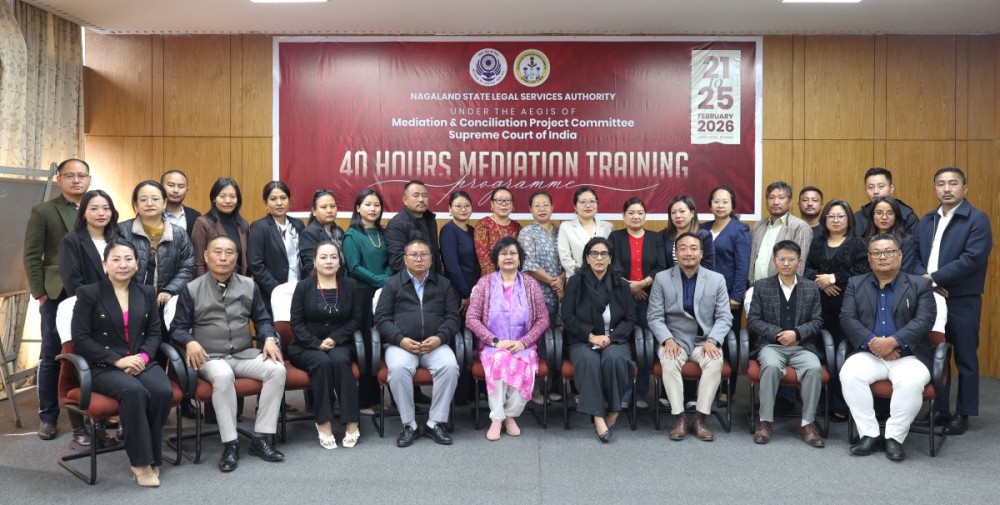
Kohima, February 25 (MExN): A 40-hour mediation training programme organised by the Nagaland State Legal Services Authority (NSLSA) under the aegis of the Mediation and Conciliation Project Committee (MCPC), Supreme Court of India, concluded on Wednesday at Hotel Japfü, Kohima.
The training, which began on Saturday, culminated with a certificate distribution ceremony where 26 mediators from 11 districts of Nagaland received completion certificates.
Delivering the closing note, NSLSA Member Secretary Neiko Akami, NJS, commended the senior trainers under MCPC, Supreme Court of India — Reema Bhandari and Rita Das Mozumdar — for imparting structured mediation training through practical techniques and professional expertise.
Highlighting the positive aspects of mediation, Akami said mediators are professionally trained individuals who attempt to bring parties in conflict to an agreement for amicable settlement of disputes.
He stated that mediators act as neutral facilitators between conflicting parties to help resolve cases.
He further emphasised that apart from professional training, mediators must uphold honesty and integrity in their role. Cases resolved through mediation, he noted, are permanently settled, and agreements arrived at are binding, enforceable in courts and final.
Akami said the training programme was aimed at training at least two counsels for mediation from each district of Nagaland. He expressed optimism that cases referred to mediation by courts of law, or those eligible for mediation, would be effectively undertaken by the trained mediators.
During the intensive 40-hour programme, the senior trainers covered topics including ground rules of mediation, conflict management and resolution, types and processes of Alternate Dispute Resolution (ADR), role of lawyers, communication skills, negotiation and bargaining techniques, stages of impasse and mediator reflection, professional ethics, and ethical principles for judicial and advocate mediators.
As per the Mediation Act, courts or tribunals may refer parties to mediation at any stage of proceedings.
The mediation training was imparted to advocates with at least 10 years of standing at the Bar.
To become a certified mediator, candidates are required to complete a 40-hour intensive mediation training programme accredited by the MCPC, Supreme Court of India.

.jpg)
.jpg)
.jpg)
